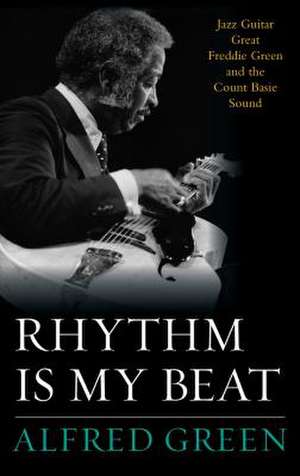
Rhythm Is My Beat: Jazz Guitar Great Freddie Green and the Count Basie Sound: Studies in Jazz
Autor Alfred Greenen Limba Engleză Hardback – 6 aug 2015
This American jazz icon, much like his inimitable sound, achieved stardom as a sideman, both in and out of Basie's band. Green's signature sound provided lift to soloists like Lester Young and vocalist Lil' Jimmy Rushing, a reflection of Green's sophisticated technique, that produced, in Green's words, his "rhythm wave." Billie Holiday, Ruby Braff, Benny Goodman, Gerry Mulligan, Teddy Wilson, Ray Charles, Judy Carmichael, Joe Williams and other recording artists all benefited from the relentless fours of the man who came to be known as Mr. Rhythm. The mystique surrounding Freddie Green's technique is illuminated through generous commentary by insightful interviews with other musicians, guitar professionals and scholars, all of whom offer their ideas on Freddie Green's sound. Alfred Green throughout demystifies the man behind the legend.
This work will interest jazz fans, students, and scholars; guitar enthusiasts and professionals; music historians and anyone interested not only in the history of jazz but of the African American experience in jazz.
Din seria Studies in Jazz
- 32%
 Preț: 382.18 lei
 - 28%
 Preț: 451.43 lei
 - 18%
 Preț: 369.99 lei
 - 27%
 Preț: 391.53 lei
 - 31%
 Preț: 486.56 lei
 - 21%
 Preț: 318.05 lei
 - 28%
 Preț: 387.69 lei
 - 30%
 Preț: 378.61 lei
 - 27%
 Preț: 345.85 lei
 - 36%
 Preț: 779.75 lei
 -
 Preț: 297.39 lei
 - 34%
 Preț: 396.99 lei
 - 29%
 Preț: 211.62 lei
 - 29%
 Preț: 334.41 lei
 - 35%
 Preț: 338.89 lei
 - 27%
 Preț: 352.28 lei
 - 34%
 Preț: 978.43 lei
 - 33%
 Preț: 441.65 lei
 - 36%
 Preț: 652.82 lei
 - 31%
 Preț: 482.79 lei
 - 34%
 Preț: 864.46 lei
 - 35%
 Preț: 426.74 lei
 - 34%
 Preț: 797.96 lei
 - 36%
 Preț: 418.17 lei
 - 33%
 Preț: 439.37 lei
 - 30%
 Preț: 436.11 lei
 - 36%
 Preț: 416.17 lei
 - 32%
 Preț: 515.10 lei
 - 34%
 Preț: 1386.12 lei
 - 34%
 Preț: 430.96 lei
 - 33%
 Preț: 478.78 lei
 - 28%
 Preț: 486.24 lei
 - 34%
 Preț: 587.27 lei
 - 35%
 Preț: 609.46 lei
 - 37%
 Preț: 716.43 lei
 - 29%
 Preț: 332.78 lei
 - 23%
 Preț: 315.82 lei
Preț: 525.74 lei
Preț vechi: 791.52 lei
-34%
Puncte Express: 789
Carte tipărită la comandă
Livrare economică 08-22 iunie
Specificații
ISBN-13: 9781442242463
ISBN-10: 1442242469
Pagini: 376
Ilustrații: 20 b/w illustrations; 49 b/w photos; 1 tables;
Dimensiuni: 152 x 232 x 28 mm
Greutate: 0.52 kg
Editura: Bloomsbury Publishing
Colecția Rowman & Littlefield
Seria Studies in Jazz
Locul publicării:New York, United States
ISBN-10: 1442242469
Pagini: 376
Ilustrații: 20 b/w illustrations; 49 b/w photos; 1 tables;
Dimensiuni: 152 x 232 x 28 mm
Greutate: 0.52 kg
Editura: Bloomsbury Publishing
Colecția Rowman & Littlefield
Seria Studies in Jazz
Locul publicării:New York, United States
Cuprins
Dedication
Foreword
Preface
Acknowledgment
Chronology
Chapter 1: God Said: "Let There Be Rhythm" and Freddie Green Heard the Call
Chapter 2: The Trail to Basie
Chapter 3: Finding the Groove
Chapter 4: Building the Wave
Chapter 5: On the Road
Chapter 6: You Don't Screw With What Got You Here
Chapter 7: "You Don't Have to Shout to Be Heard."
Chapter 8: Mr. Rhythm the Man
Appendix 1: The Quest of Freddie Green: From Ukulele to "Mr. Rhythm" by Michael Pettersen
Appendix 2: The Dynamic Chord and Muted Notes (DCMN) analysis of Freddie Green's Rhythm Guitar Style: What's in a "One-Note" Chord? by M.D. Allen
Appendix 3: For the Experienced Jazz Guitarist: Freddie Green Fundamentals by Michael Pettersen
Appendix 4: Favorite Chord Voicings of Freddie Green by Michael Pettersen
Appendix 5The String Height of Freddie's Guitar and How It Shaped His Unique Style by Michael Pettersen
Appendix 6: Did Freddie Green always play the guitar chart "as written?" by Michael Pettersen
Appendix 7: Improvised Jazz
Foreword
Preface
Acknowledgment
Chronology
Chapter 1: God Said: "Let There Be Rhythm" and Freddie Green Heard the Call
Chapter 2: The Trail to Basie
Chapter 3: Finding the Groove
Chapter 4: Building the Wave
Chapter 5: On the Road
Chapter 6: You Don't Screw With What Got You Here
Chapter 7: "You Don't Have to Shout to Be Heard."
Chapter 8: Mr. Rhythm the Man
Appendix 1: The Quest of Freddie Green: From Ukulele to "Mr. Rhythm" by Michael Pettersen
Appendix 2: The Dynamic Chord and Muted Notes (DCMN) analysis of Freddie Green's Rhythm Guitar Style: What's in a "One-Note" Chord? by M.D. Allen
Appendix 3: For the Experienced Jazz Guitarist: Freddie Green Fundamentals by Michael Pettersen
Appendix 4: Favorite Chord Voicings of Freddie Green by Michael Pettersen
Appendix 5The String Height of Freddie's Guitar and How It Shaped His Unique Style by Michael Pettersen
Appendix 6: Did Freddie Green always play the guitar chart "as written?" by Michael Pettersen
Appendix 7: Improvised Jazz
Recenzii
[The book] also includes some great stories - a successful feat by author-son to personalize and demystify his musician-father.
Alfred Green presents a good overview of his father's career. . . .Green adequately summarizes his father's career without getting bogged down in details or becoming technical when discussing music . . . General readers can enjoy the book.
Alfred Green has done a marvelous job of gathering the facts about his father's life, interviewing musicians and others who knew or were influenced by Freddie, providing analyses of his style and technique, and providing relevant information about their personal relationship. . . .This book is valuable on many levels. For the layman who loves jazz and big bands, there is ample information and entertainment, for musicians, particularly guitarists, the technical aspects of Freddie Green's artistry are addressed, and for whose approach to jazz is an educational one, it offers a wealth of information about various areas of jazz history. It is well conceived and nicely written, a valuable addition to jazz literature.
Alfred Green's biography of his father is lovingly written, with long-hidden details of the life, music, and personality of a figure so intensely private that only a close relative would have access. Green goes beyond his perspective as a son, however, to contribute a valuable and comprehensive account of the elder Green's professional activity and evolution as the bedrock of the Count Basie rhythm section. . . .Rhythm Is My Beat fills a long-standing need for an authoritative biography of Freddie Green - a tall order when one considers that the book's subject was such a private figure, and gave few interviews. Alfred Green's own recollections, access to primary sources, and willingness to incorporate the work of other experts on Freddie Green's music combine to form a comprehensive account of his father's life and impact. The book's supplemental materials offer a valuable reference tool for those who seek an authentic account of Green's technique, or who marvel at how the quietly steadfast guitarist elevated the often thankless job of rhythm guitar to an essential part of one of jazz history's most powerful rhythm sections.
Alfred Green presents a good overview of his father's career. . . .Green adequately summarizes his father's career without getting bogged down in details or becoming technical when discussing music . . . General readers can enjoy the book.
Alfred Green has done a marvelous job of gathering the facts about his father's life, interviewing musicians and others who knew or were influenced by Freddie, providing analyses of his style and technique, and providing relevant information about their personal relationship. . . .This book is valuable on many levels. For the layman who loves jazz and big bands, there is ample information and entertainment, for musicians, particularly guitarists, the technical aspects of Freddie Green's artistry are addressed, and for whose approach to jazz is an educational one, it offers a wealth of information about various areas of jazz history. It is well conceived and nicely written, a valuable addition to jazz literature.
Alfred Green's biography of his father is lovingly written, with long-hidden details of the life, music, and personality of a figure so intensely private that only a close relative would have access. Green goes beyond his perspective as a son, however, to contribute a valuable and comprehensive account of the elder Green's professional activity and evolution as the bedrock of the Count Basie rhythm section. . . .Rhythm Is My Beat fills a long-standing need for an authoritative biography of Freddie Green - a tall order when one considers that the book's subject was such a private figure, and gave few interviews. Alfred Green's own recollections, access to primary sources, and willingness to incorporate the work of other experts on Freddie Green's music combine to form a comprehensive account of his father's life and impact. The book's supplemental materials offer a valuable reference tool for those who seek an authentic account of Green's technique, or who marvel at how the quietly steadfast guitarist elevated the often thankless job of rhythm guitar to an essential part of one of jazz history's most powerful rhythm sections.