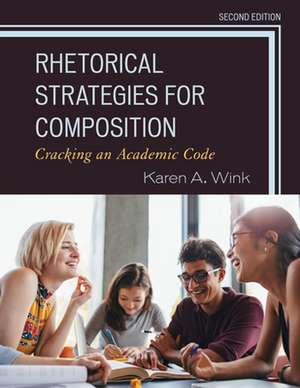
Rhetorical Strategies for Composition: Cracking an Academic Code
Autor Karen A. Winken Limba Engleză Paperback – 10 noi 2020
Preț: 210.18 lei
Preț vechi: 283.92 lei
-26%
Puncte Express: 315
Preț estimativ în valută:
37.15€ • 43.70$ • 32.43£
37.15€ • 43.70$ • 32.43£
Carte tipărită la comandă
Livrare economică 06-20 aprilie
Specificații
ISBN-13: 9781475857306
ISBN-10: 1475857306
Pagini: 188
Ilustrații: 18 b/w illustrations;38 tables; 11 textboxes
Dimensiuni: 216 x 270 x 9 mm
Greutate: 0.33 kg
Ediția:2
Editura: Bloomsbury Publishing
Colecția Rowman & Littlefield
Locul publicării:New York, United States
ISBN-10: 1475857306
Pagini: 188
Ilustrații: 18 b/w illustrations;38 tables; 11 textboxes
Dimensiuni: 216 x 270 x 9 mm
Greutate: 0.33 kg
Ediția:2
Editura: Bloomsbury Publishing
Colecția Rowman & Littlefield
Locul publicării:New York, United States
Cuprins
Acknowledgments
Introduction
1: Rhetoric
2: Forming an Argument: Aristotle's Parts of an Argument
3: Rhetorical Situations
4: Appeals and Fallacies
5: Voice
6: Stylistics
7: Revision
8: Documenting Sources
9: Grammar, Punctuation, and Usage
10: Visual Arguments
Appendix I: Sample Research Paper with Audience Analysis:
Angela, College Freshman, Composition Course
Audience Analysis for Angela's Research Paper
Appendix II: Answer Key and Reference Lists
Works Cited
About the Author
Introduction
1: Rhetoric
2: Forming an Argument: Aristotle's Parts of an Argument
3: Rhetorical Situations
4: Appeals and Fallacies
5: Voice
6: Stylistics
7: Revision
8: Documenting Sources
9: Grammar, Punctuation, and Usage
10: Visual Arguments
Appendix I: Sample Research Paper with Audience Analysis:
Angela, College Freshman, Composition Course
Audience Analysis for Angela's Research Paper
Appendix II: Answer Key and Reference Lists
Works Cited
About the Author
Recenzii
Karen Wink's text offers the essentials of classical rhetoric for writing students in a textbook that is brief, clear and yet amazingly thorough. Using questions as headings, Wink covers everything from assessing the writer's initial rhetorical situation, to the five parts of an argument, the appeals of ethos, pathos and logos, and the common fallacies, down through matters of style, revision, documentation, and proofreading. Traditional material like the writing process is covered, but in a way that makes them part of the overall strategy of a well-designed argument. At the same time, less frequently covered topics are included so that students acquire a deeper appreciation of rhetorical argument, as in Wink's version of the stases combined with the topics in Chapter 2, or her especially strong coverage of Style in a chapter (6) that includes a useful list of figures of speech and methods of sentence analysis and invention. Drawing on her years of classroom experience, Wink includes published and student-written examples throughout, as well as useful tables, checklists and exercises that immediately apply the material just explained. Altogether, Karen Wink's text covers everything needed for a complete, rhetorically-based writing course in the most engaging and student-friendly way possible.
Karen Wink's Rhetorical Strategies for Composition is a valuable text for secondary and post-secondary writing instructors. Written from the deep knowledge of someone who understands writing as process, this handbook is an effective tool to accompany the teaching and learning of how to write well. Most specifically, this text makes clear how to write cogent, powerful arguments that respond to various situations and purposes. What I found most relevant about this text was its inclusion of contemporary examples that students use for practice to learn the skills Wink articulates. This contemporaneousness connects readers to the work, encouraging them to understand the links between arguments made throughout history and the ones of today. Additionally, the tone of the text invites readers to try their hand at writing while feeling comfortable learning the why behind arguments without feeling condescended to or demeaned for what they might not know. Thus, Rhetorical Strategies for Composition is an excellent text for educators working with high school seniors as a way to prepare them for life beyond high school as well as for educators working with students in post-secondary schools. For all students using this text, is, indeed, the "Lonely Planet Guide" to understanding arguments and how to write them.
Wink's clear explication of the assumptions underlying academic and professional writing persuades us of the continuing relevance of classical rhetoric. The textbook's contemporary examples, practical exercises, and tools for revision will engage composition students from high school to upper-division undergraduate level.
Karen Wink's Rhetorical Strategies for Composition is a valuable text for secondary and post-secondary writing instructors. Written from the deep knowledge of someone who understands writing as process, this handbook is an effective tool to accompany the teaching and learning of how to write well. Most specifically, this text makes clear how to write cogent, powerful arguments that respond to various situations and purposes. What I found most relevant about this text was its inclusion of contemporary examples that students use for practice to learn the skills Wink articulates. This contemporaneousness connects readers to the work, encouraging them to understand the links between arguments made throughout history and the ones of today. Additionally, the tone of the text invites readers to try their hand at writing while feeling comfortable learning the why behind arguments without feeling condescended to or demeaned for what they might not know. Thus, Rhetorical Strategies for Composition is an excellent text for educators working with high school seniors as a way to prepare them for life beyond high school as well as for educators working with students in post-secondary schools. For all students using this text, is, indeed, the "Lonely Planet Guide" to understanding arguments and how to write them.
Wink's clear explication of the assumptions underlying academic and professional writing persuades us of the continuing relevance of classical rhetoric. The textbook's contemporary examples, practical exercises, and tools for revision will engage composition students from high school to upper-division undergraduate level.