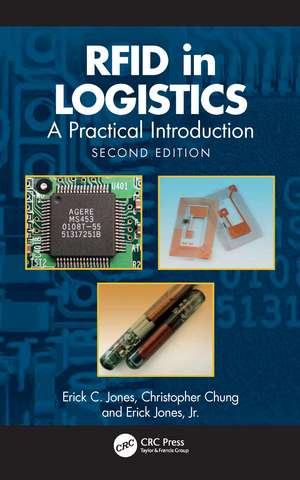
RFID in Logistics: A Practical Introduction
Autor Erick C. Jones, Sr., Christopher Chung, Erick C. Jones, Jr.en Limba Engleză Hardback – 23 dec 2026
RFID in Logistics: A Practical Introduction, Second Edition offers businesses and other relevant entities an authoritative, step-by-step guide to implementing and utilizing RFID communications technology. The book explores a variety of RFID applications in entertainment, credit devices, wireless communications, healthcare, and libraries. It covers both active and passive system components, testing models, and best practices for integrating RFID technology into supply chain management. This new edition provides an update on RFID history, system design mandates, supply chain planning, reshoring in the US, manufacturing operations at the tactical level, challenges for automation, ESG standards, global sourcing, and more.
The book aims to educate professionals, students, and academia on the use of RFID in supply chain planning and logistics. It also serves as a valuable resource for industry and government personnel, contractors, individuals, and corporate managers seeking to enhance productivity.
Preț: 1213.73 lei
Preț vechi: 1607.27 lei
-24% Precomandă
Puncte Express: 1821
Carte nepublicată încă
Livrare prin curier în România Precomanda se expediază când titlul devine disponibil.
Transport gratuit pentru acest produs Plată online sau ramburs, în funcție de opțiunile comenzii.
Retur gratuit în 14 zile Comandă securizată și suport în română.
Doresc să fiu notificat când acest titlu va fi disponibil:
Se trimite...
Specificații
ISBN-13: 9781032971681
ISBN-10: 1032971681
Pagini: 576
Ilustrații: 470
Dimensiuni: 156 x 234 mm
Ediția:2
Editura: CRC Press
Colecția CRC Press
ISBN-10: 1032971681
Pagini: 576
Ilustrații: 470
Dimensiuni: 156 x 234 mm
Ediția:2
Editura: CRC Press
Colecția CRC Press
Public țintă
Academic, Professional Practice & Development, and Professional ReferenceCuprins
Part 1: Understanding RFID. 1. RFID History. 2. Basic Introduction to Common RFID Components. 3. Passive RFID System Components. 4. Active RFID System Components. 5. RFID System Design. 6. Important RFID Mandates. 7. Standards Organizations and RFID Standards. Part 2: Integrating RFID into Logistics Model. 8. RFID in Logistics. 9. Inventory Control Basics. 10. RFID Supply Chain Planning Levels. Part 3: Principles in Practice. 11. RFID Project Management. 12. Implementing RFID Systems. 13. The Engineering Economics of RFID. Part 4: RFID Applications. 14. Animal Tracking RFID Applications. 15.Credit Device RFID Applications. 16. Secure Document RFID Applications. 17. DOD RFID and Wireless Communications Initiatives. 18. Entertainment RFID Applications. 19. Evaluating RFID Solutions for Healthcare Improvement. 20. RFID Applications in Libraries. 21. Marine RFID Security Applications. 22. Inventory Tracking on International Space Station using RFID Technology. 23. Individual Sport Competition RFID Applications. 24. Surgical RFID Technology Applications. 25. Tollway RFID Applications. 26. RFID Transportation Systems Applications. 27. Marine Terminal RFID Applications. 28. RFID Uses in Warehousing. Part 5: RFID Case Studies and Research. 29. RFID Research Activities in Academia. 30. Optimizing RFID Portal Locations in Distribution using Systematic Layout Planning (SLP). 31. Obsolete Inventory Reduction with Modified Carrying Cost Ratio. 32. A Case Study of a Supply Chain Management Network Model in Government Public Works Department. 33. The Future of RFID in Army Logistics. 34. RFID in Golf—Applications and Parallels. 35. Railroad Car Tracking by an RFID System to Organize Traffic Flow. 36. RFID Middleware and Web Service. Part 6: Book Software. 37. RFID Handbook Interactive Learning Simulator Manual. 38. Developing Facility Layouts With BLOCPLAN For Windows. Part 7: Other RFID Material. 39. Radio Frequency Theory. 40. RFID Facilities Access Applications. 41. RFID Countermeasure Strategies.
Notă biografică
Erick C. Jones, Sr., Ph.D., is a Professor and Dean at the University of Nevada, Reno College of Engineering, USA. He is a former senior science advisor in the Office of the Chief Economist at the U.S. State Department. Dr. Jones is an internationally recognized researcher in industrial manufacturing and systems engineering. Over the past 25 years, his career has spanned industry, government, and academia. He is internationally recognized for his pioneering work with Radio Frequency Identification (RFID) technologies, Lean Six Sigma Quality Management (the understanding of whether a process is well controlled), and autonomous inventory control. He has published three textbooks and has garnered more than $10 million in grants and contracts. Dr. Jones worked in the industry for more than a decade before returning to academia to attain his Ph.D. at the University of Houston. He held engineering, management, and executive management positions while in the industry, including Engineering Supervisor, Director of Engineering, and Executive Manager for companies such as UPS, Academy Sports and Outdoors, Arthur Andersen, and LLP, respectively. Dr. Jones earned his bachelor’s degree in industrial engineering from Texas A&M University in 1993, and his master’s and doctoral degrees in Industrial Engineering from the University of Houston in 1996 and 2003, respectively.
Christopher Chung is currently an Associate Professor at the University of Houston, Cullen College of Engineering in the Industrial Engineering Department, Houston, Texas, USA. His research interests are in the areas of management, operations, equipment training simulators, educational simulators, and discrete event simulation. This includes interactive simulators for responding to bomb threats and implementing Advanced Manufacturing Technology projects. He has also researched the operation of airport security checkpoints under increased threat conditions and simultaneous service approaches to reduce airport check-in times. Dr. Chung's research has received funding from the U.S. Department of Justice and Continental Airlines. He is a former U.S. Army bomb disposal officer and NEST team member, and a graduate of a citizens' police academy course. He has also worked as a manufacturing quality engineer with the Michelin Tire Corporation.
Erick C. Jones Jr. is an Assistant Professor in the Industrial, Manufacturing, and Systems Engineering Department at The University of Texas at Arlington, USA, and the founder and director of the Sustainable and Equitable Allocation of Resources (SEAR) Lab. Dr. Jones’ research mission is to advance the clean energy transition by developing technologies and decision-making tools, measuring its progress, and implementing systems in the field to serve as reproducible examples and provide immediate community benefits. His background in oil and gas and engineering design gives him a unique perspective on the opportunities and challenges of the energy transition, especially in energy technologies, infrastructure, and supply chains.
Christopher Chung is currently an Associate Professor at the University of Houston, Cullen College of Engineering in the Industrial Engineering Department, Houston, Texas, USA. His research interests are in the areas of management, operations, equipment training simulators, educational simulators, and discrete event simulation. This includes interactive simulators for responding to bomb threats and implementing Advanced Manufacturing Technology projects. He has also researched the operation of airport security checkpoints under increased threat conditions and simultaneous service approaches to reduce airport check-in times. Dr. Chung's research has received funding from the U.S. Department of Justice and Continental Airlines. He is a former U.S. Army bomb disposal officer and NEST team member, and a graduate of a citizens' police academy course. He has also worked as a manufacturing quality engineer with the Michelin Tire Corporation.
Erick C. Jones Jr. is an Assistant Professor in the Industrial, Manufacturing, and Systems Engineering Department at The University of Texas at Arlington, USA, and the founder and director of the Sustainable and Equitable Allocation of Resources (SEAR) Lab. Dr. Jones’ research mission is to advance the clean energy transition by developing technologies and decision-making tools, measuring its progress, and implementing systems in the field to serve as reproducible examples and provide immediate community benefits. His background in oil and gas and engineering design gives him a unique perspective on the opportunities and challenges of the energy transition, especially in energy technologies, infrastructure, and supply chains.
Descriere
This updated edition provides a detailed overview of RFID history, current applications, and future research directions. Additionally, it introduces a Logistics RFID model developed by the lead author to facilitate the integration of RFID technology into supply chain operations.