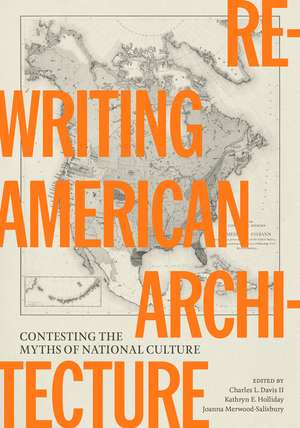
Rewriting American Architecture: Contesting the Myths of National Culture
Editat de Charles L. Davis, II, Kathryn E. Holliday, Joanna Merwood-Salisburyen Limba Engleză Paperback – 8 sep 2026
Rewriting American Architecture offers a revisionist riposte to the canonical story of nineteenth-century American architecture. Drawing on new archival research and revisionist historiography, the essays in this volume reveal how American architecture was shaped not by inevitable progress toward a unified national culture but by the turbulent realities of race, labor, settler colonialism, and territorial expansion. Rather than treating architecture as an apolitical aesthetic expression, the contributors expose it as an active arena in which the meanings of nationhood were constructed, contested, and often violently enforced. From Indigenous spatial practices and Black institutional building to transnational exchanges and the racial politics embedded in professionalization, this collection reframes the built environment as central to the competing cultural, political, and geographic claims that defined the United States during this period.
Preț: 277.41 lei
Nou
Puncte Express: 416
Carte disponibilă
Livrare economică 16-30 noiembrie
Livrare express 30 octombrie-05 noiembrie pentru 53.04 lei
Livrare prin curier în România Termenul estimat este afișat lângă disponibilitate.
Transport gratuit de la 400.00 lei Plată online sau ramburs, în funcție de opțiunile comenzii.
Retur gratuit în 14 zile Comandă securizată și suport în română.
Specificații
ISBN-13: 9781477334171
ISBN-10: 1477334173
Pagini: 408
Ilustrații: 114 b&w photos
Dimensiuni: 178 x 254 x 30 mm
Greutate: 0.86 kg
Editura: University of Texas Press
Colecția University of Texas Press
ISBN-10: 1477334173
Pagini: 408
Ilustrații: 114 b&w photos
Dimensiuni: 178 x 254 x 30 mm
Greutate: 0.86 kg
Editura: University of Texas Press
Colecția University of Texas Press
Notă biografică
Charles L. Davis II is an associate professor and Director of the Architectural History program at the University of Texas at Austin School of Architecture.
Kathryn E. Holliday is the Randall J. Biallas Professor of Historic Preservation and American Architectural History and professor of landscape architecture at the University of Illinois Urbana-Champaign.
Joanna Merwood-Salisbury is a professor of architecture and Associate Dean of Postgraduate Research at Victoria University of Wellington, New Zealand.
Kathryn E. Holliday is the Randall J. Biallas Professor of Historic Preservation and American Architectural History and professor of landscape architecture at the University of Illinois Urbana-Champaign.
Joanna Merwood-Salisbury is a professor of architecture and Associate Dean of Postgraduate Research at Victoria University of Wellington, New Zealand.
Cuprins
- Introduction (Charles L. Davis II, Kathryn E. Holliday, and Joanna Merwood-Salisbury)
- Part I: Defining the Profession
- 1. Spatializing the American Architectural Profession in the Nineteenth Century (Kathryn E. Holliday)
- 2. Vernacular Professionalism: Rural Home Economics and the Racial Contract of Expertise (Athanasiou Geolas)
- 3. A Cattle Brand and a Cattle Ranch: Land, Race, and Power in Architectural History (Kathryn E. O’Rourke)
- Part II: Reconstruction and Architecture
- 4. Slavery and Sovereignty in Stone: The Mason Family in Austin, Texas (Tara A. Dudley)
- 5. Grand Narratives in Black: The Architectural Histories of John Marrant, Robert Benjamin Lewis, and Martin Delaney (Bryan E. Norwood)
- 6. The Black Parti: Reinterpreting African American Placemaking as Design Ideation (Andrea Roberts)
- 7. Identifying the Religio-Racial Aesthetics of AME Church Design, 1876–1920 (Melanee Harvey)
- 8. Demolishing Historic Architecture: Black Activists’ Crusade Against the One-Room Cabin in the Early Jim Crow Era (Whitney Nell Stewart)
- Part III: Transnational Americas
- 9. Border Crossing: Architecture in Brownsville, Texas, and Heroica Matamoros, Tamaulipas, as a Case Study (Stephen Fox)
- 10. Aesthetic Imperialism in the Asia-Pacific: The Coastal Politics of Bernard Maybeck’s Architectural Practice (Charles L. Davis II)
- 11. Mahogany and the Locations of American Architecture (Jonah Rowen)
- 12. Building an Evangelical Utopia: Missionaries and the Racial Destiny of the United States in the “Near East” (Yasmina El Chami)
- Part IV: Building Settler Colonialism
- 13. The Apple of Discord: Free Labor, Sectionalism, and Anglo-Assimilation in Olmsted’s Agricultural Colleges (Maura Lucking)
- 14. Confronting Assimilation: The Interplay Between Očéti Ŝakówiŋ and Settler Spatialities in Dakota Territory, 1883–1888 (Katherine Solomonson)
- 15. Designed Assimilation: The Architecture of Federal Indian Boarding Schools (Anjelica S. Gallegos)
- 16. The Native American Ranch House: Dialectics of Architecture, Race, and Land in Southern California, 1850–1935 (Manuel Shvartzberg Carrió)
- Part V: Modern Mythologies
- 17. Jefferson’s Ashes and Architecture’s Racial Dialectic (Peter Minosh)
- 18. Ordering Things: Ethnology, Empire, and Everything Else at the Library of Congress (Diana Martinez)
- 19. Chicago Frame: Evolution, Ethnology, and the Idea of the First Skyscraper (Joanna Merwood-Salisbury)
- 20. “Americans” and Others: A Prehistory of Frank Lloyd Wright’s Usonia (Joseph M. Watson)
- Acknowledgments
- Index
Recenzii
Beautifully organizing twenty expertly researched case studies, these editors deftly dismiss stale histories of nineteenth-century American architecture that embrace an uncontested arc of historical progress and American success and, in deference to professional architects, uncomfortably frame their subject as 'protomodern.' Rather, these essays center buildings and places in thick contexts of local and regional identities and racial politics, and they understand users as agents, expanding the horizon of architectural makers. Understanding buildings as evidence of contested and competing visions of the making of nineteenth-century America, this refreshing collection helps us see architecture in real historical time and will define the field for years to come.
This groundbreaking book mounts an important challenge to the canonical narratives of nineteenth-century US architectural history. In place of traditional themes such as aesthetic innovation, technological progress, and cultural assimilation, Rewriting American Architecture foregrounds architecture’s relationship to topics such as settler colonialism, transnationality, slavery, race, land, and labor. Together, these critical and methodologically groundbreaking essays expand our understanding of the heterogeneous authors, actors, buildings, and forces that compose the 'American' built environment.
This groundbreaking book mounts an important challenge to the canonical narratives of nineteenth-century US architectural history. In place of traditional themes such as aesthetic innovation, technological progress, and cultural assimilation, Rewriting American Architecture foregrounds architecture’s relationship to topics such as settler colonialism, transnationality, slavery, race, land, and labor. Together, these critical and methodologically groundbreaking essays expand our understanding of the heterogeneous authors, actors, buildings, and forces that compose the 'American' built environment.
Descriere
A critical reassessment of nineteenth-century American architecture that uncovers how race, settler colonialism, and contested national identities shaped the built environment and its historiography.