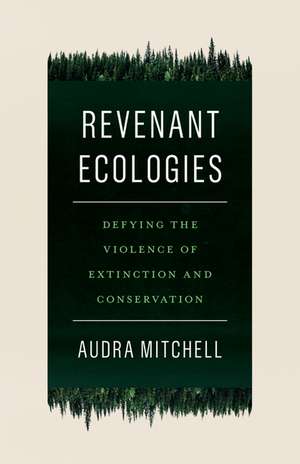
Revenant Ecologies: Defying the Violence of Extinction and Conservation
Autor Audra Mitchellen Limba Engleză Paperback – 16 ian 2024
Revenant Ecologies este o lucrare de referință profesională și academică, esențială pentru cercetătorii de la nivel de licență și masterat care studiază etica globală și ecologia politică. Observăm o critică riguroasă a modului în care discursurile occidentale despre biodiversitate și conservare pot, în mod paradoxal, să amplifice violențe structurale precum colonialismul și extractivismul. Audra Mitchell nu se limitează la o analiză teoretică, ci propune un cadru ambițios denumit (bio)pluralitate, menit să protejeze relațiile și ecosistemele unice prin prisma filosofiilor indigene și a sistemelor de cunoaștere marginalizate.
Descoperim aici o abordare care fuzionează studiile asupra violenței cu ecologia practică, oferind alternative concrete precum procesele de returnare a pământurilor către comunitățile indigene. Volumul de față extinde cercetările anterioare ale autoarei din Hybrid Forms of Peace, unde analiza rolul acțiunilor cotidiene în modelarea intervențiilor internaționale, trecând acum de la pacea socială la supraviețuirea multi-specii. Reținem că această ediție de 392 de pagini, publicată de University of Minnesota Press, integrează 5 ilustrații alb-negru care susțin argumentația vizuală a textului.
Cititorii familiarizați cu Contesting Extinctions de Suzanne M. McCullagh vor aprecia modul în care Audra Mitchell duce mai departe interogarea sistemelor care generează pierderea bioculturală, punând un accent mai pronunțat pe sfidarea activă a violenței de către lumile multi-formă de viață. Spre deosebire de alte abordări din domeniu, această lucrare refuză să trateze extincția doar ca pe un fenomen biologic, reîncadrând-o ca pe o problemă de etică politică globală și suveranitate.
Preț: 240.94 lei
Carte disponibilă
Livrare economică 28 octombrie-11 noiembrie
Livrare express 13-17 octombrie pentru 33.62 lei
Specificații
ISBN-10: 1517906814
Pagini: 392
Ilustrații: 5 black and white illustrations
Dimensiuni: 140 x 216 x 28 mm
Greutate: 0.48 kg
Editura: University of Minnesota Press
Colecția Univ Of Minnesota Press
V-ar putea interesa
-
 Human Geography: A Very Short IntroductionPatricia Daley-20%Preț: 56.81 lei71.01 lei
 -
 Preț: 241.04 lei
 -
 VanishedSadiah QureshiPreț: 228.65 lei
 -
 Being Ecological, with a New Preface by the AuthorTimothy MortonPreț: 97.32 lei
 -
 Preț: 122.91 lei
 -
 What Is Critical Environmental Justice?David Naguib PellowPreț: 157.95 lei
 -
 Alterhumanism: Becoming Human on a Conservation FrontierPiergiorgio Di GiminianiPreț: 232.23 lei
 -
 A New Garden EthicBenjamin VogtPreț: 136.01 lei
 -
 Preț: 424.79 lei
 -
 Ecological ReasoningsKilian Jörg-32%Preț: 554.74 lei819.21 lei
 -
 Unsettling ExtinctionRoman Bartosch-22%Preț: 179.13 lei229.93 lei
 -
 DeColonize EcoModernism!Ariel SallehPreț: 140.09 lei
 -
 The Ends of the WorldDeborah DanowskiPreț: 149.52 lei
 -
 Preț: 158.15 lei
 -
 Arts of Living on a Damaged Planet: Ghosts and Monsters of the AnthropoceneAnna Lowenhaupt TsingPreț: 159.21 lei
 -
 -28%Preț: 66.38 lei91.58 lei
 -
 Finding Our Niche: Toward A Restorative Human EcologyPhilip A. Loring-18%Preț: 128.36 lei157.48 lei
 -
 On ExtinctionBen WarePreț: 115.37 lei
 -
 No Straight Road Takes You ThereRebecca SolnitPreț: 92.62 lei
De ce să citești această carte
Recomandăm această carte specialiștilor în protecția mediului și studenților la științe politice sau etică. Cititorul câștigă o perspectivă decolonizată asupra conservării naturii, înțelegând cum politicile de mediu actuale pot perpetua inegalități istorice. Este o lectură necesară pentru cei care caută soluții practice și etice la criza extincției, dincolo de modelele matematice și biologice tradiționale, oferind un instrumentar critic pentru protejarea diversității vieții.
Despre autor
Audra Mitchell este o cercetătoare recunoscută în domeniul eticii globale și al ecologiei politice. Opera sa se concentrează pe intersecția dintre violența structurală, supraviețuirea speciilor și filosofiile indigene. În lucrarea sa anterioară, Hybrid Forms of Peace, autoarea a explorat modul în care intervențiile internaționale sunt remodelate de actorii locali. Prin Revenant Ecologies, Mitchell își extinde expertiza către studiile de mediu, consolidându-și poziția de voce critică în analiza sistemelor de putere care definesc criza ecologică contemporană.
Descriere scurtă
As global rates of plant and animal extinctions mount, anxieties about the future of the earth’s ecosystems are fueling ever more ambitious efforts at conservation, which draw on Western scientific principles to manage species and biodiversity. In Revenant Ecologies, Audra Mitchell argues that these responses not only ignore but also magnify powerful forms of structural violence like colonialism, racism, genocide, extractivism, ableism, and heteronormativity, ultimately contributing to the destruction of unique life forms and ecosystems.
Critiquing the Western discourse of global extinction and biodiversity through the lens of diverse Indigenous philosophies and other marginalized knowledge systems, Revenant Ecologies promotes new ways of articulating the ethical enormity of global extinction. Mitchell offers an ambitious framework—(bio)plurality—that focuses on nurturing unique, irreplaceable worlds, relations, and ecosystems, aiming to transform global ecological–political relations, including through processes of land return and critically confronting discourses on “human extinction.”
Highlighting the deep violence that underpins ideas of “extinction,” “conservation,” and “biodiversity,” Revenant Ecologies fuses political ecology, global ethics, and violence studies to offer concrete, practical alternatives. It also foregrounds the ways that multi-life-form worlds are actively defying the forms of violence that drive extinction—and that shape global efforts to manage it.
Retail e-book files for this title are screen-reader friendly with images accompanied by short alt text and/or extended descriptions.
Notă biografică
Recenzii
"Mitchell’s novel contribution with this book [...] is a close reading of the way Western projects of conservation reproduce many of the same kinds of violence as colonization."—Ancillary Review of Books
"For any geographer whose work is connected to conservation, extinction, and environmental justice, or for the reader who wants to reframe their climate anxiety, this transformative book is a must read."—Canadian Geographies
"Highly recommended."—CHOICE
"Mitchell’s book is crucial for anyone working in extinction studies or Anthropocene studies, and it contains many valuable insights for those working in environmental humanism more broadly."—H-Net Reviews
"Revenant Ecologies by Audra Mitchell is an excellent book. It is a rare example of a book that can serve as both an introductory text to understanding the features and critiques of Western hegemonic forms of conservation, and a highly original and thought-provoking challenge to academics who are already very familiar with these debates."—Environment and Security
"It is easy to fall into the trap of the good of conservation without realising how much harm is generated in the process. In doing battle with these conventions, Mitchell dismantles the key questions of who, where and why someone is worth saving." —Green Letters