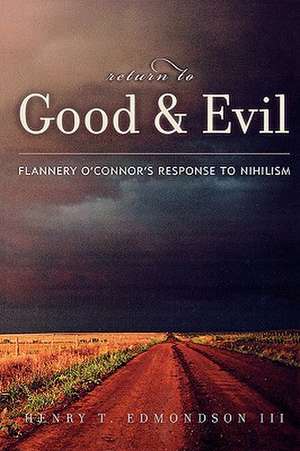
Return to Good and Evil: Flannery O'Connor's Response to Nihilism
Autor Henry T. Edmondson, III Cuvânt înainte de Marion Montgomeryen Limba Engleză Paperback – 5 apr 2005
"Right now the whole world seems to be going through a dark night of the soul," O'Connor once said, in response to the nihilistic tendencies she saw in the world around her. Nihilism-Nietzche's idea that "God is dead"-preoccupied O'Connor, and she used her fiction to draw a tableau of human civilization on the brink of a catastrophic moral, philosophical, and religious crisis. Again and again, O'Connor suggests that the only way back from this precipice is to recognize the human need for grace, redemption, and God. She argues brilliantly and persuasively through her novels and short stories that the Nietzschean challenge to the notions of good and evil is an ill-conceived effort that will result only in disaster.
With rare access to O'Connor's correspondence, prose drafts, and other personal writings, Edmondson investigates O'Connor's deepest motivations through more than just her fiction and illuminates the philosophical and theological influences on her life and work. Edmondson argues that O'Connor's artistic brilliance and philosophical genius reveal the only possible response to the nihilistic despair of the modern world: a return to good and evil through humility and grace.
Preț: 321.74 lei
Preț vechi: 416.77 lei
-23%
Puncte Express: 483
Carte tipărită la comandă
Livrare economică 30 noiembrie-14 decembrie
Livrare prin curier în România Termenul estimat este afișat lângă disponibilitate.
Transport gratuit de la 400.00 lei Plată online sau ramburs, în funcție de opțiunile comenzii.
Retur gratuit în 14 zile Comandă securizată și suport în română.
Specificații
ISBN-13: 9780739111055
ISBN-10: 0739111051
Pagini: 218
Dimensiuni: 163 x 229 x 18 mm
Greutate: 0.35 kg
Editura: Bloomsbury Publishing
Colecția Lexington Books
Locul publicării:New York, United States
ISBN-10: 0739111051
Pagini: 218
Dimensiuni: 163 x 229 x 18 mm
Greutate: 0.35 kg
Editura: Bloomsbury Publishing
Colecția Lexington Books
Locul publicării:New York, United States
V-ar putea interesa
-
 African Drama and PerformanceJohn Conteh-MorganPreț: 196.19 lei
 -
 Robert Frost: An Adventure in Poetry, 1900-1918Lesley Lee FrancisPreț: 471.22 lei
 -
 Herman Wouk: The Novelist as Social HistorianArnold BeichmanPreț: 470.92 lei
 -
 Preț: 153.74 lei
 -
 Preț: 295.97 lei
 -
 The Reception of James Joyce in EuropeProfessor Geert Lernout-39%Preț: 2447.14 lei4018.16 lei
 -
 Evolution and the Sex ProblemThe Kent State University PressPreț: 343.84 lei
 -
 Adventures with a Texas HumanistJames Ward LeePreț: 143.89 lei
 -
 Writing in Our TimePauline ButlingPreț: 401.90 lei
 -
 Pacific Rim LettersRoy Kiyooka-10%Preț: 187.67 lei207.84 lei
Cuprins
Chapter 1 Faith, Philosophy, and Fiction
Chapter 2 O'Connor contra Nihilism
Chapter 3 Modern Man as Malgre Lui in Wise Blood
Chapter 4 Wise Blood and the Difficult Return to God
Chapter 5 "Good Country People" and the Seduction of Nihilism
Chapter 6 The Nature of Evil in "The Lame Shall Enter First"
Chapter 7 Social Change in "The Enduring Chill"
Chapter 8 Modernity versus Mystery in "A View of the Woods"
Chapter 9 Redemption and the Ennoblement of Suffering in "The Artificial Nigger"
Chapter 10 Grace, the Devil, and the Prophet
Chapter 2 O'Connor contra Nihilism
Chapter 3 Modern Man as Malgre Lui in Wise Blood
Chapter 4 Wise Blood and the Difficult Return to God
Chapter 5 "Good Country People" and the Seduction of Nihilism
Chapter 6 The Nature of Evil in "The Lame Shall Enter First"
Chapter 7 Social Change in "The Enduring Chill"
Chapter 8 Modernity versus Mystery in "A View of the Woods"
Chapter 9 Redemption and the Ennoblement of Suffering in "The Artificial Nigger"
Chapter 10 Grace, the Devil, and the Prophet
Recenzii
As ... Henry Edmondson... shows, O'Connor takes us through evil to good, through sacrifice to redemption, and through tragedy to comedy.
Edmondson's considerable philosophical and theological sophistication informs every page of his interpretations of O'Connor's stories. That interpretation is wonderfully intense and nuanced, because Edmondson is convinced that these stories might just be one way we can know the truth. Edmondson's book inaugurates a new stage in the scholarly appreciation of Flannery O'Connor.
To my knowledge, this is the best thing written on Flannery O'Connor. It is extremely valuable, insightful, and beautifully written; like O'Connor's stories themselves, it is hard to put down. It is a splendid introduction to first-time readers as well as a treasure for those who are well acquainted with O'Connor's works. . . . Professor Edmondson leads us to the heart of the stories with gracefulness and directness.
Although it is widely appreciated that O'Connor was a serious Catholic, literary scholars do not explore what that means for her work with the depth that Edmondson undertakes here; neither have many of them spent the time he has examining and drawing conclusions from her library and letters.
This most illuminating book should become the standard against which past and future studies of O'Connor will be measured. Everyone mentions Nietzsche, but Edmondson seems to know his thought as intimately and as reliably as I imagine O'Connor did. We've long needed this more searching examination of O'Connor's bad angel.
With this lucid, compelling, and important book, Henry T. Edmondson III reveals Flannery O'Connor's prophetic poetry and explains her moral vision. He leads us into the heart of her fiction and exhibits a profound understanding of her intentions and of her theological sources. Moving adroitly among her stories, letters, and speeches-intrepidly tracking her every literary move-Edmondson makes it as hard for us, as it is for O'Connor's characters, to remain in 'some halfway position' on moral questions. He demonstrates, moreover, that O'Connor's 'Christian realism' is not for the faint of heart. She offers shock therapy for the morally obtuse and hard-edged truths to alarm the easygoing and sentimental. As Edmondson explains, O'Connor's stories show why the Nietzchean effort to expel good and evil, and God and the Devil, is doomed to fail-but she further shows that when this misadventure is abandoned, self-knowledge will return through grace.
[Edmondson's] passionate and detailed explanation of O'Connor's intellectual 'devils' and mentors is useful, informative, and most welcome.
Realigned, refreshed, and reinforced by Edmondson's distinctive exposition, we put down his study with our comprehension enhanced, ready once again to address ourselves to Flannery O'Connor.
For the newcomer, Edmondson's book offers a primer on O'Connor's wit and wisdom. For the seasoned reader, Return to Good and Evil offers a highly readable exposition of the philosophical and theological engagement of her stories.
Edmondson succeeds admirably in his chosen task of making explicit the vision that Flannery O'Connor dramatized so powerfully in her fiction. . . . One hopes that his achievement will lead others to read and write more abour O'Connor, and perhaps encourage even members of English departments to return to the kind of literary criticism exemplified so well in Return to Good and Evil.
Edmondson's considerable philosophical and theological sophistication informs every page of his interpretations of O'Connor's stories. That interpretation is wonderfully intense and nuanced, because Edmondson is convinced that these stories might just be one way we can know the truth. Edmondson's book inaugurates a new stage in the scholarly appreciation of Flannery O'Connor.
To my knowledge, this is the best thing written on Flannery O'Connor. It is extremely valuable, insightful, and beautifully written; like O'Connor's stories themselves, it is hard to put down. It is a splendid introduction to first-time readers as well as a treasure for those who are well acquainted with O'Connor's works. . . . Professor Edmondson leads us to the heart of the stories with gracefulness and directness.
Although it is widely appreciated that O'Connor was a serious Catholic, literary scholars do not explore what that means for her work with the depth that Edmondson undertakes here; neither have many of them spent the time he has examining and drawing conclusions from her library and letters.
This most illuminating book should become the standard against which past and future studies of O'Connor will be measured. Everyone mentions Nietzsche, but Edmondson seems to know his thought as intimately and as reliably as I imagine O'Connor did. We've long needed this more searching examination of O'Connor's bad angel.
With this lucid, compelling, and important book, Henry T. Edmondson III reveals Flannery O'Connor's prophetic poetry and explains her moral vision. He leads us into the heart of her fiction and exhibits a profound understanding of her intentions and of her theological sources. Moving adroitly among her stories, letters, and speeches-intrepidly tracking her every literary move-Edmondson makes it as hard for us, as it is for O'Connor's characters, to remain in 'some halfway position' on moral questions. He demonstrates, moreover, that O'Connor's 'Christian realism' is not for the faint of heart. She offers shock therapy for the morally obtuse and hard-edged truths to alarm the easygoing and sentimental. As Edmondson explains, O'Connor's stories show why the Nietzchean effort to expel good and evil, and God and the Devil, is doomed to fail-but she further shows that when this misadventure is abandoned, self-knowledge will return through grace.
[Edmondson's] passionate and detailed explanation of O'Connor's intellectual 'devils' and mentors is useful, informative, and most welcome.
Realigned, refreshed, and reinforced by Edmondson's distinctive exposition, we put down his study with our comprehension enhanced, ready once again to address ourselves to Flannery O'Connor.
For the newcomer, Edmondson's book offers a primer on O'Connor's wit and wisdom. For the seasoned reader, Return to Good and Evil offers a highly readable exposition of the philosophical and theological engagement of her stories.
Edmondson succeeds admirably in his chosen task of making explicit the vision that Flannery O'Connor dramatized so powerfully in her fiction. . . . One hopes that his achievement will lead others to read and write more abour O'Connor, and perhaps encourage even members of English departments to return to the kind of literary criticism exemplified so well in Return to Good and Evil.