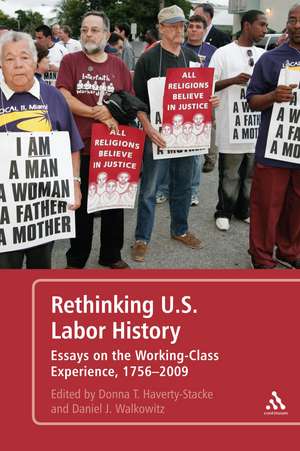
Rethinking U.S. Labor History: Essays on the Working-Class Experience, 1756-2009
Editat de Dr. Donna T. Haverty-Stacke, Daniel J. Walkowitzen Limba Engleză Paperback – 23 dec 2010
Preț: 287.05 lei
Preț vechi: 374.47 lei
-23%
Puncte Express: 431
Carte tipărită la comandă
Livrare economică 17-31 august
Livrare prin curier în România Termenul estimat este afișat lângă disponibilitate.
Transport gratuit de la 400.00 lei Plată online sau ramburs, în funcție de opțiunile comenzii.
Retur gratuit în 14 zile Comandă securizată și suport în română.
Specificații
ISBN-13: 9781441145758
ISBN-10: 1441145753
Pagini: 352
Dimensiuni: 152 x 228 x 22 mm
Greutate: 0.56 kg
Editura: Bloomsbury Publishing
Colecția Continuum
Locul publicării:New York, United States
ISBN-10: 1441145753
Pagini: 352
Dimensiuni: 152 x 228 x 22 mm
Greutate: 0.56 kg
Editura: Bloomsbury Publishing
Colecția Continuum
Locul publicării:New York, United States
V-ar putea interesa
-
 I Believe In YesterdayTim MoorePreț: 114.56 lei
 -
 -37%Preț: 57.64 lei91.91 lei
 -
 -21%Preț: 421.96 lei533.98 lei
 -
 Life On Air: A History of Radio FourDavid Hendy-16%Preț: 108.67 lei129.94 lei
 -
 Alcohol in World HistoryGina Hames-18%Preț: 1064.41 lei1298.07 lei
 -
 The Invisible CollegeRobert LomasPreț: 119.65 lei
 -
 -26%Preț: 68.98 lei93.54 lei
 -
 A Brief History of Philosophy: From Socrates to DerridaDerek Johnston-43%Preț: 113.93 lei198.55 lei
 -
 The Real Gorbals StoryColin MacFarlane-20%Preț: 74.63 lei92.85 lei
Cuprins
Contributors
1. Introduction
Donna Haverty-Stacke and Daniel J. Walkowitz.
PART I. CURRENT RESEARCH
2. Memoirs of an Invalid: James Miller and the Making of the British-American Empire during the Seven Years' War
Peter Way
3. Losing the Middle Ground: Strikebreakers and Labor Protest on the Southwestern Railroads
Theresa Case
4. Rethinking Working-Class Politics in Comparative-Transnational Contexts
Shelton Stromquist
5. No Common Creed: White Working-Class Protestantisms and the CIO's Operation Dixie
Ken Fones-Wolf and Elizabeth Fones-Wolf
6. A. Philip Randolph, Black Anticommunism, and the Race Question
Eric Arnesen
7. The Contextualization of a Moment in CIO History: The Mine-Mill Battle in the Connecticut Brass Valley During World War II
Steve Rosswurm
8. Organizing the Carework Economy: When the Private Becomes Public
Eileen Boris and Jennifer Klein
9. Solvents of Solidarity: Political Economy, Collective Action, and the Crisis of Organized Labor, 1968-2005
Joseph McCartin
PART II. NEW DIRECTIONS IN U.S. LABOR HISTORY
10. Sensing Labor: The Stinking Working-Class after the Cultural Turn
Dan Bender
11. Re-imagining Labor: Gender and New Directions in Labor and Working Class History
Liz Faue
12. The Limits of Work And The Subject of Labor History
Zach Schwartz-Weinstein
PART III. RESOURCES
Chronology
Resources
Further Reading
Index
1. Introduction
Donna Haverty-Stacke and Daniel J. Walkowitz.
PART I. CURRENT RESEARCH
2. Memoirs of an Invalid: James Miller and the Making of the British-American Empire during the Seven Years' War
Peter Way
3. Losing the Middle Ground: Strikebreakers and Labor Protest on the Southwestern Railroads
Theresa Case
4. Rethinking Working-Class Politics in Comparative-Transnational Contexts
Shelton Stromquist
5. No Common Creed: White Working-Class Protestantisms and the CIO's Operation Dixie
Ken Fones-Wolf and Elizabeth Fones-Wolf
6. A. Philip Randolph, Black Anticommunism, and the Race Question
Eric Arnesen
7. The Contextualization of a Moment in CIO History: The Mine-Mill Battle in the Connecticut Brass Valley During World War II
Steve Rosswurm
8. Organizing the Carework Economy: When the Private Becomes Public
Eileen Boris and Jennifer Klein
9. Solvents of Solidarity: Political Economy, Collective Action, and the Crisis of Organized Labor, 1968-2005
Joseph McCartin
PART II. NEW DIRECTIONS IN U.S. LABOR HISTORY
10. Sensing Labor: The Stinking Working-Class after the Cultural Turn
Dan Bender
11. Re-imagining Labor: Gender and New Directions in Labor and Working Class History
Liz Faue
12. The Limits of Work And The Subject of Labor History
Zach Schwartz-Weinstein
PART III. RESOURCES
Chronology
Resources
Further Reading
Index
Recenzii
"Drawing on new as well as seasoned talents to probe the outer limits of a rapidly evolving field, Rethinking U.S. Labor History will undoubtedly take its place as a valuable marker of the discipline's own history." --Leon Fink, University of Illinois at Chicago
"Much the way Walkowitz and Michael Frisch did a quarter century ago with Working-Class America, this superb new volume of essays illustrates the state of the field while setting the agenda for the next generation of U.S. labor history. While attentive to the intersections of class and culture that have animated much recent scholarship, this volume also offers a renewed focus on the structural factors that have impinged on workers' lives. Some of the most interesting essays explore how aspects of working-class culture and consciousness offered resistance to the entreaties of organizers, militants, and strikers, matters historians have too often ignored. Yet others consider the past in light of the new demographics and sectoral dimensions of today's labor force, while emphasizing the power of the state and transnational links to shape working-class lives. Collectively, Walkowitz's and Haverty-Stacke's contributors insist that U.S. labor historians rethink for the politics of a new century the shop-worn definitions of our essential subjects: work and the worker. If "labor" has a future in our neo-liberal era-as a material practice, a form of social organization, and a subject fit for close study-clues to its dynamics will be found in these pages." --Alex Lichtenstein, Florida International University, USA
"Much the way Walkowitz and Michael Frisch did a quarter century ago with Working-Class America, this superb new volume of essays illustrates the state of the field while setting the agenda for the next generation of U.S. labor history. While attentive to the intersections of class and culture that have animated much recent scholarship, this volume also offers a renewed focus on the structural factors that have impinged on workers' lives. Some of the most interesting essays explore how aspects of working-class culture and consciousness offered resistance to the entreaties of organizers, militants, and strikers, matters historians have too often ignored. Yet others consider the past in light of the new demographics and sectoral dimensions of today's labor force, while emphasizing the power of the state and transnational links to shape working-class lives. Collectively, Walkowitz's and Haverty-Stacke's contributors insist that U.S. labor historians rethink for the politics of a new century the shop-worn definitions of our essential subjects: work and the worker. If "labor" has a future in our neo-liberal era-as a material practice, a form of social organization, and a subject fit for close study-clues to its dynamics will be found in these pages." --Alex Lichtenstein, Florida International University, USA