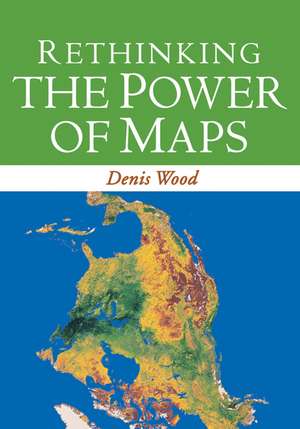
Rethinking the Power of Maps
Autor Denis Wooden Limba Engleză Paperback – 11 iun 2010
Această monografie de cercetare semnată de Denis Wood reprezintă o reevaluare critică și necesară a funcției politice și sociale a cartografiei contemporane. Conceput ca o continuare a volumului său revoluționar, The Power of Maps, textul de față investighează modul în care hărțile nu sunt simple instrumente de orientare, ci mecanisme prin care statul modern își exercită și își consolidează autoritatea. Suntem de părere că abordarea lui Wood demitizează neutralitatea presupusă a hărților, dezvăluind ipotezele ascunse din spatele procesului de creare a acestora.
Structura volumului este organizată riguros în două părți. Prima secțiune, „Mapping”, urmărește evoluția semnelor cartografice în serviciul statului, explicând cum hărțile „înfloresc” odată cu centralizarea puterii. A doua parte, „Counter-Mapping”, explorează formele de rezistență, de la arta cartografică la practicile radicale de „talking back” (reproșul adresat hărții oficiale). Cititorii familiarizați cu A History of Spaces de John Pickles vor aprecia modul în care Wood trece de la analiza teoretică la exemple practice și vizuale, precum hărțile electorale, cele de transport sau cartografierea participativă.
În contextul operei sale, Rethinking the Power of Maps se situează la intersecția dintre design și geografie umană, teme explorate anterior în Everything Sings sau în manualul Making Maps, Fourth Edition. Totuși, spre deosebire de lucrările cu caracter tehnic, acest volum pune accentul pe dimensiunea subversivă, analizând inclusiv utilizarea hărților în conflicte teritoriale complexe, cum este cel din Palestina. Apreciem în mod deosebit echilibrul dintre rigoarea academică și selecția de ilustrații provocatoare care demonstrează că o hartă este, în esență, o propunere despre lume, nu o reflectare fidelă a acesteia.
Preț: 379.61 lei
Carte disponibilă
Livrare economică 18 mai-01 iunie
Livrare express 01-07 mai pentru 40.48 lei
Specificații
ISBN-10: 1593853661
Pagini: 335
Ilustrații: Illustrations
Dimensiuni: 178 x 254 x 25 mm
Greutate: 0.6 kg
Ediția:1
Editura: Guilford Publications
Colecția Guilford Press
V-ar putea interesa
-
 A History of the World in Twelve MapsJerry Brotton-19%Preț: 84.63 lei104.51 lei
 -
 How to Lie with Maps, Third EditionMark MonmonierPreț: 174.97 lei
 -
 Preț: 336.64 lei
 -
 Preț: 175.00 lei
 -
 Preț: 267.78 lei
 -
 40 Maps That Will Change How You See the WorldAlastair Bonnett-18%Preț: 115.70 lei141.23 lei
 -
 A History of America in 100 MapsSusan SchultenPreț: 223.21 lei
 -
 MapmaticsPaulina Rowinska-49%Preț: 45.83 lei89.13 lei
 -
 -8%Preț: 426.14 lei463.19 lei
 -
 Radical CartographyWilliam Rankin-45%Preț: 124.42 lei226.45 lei
 -
 Cartography.Kenneth Field-15%Preț: 470.53 lei553.57 lei
 -
 -18%Preț: 256.18 lei312.19 lei
 -
 The Library of Lost MapsJames CheshirePreț: 256.97 lei
 -
 -14%Preț: 224.70 lei261.44 lei
 -
 All Mapped Out: How Maps Shape UsMike Duggan-5%Preț: 105.44 lei110.69 lei
 -
 MapPhaidon Editors-18%Preț: 171.53 lei209.96 lei
 -
 Maps: Their Untold Stories 2nd EditionRose Mitchell-27%Preț: 139.16 lei191.04 lei
 -
 On The Map: Why the world looks the way it doesSimon Garfield-19%Preț: 73.17 lei90.28 lei
 -
 Shifts in Mapping: Maps as a Tool of KnowledgeChristine Schranz-19%Preț: 302.51 lei371.45 lei
Public țintă
Professional Practice & DevelopmentDe ce să citești această carte
Recomandăm această carte profesioniștilor din geografie, planificare urbană și științe politice care doresc să înțeleagă dedesubturile ideologice ale reprezentărilor spațiale. Cititorul câștigă o perspectivă critică asupra modului în care datele sunt transformate în putere vizuală. Este un instrument esențial pentru oricine dorește să utilizeze cartografia nu doar ca tehnică, ci ca formă de comunicare strategică și rezistență socială.
Despre autor
Denis Wood este un geograf independent și scriitor stabilit în Raleigh, Carolina de Nord. A fost profesor distins de design la North Carolina State University între anii 1974 și 1998, perioadă în care și-a consolidat reputația de teoretician de avangardă al cartografiei critice. Lucrările sale, printre care se numără celebrul volum The Power of Maps și Weaponizing Maps, au influențat profund modul în care comunitatea academică raportează designul vizual la structurile de putere. Experiența sa diversă, de la istoria pământului la regulile spațiului domestic, îi permite să abordeze cartografia dintr-o perspectivă interdisciplinară unică.
Descriere scurtă
Cuprins
I. Mapping
1. Maps Blossom in the Springtime of the State
2. Unleashing the Power of the Map
3. Signs in the Service of the State
4. Making Signs Talk to Each Other
II. Counter-Mapping
5. Counter-Mapping and the Death of Cartography
6. Talking Back to the Map
7. Map Art: Stripping the Mask from the Map
8. Mapmaking, Counter-Mapping, and Map Art in the Mapping of Palestine
Recenzii
In an age when mapping is sexy again, Wood explains why it should matter to everyone, how maps came to be deployed by states, and how the authority of the image is now being used by many different voices. This is a passionate humanist argument for a critical approach to mapping, strongly academic but reassuringly accessible. Wood’s work always challenges; the style and panache of his scholarship carry the reader along and persuade us to listen to his original ideas. Mapping and counter-mapping are brought together for the first time. Researchers and students across the social sciences, and indeed from all disciplines, should read this book and take its lessons to heart!--Chris Perkins, Senior Lecturer, Geography, University of Manchester, United Kingdom
Notă biografică
John Fels, PhD, until his death in 2014, was Adjunct Associate Professor in the Graduate GIS Faculty at North Carolina State University. He worked as a professional cartographer with the Ontario Ministry of Natural Resources and as a freelance cartographic designer and consultant, and developed and taught the core design curriculum in the Cartography Program at Sir Sandford Fleming College in Ontario. Dr. Fels was the author of the North Carolina Watersheds map and also coauthor (with Denis Wood) of The Natures of Maps.
John Krygier, PhD, is Professor in the Department of Geology and Geography at Ohio Wesleyan University, with teaching and research specializations in cartography, geographic information systems (GIS), and environmental and human geography. He has published on map design, educational technology, cultural geography, multimedia in cartography, planning, the history of cartography, and participatory GIS.