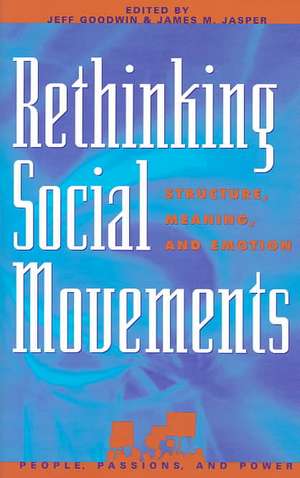
Rethinking Social Movements: Structure, Meaning, and Emotion: People, Passions, and Power: Social Movements, Interest Organizations, and the P
Editat de Jeff Goodwin, James M. Jasper Contribuţii de Myra Marx Ferree, Richard Flacks, Marshall Ganz, Deborah B. Gould, Ruud Koopmans, Charles Kurzman, Doug McAdam, David A. Merrill, David S. Meyer, Aldon Morris, Francesca Polletta, Marc W. Steinberg, Sidney Tarrow, Charles Tillyen Limba Engleză Paperback – 7 oct 2003






Preț: 368.85 lei
Preț vechi: 462.91 lei
-20%
Puncte Express: 553
Carte tipărită la comandă
Livrare economică 23 noiembrie-07 decembrie
Livrare prin curier în România Termenul estimat este afișat lângă disponibilitate.
Transport gratuit de la 400.00 lei Plată online sau ramburs, în funcție de opțiunile comenzii.
Retur gratuit în 14 zile Comandă securizată și suport în română.
Specificații
ISBN-13: 9780742525962
ISBN-10: 0742525961
Pagini: 307
Dimensiuni: 150 x 226 x 20 mm
Greutate: 0.49 kg
Ediția:0304
Editura: Bloomsbury Publishing
Colecția Rowman & Littlefield
Seria People, Passions, and Power: Social Movements, Interest Organizations, and the P
Locul publicării:New York, United States
ISBN-10: 0742525961
Pagini: 307
Dimensiuni: 150 x 226 x 20 mm
Greutate: 0.49 kg
Ediția:0304
Editura: Bloomsbury Publishing
Colecția Rowman & Littlefield
Seria People, Passions, and Power: Social Movements, Interest Organizations, and the P
Locul publicării:New York, United States
V-ar putea interesa
-
 Broken VowsTom BowerPreț: 109.34 lei
 -
 United States of JihadPeter BergenPreț: 124.24 lei
 -
 Contested Knowledge - Social Theory Today 6eSteven SeidmanPreț: 450.85 lei
 -
 FoucaultStuart EldenPreț: 168.41 lei
 -
 -27%Preț: 944.61 lei1286.77 lei
 -
 Thomas Piketty's Capital in the Twenty-First CenturyStephan KaufmannPreț: 106.34 lei
 -
 Preț: 93.78 lei
 -
 Preț: 89.72 lei
Cuprins
Chapter 1 Introduction
Part 2 I Political Process Theory: Opportunity or Constraint?
Chapter 3 Caught in a Winding, Snarling Vine: The Structural Bias of Political Process Theory
Chapter 4 Wise Quacks
Chapter 5 Paradigm Warriors: Regress and Progress in the Study of Contentious Politics
Chapter 6 Tending the Vineyard: Cultivating Political Process Research
Chapter 7 Political Opportunity Structure: Some Splitting to Balance the Lumping
Chapter 8 Trouble in Paradigms
Part 9 II Beyond Dominant Paradigms
Chapter 10 Culture Is Not Just in Your Head
Chapter 11 The Post-Structuralist Consensus in Social Movement Theory
Chapter 12 The Intellectual Challenges of Toiling in the Vineyard
Chapter 13 Knowledge for What? Thoughts on the State of Social Movements Studies
Chapter 14 Passionate Political Processes: Bringing Emotions Back into the Study of Social Movements
Chapter 15 Why David Sometimes Wins: Strategic Capacity in Social Movements
Part 16 III Concluding Reflections
Chapter 17 Rethinking Political Process Theory
Chapter 18 Reflections on Social Movement Theory: Criticisms and Proposals
Chapter 19 Hot Movements, Cold Cognition: Thinking about Social Movements in Gendered Frames
Part 2 I Political Process Theory: Opportunity or Constraint?
Chapter 3 Caught in a Winding, Snarling Vine: The Structural Bias of Political Process Theory
Chapter 4 Wise Quacks
Chapter 5 Paradigm Warriors: Regress and Progress in the Study of Contentious Politics
Chapter 6 Tending the Vineyard: Cultivating Political Process Research
Chapter 7 Political Opportunity Structure: Some Splitting to Balance the Lumping
Chapter 8 Trouble in Paradigms
Part 9 II Beyond Dominant Paradigms
Chapter 10 Culture Is Not Just in Your Head
Chapter 11 The Post-Structuralist Consensus in Social Movement Theory
Chapter 12 The Intellectual Challenges of Toiling in the Vineyard
Chapter 13 Knowledge for What? Thoughts on the State of Social Movements Studies
Chapter 14 Passionate Political Processes: Bringing Emotions Back into the Study of Social Movements
Chapter 15 Why David Sometimes Wins: Strategic Capacity in Social Movements
Part 16 III Concluding Reflections
Chapter 17 Rethinking Political Process Theory
Chapter 18 Reflections on Social Movement Theory: Criticisms and Proposals
Chapter 19 Hot Movements, Cold Cognition: Thinking about Social Movements in Gendered Frames
Recenzii
[This book] is a most welcome and useful assessment of recent theory, one that will contribute to regenerating the field of social movements and contentious politics.
This volume should be particularly valuable reading on social movements for academics and those with an advanced knowledge of social movement theories. True to its title, the book engages several important topics in these fields and gives one the feeling of being privy to discussions on the state-of-the-art of new research in an increasingly important body of work.
This volume should be particularly valuable reading on social movements for academics and those with an advanced knowledge of social movement theories. True to its title, the book engages several important topics in these fields and gives one the feeling of being privy to discussions on the state-of-the-art of new research in an increasingly important body of work.