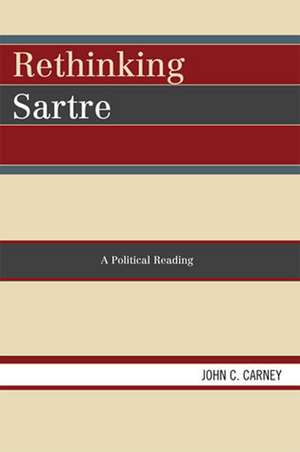
Rethinking Sartre: A Political Reading
Autor John C. Carneyen Limba Engleză Paperback – 18 apr 2007
Sartre's later philosophical account of why essentialist theories of human nature are particularly damaging in relation to political theory is explained with an eye towards the current global danger wherein ideologies of human nature are increasingly masked as religion. Sartre's philosophy insists that the full exposition of human freedom and agency must be established first for only then can the life of history and culture enhance and not detract from the actualization of humanist goals. It explicates this concept first, through a study of Sartre's early article on Intentionality, and then the larger work, Transcendence of the Ego. A detailed account is given of Sartre's direct realism in which the intentional structure of consciousness emerges as evidence against essentialist claims of human nature.
Professor Carney's analysis considers the way Sartre develops the concept of Intentional
Preț: 272.73 lei
Preț vechi: 378.12 lei
-28%
Puncte Express: 409
Carte tipărită la comandă
Livrare economică 28 noiembrie-12 decembrie
Livrare prin curier în România Termenul estimat este afișat lângă disponibilitate.
Transport gratuit de la 400.00 lei Plată online sau ramburs, în funcție de opțiunile comenzii.
Retur gratuit în 14 zile Comandă securizată și suport în română.
Specificații
ISBN-13: 9780761836889
ISBN-10: 0761836888
Pagini: 132
Dimensiuni: 154 x 231 x 11 mm
Greutate: 0.22 kg
Editura: Bloomsbury Publishing
Colecția University Press of America
Locul publicării:New York, United States
ISBN-10: 0761836888
Pagini: 132
Dimensiuni: 154 x 231 x 11 mm
Greutate: 0.22 kg
Editura: Bloomsbury Publishing
Colecția University Press of America
Locul publicării:New York, United States
Cuprins
Part 1 Acknowledgments
Chapter 2 Rethinking Sartre
Chapter 3 Intentionality
Chapter 4 The Issue of the Subject and the Debate with Husserl
Chapter 5 What is Bad Faith?
Chapter 6 Political Theory and Alienation
Chapter 7 Sartre's Account of Social Evil in The Flies
Chapter 8 Satre's Philosophy of Political History
Part 9 Bibliography
Chapter 2 Rethinking Sartre
Chapter 3 Intentionality
Chapter 4 The Issue of the Subject and the Debate with Husserl
Chapter 5 What is Bad Faith?
Chapter 6 Political Theory and Alienation
Chapter 7 Sartre's Account of Social Evil in The Flies
Chapter 8 Satre's Philosophy of Political History
Part 9 Bibliography
Recenzii
This study is recommended for those who seek to understand how the works of Sartre can provide insight to understanding contemporary debates in political theory especially around the venerable problem of human nature. For those students of political theory who think Sartre's relevance is PASSE and only of historical interest, this analysis by Carney is an eye-opening refutation. This book argues that Sartre has much to teach us of political importance today and will assist readers in achieving this illuminating recognition.
There has been a renewed interest in recent years in the work of Jean-Paul Sartre. Rethinking Sartre, a Political Reading comes to this topic with a fresh and unique perspective. The author brings a wealth of background and information along with his use of a variety of levels of analysis to clarify the significance of Sartre for contemporary politics. The reader will come away from this work with renewed appreciation for the relevance of Sartre's work for the state of the contemporary political landscape.
There has been a renewed interest in recent years in the work of Jean-Paul Sartre. Rethinking Sartre, a Political Reading comes to this topic with a fresh and unique perspective. The author brings a wealth of background and information along with his use of a variety of levels of analysis to clarify the significance of Sartre for contemporary politics. The reader will come away from this work with renewed appreciation for the relevance of Sartre's work for the state of the contemporary political landscape.