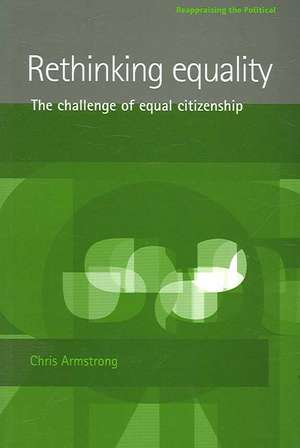
Rethinking equality: Reappraising the Political
Autor Chris Armstrongen Limba Engleză Paperback – sep 2006


Preț: 233.59 lei
Puncte Express: 350
Carte tipărită la comandă
Livrare economică 05-19 decembrie
Livrare prin curier în România Termenul estimat este afișat lângă disponibilitate.
Transport gratuit de la 400.00 lei Plată online sau ramburs, în funcție de opțiunile comenzii.
Retur gratuit în 14 zile Comandă securizată și suport în română.
Specificații
ISBN-13: 9780719069253
ISBN-10: 0719069254
Pagini: 232
Dimensiuni: 156 x 234 x 13 mm
Greutate: 0.36 kg
Ediția:New.
Editura: MANCHESTER UNIVERSITY PRESS
Colecția Reappraising the Political
Seria Reappraising the Political
ISBN-10: 0719069254
Pagini: 232
Dimensiuni: 156 x 234 x 13 mm
Greutate: 0.36 kg
Ediția:New.
Editura: MANCHESTER UNIVERSITY PRESS
Colecția Reappraising the Political
Seria Reappraising the Political
Notă biografică
Sailor and librarian, navigator and researcher, teacher and trainer, and-always-a traveller: Chris Armstrong has had three careers, working as a merchant seaman, a farmhand on the farm where he still lives, and as an information scientist before retiring to become a poet and writer. He has one collection of poems in print, Mostly Welsh (Y Lolfa, 2019). Although initially entirely focussed on poetry, his writing has branched into short stories and works of fiction including this volume, The Dark Trilogy. He has published elsewhere: in Storgy, Agenda and London Grip New Poetry for example. Although born in Sussex, he has lived in a cottage in the mountains of Mid Wales most of his life.
Cuprins
Introduction Part one - A critique of liberal equality 1. The troubled life of social citizenship: Rawls on equality 2. Equality, risk and responsibility: Dworkin on the insurance market 3. Equality versus social inclusion? Part two - Alternatives: equality and citizenship 4. Equality and responsibility: towards a more critical union? 5. Opportunities, outcomes and democratic citizenship: Young and Phillips on equality 6. Equalities: recognition, redistribution and citizenship 7. Equality and citizenship in global context Conclusion