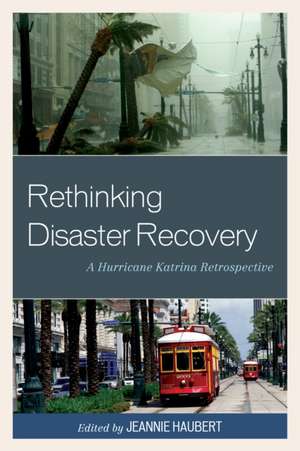
Rethinking Disaster Recovery: A Hurricane Katrina Retrospective
Editat de Jeannie Haubert Contribuţii de Elizabeth Fussell, Timothy J. Haney, James R. Elliott, Kristen Barber, Jean Ait Belkhir, Amy Bellone Hite, Farrah Gafford Cambrice, Jennifer Day-Sully, Shiloh Deitz, Erica Dudas, Dana M. Greene, Andrea Wilbon Hartman, Danielle Antoinette Hidalgo, Pamela Jenkins, Jessica W. Pardee, Mimi Schippers, Bethany L. Van Brownen Limba Engleză Paperback – 11 apr 2019
| Toate formatele și edițiile | Preț | Express |
|---|---|---|
| Paperback (1) | 272.17 lei 6-8 săpt. | |
| Bloomsbury Publishing – 11 apr 2019 | 272.17 lei 6-8 săpt. | |
| Hardback (1) | 603.11 lei 6-8 săpt. | |
| Bloomsbury Publishing – 5 feb 2015 | 603.11 lei 6-8 săpt. |
Preț: 272.17 lei
Preț vechi: 367.62 lei
-26%
Puncte Express: 408
Preț estimativ în valută:
48.13€ • 56.48$ • 41.75£
48.13€ • 56.48$ • 41.75£
Carte tipărită la comandă
Livrare economică 09-23 martie
Specificații
ISBN-13: 9781498501224
ISBN-10: 1498501222
Pagini: 258
Ilustrații: 6 BW Photos
Dimensiuni: 150 x 223 x 19 mm
Greutate: 0.39 kg
Editura: Bloomsbury Publishing
Colecția Lexington Books
Locul publicării:New York, United States
ISBN-10: 1498501222
Pagini: 258
Ilustrații: 6 BW Photos
Dimensiuni: 150 x 223 x 19 mm
Greutate: 0.39 kg
Editura: Bloomsbury Publishing
Colecția Lexington Books
Locul publicării:New York, United States
Cuprins
Foreword, James R. Elliott
Chapter 1: Rethinking Disaster Recovery: Editor's Introduction, Jeannie Haubert
Part I: Gender and Sexuality in the Recovery Process
Chapter 2: Trauma, Recovery, and Sexuality in Post- Katrina New Orleans, Mimi Schippers
Chapter 3: It's Raining Men: Gender and Street Harassment in Post-Katrina New Orleans, Andrea Wilbon Hartman, Erica Dudas, and Jennifer Day-Sully
Chapter 4: Ten Years Later: Domestic Violence and Hurricane Katrina, Pamela Jenkins and Bethany Van Brown
Chapter 5: Missing in the Storm: The Gender Gap in Hurricane Katrina Research and Disaster Management Efforts, Kristen Barber and Shiloh Deitz
Part II: Race and Class in the Recovery Process
Chapter 6: On the Kindness of Strangers: Am I More Worthy of Your Sympathy than Lakisha and Jamal?, Jeannie Haubert
Chapter 7: Disaster, Reconstruction, and Racialization: Latinos in New Orleans After Hurricane Katrina, Elizabeth Fussell and Amy Bellone-Hite
Chapter 8: Flourishing or Floundering? Examining the Career Paths of African American Emerging Adults in Post-Katrina New Orleans, Farrah Gafford Cambrice
Chapter 9: New Orleans' Katrina Recovery for Whom and What? A Race, Gender, and Class Approach, Jean Ait Belkhir
Part III: Doing Academia Through Disaster
Chapter 10: Trauma Survivor as Author; Method as Recovery, Jessica W. Pardee
Chapter 11: Housing Market Mayhem: Problems Studying Discrimination Post-Disaster, Jeannie Haubert
Chapter 12: "We're Still in the Trenches Baby": Navigating Academia in an Uncertain, Post-Katrina World, Danielle Antoinette Hidalgo and Dana M. Greene
Chapter 13: Learning from Disaster: Post-Katrina New Orleans as a Sociological Classroom, Timothy J. Haney
Postscript, Dana M. Greene
Chapter 1: Rethinking Disaster Recovery: Editor's Introduction, Jeannie Haubert
Part I: Gender and Sexuality in the Recovery Process
Chapter 2: Trauma, Recovery, and Sexuality in Post- Katrina New Orleans, Mimi Schippers
Chapter 3: It's Raining Men: Gender and Street Harassment in Post-Katrina New Orleans, Andrea Wilbon Hartman, Erica Dudas, and Jennifer Day-Sully
Chapter 4: Ten Years Later: Domestic Violence and Hurricane Katrina, Pamela Jenkins and Bethany Van Brown
Chapter 5: Missing in the Storm: The Gender Gap in Hurricane Katrina Research and Disaster Management Efforts, Kristen Barber and Shiloh Deitz
Part II: Race and Class in the Recovery Process
Chapter 6: On the Kindness of Strangers: Am I More Worthy of Your Sympathy than Lakisha and Jamal?, Jeannie Haubert
Chapter 7: Disaster, Reconstruction, and Racialization: Latinos in New Orleans After Hurricane Katrina, Elizabeth Fussell and Amy Bellone-Hite
Chapter 8: Flourishing or Floundering? Examining the Career Paths of African American Emerging Adults in Post-Katrina New Orleans, Farrah Gafford Cambrice
Chapter 9: New Orleans' Katrina Recovery for Whom and What? A Race, Gender, and Class Approach, Jean Ait Belkhir
Part III: Doing Academia Through Disaster
Chapter 10: Trauma Survivor as Author; Method as Recovery, Jessica W. Pardee
Chapter 11: Housing Market Mayhem: Problems Studying Discrimination Post-Disaster, Jeannie Haubert
Chapter 12: "We're Still in the Trenches Baby": Navigating Academia in an Uncertain, Post-Katrina World, Danielle Antoinette Hidalgo and Dana M. Greene
Chapter 13: Learning from Disaster: Post-Katrina New Orleans as a Sociological Classroom, Timothy J. Haney
Postscript, Dana M. Greene
Recenzii
The text is well written with excellent incorporation of current theory and research in the sociology of disasters. Further, the narrative style of the book provides for a quick read. This text would be a useful supplement to graduate disaster courses, especially since the chapters raise interesting questions that doctoral students could undertake as research projects. As a disaster scholar, the book provided thought-provoking information in a format different from traditional journal articles or scholarly texts and helped contextualize the research from Hurricane Katrina.... The book also highlights issues that researchers of disasters hope they only in rare cases have to experience personally, while encouraging us to analyze our own sociological lens and how our research intersects with our lives, our colleagues' lives, and the lives of the survivors we study.
Rethinking Disaster Recovery is a pioneering collection of essays, and this for two reasons. First, it is written by scholars who themselves experienced the massive disordering that was, and in many ways still is, Hurricane Katrina. And second, each essay, in its own way, reminds us of what there is to learn if we follow the crooked path of disaster long after the cameras are turned off.
Only a catastrophe the magnitude of Hurricane Katrina striking a major urban region could have impacted so many social institutions, including its universities, that the one university in the city to have had a sociology doctoral program [Tulane] could have been the source of a such a robust core of 'survivor scholars' who have contributed to such an interesting and important book of personal and professional experiences out of the event.
Rethinking Disaster Recovery is a pioneering collection of essays, and this for two reasons. First, it is written by scholars who themselves experienced the massive disordering that was, and in many ways still is, Hurricane Katrina. And second, each essay, in its own way, reminds us of what there is to learn if we follow the crooked path of disaster long after the cameras are turned off.
Only a catastrophe the magnitude of Hurricane Katrina striking a major urban region could have impacted so many social institutions, including its universities, that the one university in the city to have had a sociology doctoral program [Tulane] could have been the source of a such a robust core of 'survivor scholars' who have contributed to such an interesting and important book of personal and professional experiences out of the event.