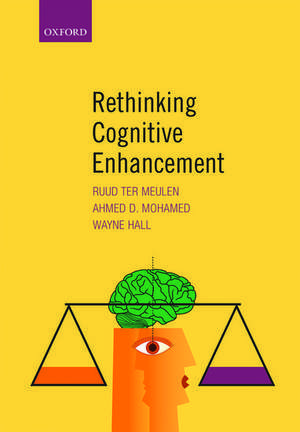
Rethinking Cognitive Enhancement
Editat de Ruud ter Meulen, Ahmed Mohamed, Wayne Hallen Limba Engleză Hardback – 2 mar 2017
Preț: 638.26 lei
Preț vechi: 921.90 lei
-31%
Puncte Express: 957
Carte tipărită la comandă
Livrare economică 27 noiembrie-02 decembrie
Livrare prin curier în România Termenul estimat este afișat lângă disponibilitate.
Transport gratuit pentru acest produs Plată online sau ramburs, în funcție de opțiunile comenzii.
Retur gratuit în 14 zile Comandă securizată și suport în română.
Specificații
ISBN-13: 9780198727392
ISBN-10: 0198727399
Pagini: 336
Dimensiuni: 177 x 252 x 25 mm
Greutate: 0.75 kg
Editura: OUP OXFORD
Colecția OUP Oxford
Locul publicării:Oxford, United Kingdom
ISBN-10: 0198727399
Pagini: 336
Dimensiuni: 177 x 252 x 25 mm
Greutate: 0.75 kg
Editura: OUP OXFORD
Colecția OUP Oxford
Locul publicării:Oxford, United Kingdom
V-ar putea interesa
-
 Subcortical StrokeGeoffrey Donnan-27%Preț: 3177.24 lei4330.09 lei
 -
 The Central Auditory SystemGünter Ehret-31%Preț: 650.79 lei940.34 lei
 -
 How the Brain Evolved LanguageDonald Loritz-22%Preț: 449.63 lei573.56 lei
 -
 The Lost Self: Pathologies of the Brain and IdentityTodd E. Feinberg-29%Preț: 506.00 lei709.05 lei
 -
 Emotions and the BodyBeatrice de Gelder-31%Preț: 679.30 lei984.78 lei
 -
 The Cognitive and Neural Bases of Spatial NeglectHans-Otto Karnath-32%Preț: 986.35 lei1461.07 lei
 -
 Evolution of the Cerebellar Sense of SelfJohn Montgomery-28%Preț: 518.35 lei724.53 lei
 -
 The Oxford Handbook of MetamemoryJohn Dunlosky-32%Preț: 1165.22 lei1724.63 lei
 -
 Cannabis Use and DependenceWayne HallPreț: 230.68 lei
 -
 -15%Preț: 523.93 lei616.39 lei
 -
 Talking the Talk: Language, Psychology and ScienceTrevor A. Harley-15%Preț: 463.17 lei544.90 lei
 -
 Neural Plasticity Across the Lifespan: How the brain can changeGianfranco DenesPreț: 463.14 lei
 -
 A Life ScientificBernard DonovanPreț: 121.99 lei
 -
 -15%Preț: 659.54 lei775.93 lei
 -
 -18%Preț: 1039.73 lei1267.95 lei
 -
 Zic familyJun Aruga-18%Preț: 992.48 lei1210.34 lei
 -
 COMPEN VIVO MONIT REAL-TIME (V2)Wilson George S-18%Preț: 1008.18 lei1229.49 lei
 -
 NEURAL STEM CELLS IN HEALTH AND DISEASEShetty Ashok K-15%Preț: 707.75 lei832.64 lei
 -
 BIOPHYSICS OF CONSCIOUSNESSPoznanski Roman R-18%Preț: 1353.48 lei1650.58 lei
 -
 HANDBOOK OF PHOTODYNAMIC THERAPYPandey Ravindra K-18%Preț: 1158.29 lei1412.54 lei
Notă biografică
Professor Ruud ter Meulen (1952) is psychologist and ethicist. He was Professor and Director at the Institute for Bioethics and the University of Maastricht in the Netherlands. In 2005 he was appointed Chair for Ethics of Medicine and Director of the Centre for ethics in Medicine at the University of Bristol. He has directed a range of European projects in the field of biomedical ethics. He was co-ordinator of the ENHANCE project, dealing with the ethical, philosophical and social issues of enhancement technologies. He was also co-ordinator of the recently finished European EPOCH project on the role of ethics in public policy-making on new biotechnologies, with enhancement as a case, and of the European SYBHEL project on the ethical, legal and social issues of synthetic biology as applied to human health. He has published about 150 articles, book chapters and edited volumes on a range of topics in bioethics.Wayne Hall is a Professor and Director of the Centre for Youth Substance Abuse Research at the University of Queensland. He was formerly: an NHMRC Australia Fellow in addiction neuroethics at the University of Queensland Centre for Clinical Research and the University of Queensland Brain Institute (2009-2014); Professor of Public Health Policy, School of Population Health, UQ (2005-2009); Director of the Office of Public Policy and Ethics at the Institute for Molecular Bioscience (2001-2005) at the University of Queensland; and Director of the National Drug and Alcohol Research Centre, UNSW (1994-2001). He has advised the World Health Organization on: the health effects of cannabis use; the effectiveness of drug substitution treatment; the contribution of illicit drug use to the global burden of disease; and the ethical implications of genetic and neuroscience research on addiction.Dr Ahmed Dahir Mohamed is a registered psychologist, neuroscientist and author. He was the recipient of the Emerging Psychologist Award from the 2016 International Congress of Psychology in Yokohama, Japan for his work on the effects of mindfulness in young people. He was formerly a post-doctoral fellow in Developmental Cognitive and Affective Neuroscience at the School of Psychology University of Nottingham Malaysia Campus. He obtained his doctorate in Psychology from the University of Cambridge, where the focus of his thesis was how to enhance cognition in young people. Dr. Mohamed was a recognized DPhil student at the Oxford Centre for Neuroethics, University of Oxford. In 2013, he was a visiting neuroscience and ethics fellow at St Cross College, University of Oxford. Dr. Mohamed holds a first class honours degree in psychology from the University of Reading and he became a full chartered member of the British Psychological Society in 2013 and elected associate fellow in 2015.