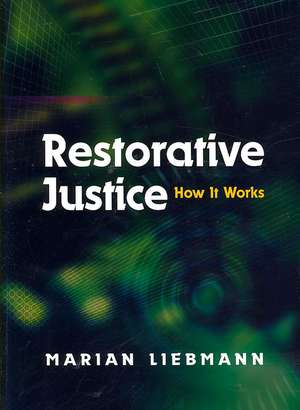
Restorative Justice: How It Works
Autor Marian Liebmannen Limba Engleză Paperback – 15 apr 2007
Drawing on many years' experience of working in victim support, probation, mediation and restorative practices, Marian Liebmann uses pertinent case examples to illustrate how restorative justice can be used effectively to work with crime and its effects. Also included are sections on confronting bullying in schools, dealing with sexual and racial violence, tackling antisocial behaviour and community reconciliation after war. Whether in the context of families, schools, communities, criminal justice or prisons, the author argues that restorative justice is a `seamless philosophy' which can be applied flexibly to meet diverse needs. Liebmann provides an international outlook, examining how restorative justice is practised around the world, including traditional Maori and Aboriginal approaches.
Restorative Justice: How It Works is a key reference for magistrates, social workers, probation officers, Youth Offending Team workers, police, teachers and health professionals, as well as the lay reader.
Preț: 397.02 lei
Preț vechi: 495.68 lei
-20%
Puncte Express: 596
Carte disponibilă
Livrare economică 10-24 noiembrie
Livrare prin curier în România Termenul estimat este afișat lângă disponibilitate.
Transport gratuit de la 400.00 lei Plată online sau ramburs, în funcție de opțiunile comenzii.
Retur gratuit în 14 zile Comandă securizată și suport în română.
Specificații
ISBN-13: 9781843100744
ISBN-10: 1843100746
Pagini: 472
Dimensiuni: 172 x 246 x 30 mm
Greutate: 0.76 kg
Editura: JESSICA KINGSLEY PUBLISHERS
Colecția Jessica Kingsley Publishers
Locul publicării:London, United Kingdom
ISBN-10: 1843100746
Pagini: 472
Dimensiuni: 172 x 246 x 30 mm
Greutate: 0.76 kg
Editura: JESSICA KINGSLEY PUBLISHERS
Colecția Jessica Kingsley Publishers
Locul publicării:London, United Kingdom
V-ar putea interesa
-
 -11%Preț: 374.63 lei419.80 lei
 -
 -28%Preț: 546.97 lei764.61 lei
 -
 -18%Preț: 1121.30 lei1367.44 lei
 -
 Murder and Mayhem: Crime in Twentieth-Century BritainProfessor David Nash-25%Preț: 194.53 lei258.01 lei
 -
 Successful Expert TestimonyMax M. Houck-18%Preț: 1039.97 lei1268.25 lei
 -
 Art Therapy for Groups: A Handbook of Themes and ExercisesMarian Liebmann-5%Preț: 1250.28 lei1316.08 lei
 -
 -15%Preț: 472.85 lei556.29 lei
 -
 Extremist Propaganda in Social Media: A Threat to Homeland SecurityMichael Erbschloe-18%Preț: 1113.71 lei1358.17 lei
 -
 -18%Preț: 1474.50 lei1798.17 lei
 -
 Preț: 408.39 lei
 -
 Wildlife Crime: From Theory to Practice: From Theory to PracticeWilliam D. MoretoPreț: 246.45 lei
 -
 The Short Guide to Criminal JusticeLisa O’MalleyPreț: 150.34 lei
 -
 Art Therapy for Groups: A Handbook of Themes and ExercisesMarian Liebmann-5%Preț: 365.37 lei384.59 lei
 -
 -26%Preț: 177.32 lei239.29 lei
 -
 -25%Preț: 243.20 lei322.23 lei
 -
 -5%Preț: 284.74 lei299.72 lei
 -
 Judges, Judging and HumourJessica Milner Davis-18%Preț: 927.64 lei1131.27 lei
 -
 The Sociology of Compromise after ConflictJohn D. Brewer-18%Preț: 756.02 lei921.98 lei
 -
 The Sociology of Everyday Life PeacebuildingJohn D. Brewer-18%Preț: 756.40 lei922.43 lei
 -
 Cruel, Inhuman or Degrading Treatment?Michael AdlerPreț: 398.36 lei
 -
 Fraud and CorruptionPeter C. Kratcoski-15%Preț: 524.79 lei617.39 lei
 -
 Narrating Injustice SurvivalWillem De Lint-15%Preț: 545.94 lei642.29 lei
 -
 Die soziale Praxis des GerichtsverfahrensSebastian StarystachPreț: 423.83 lei
Recenzii
In recent years,the idea of restorative justice increasingly is on the minds of individuals and societies interested in approaches to justice that focus on restoring victims and communities rather than punishing offenders. Thus, the arrival of Liebmann's recent book on the topic represents a welcome opportunity for a summation of the history and future of the movement both in the United Kingdom, where the author is based, and abroad. Restorative Justice: How it Works aims to be broad in scope and examines restorative justice approaches in diverse contexts, including family,school,community,criminal justice, and prison environments. The Author views her book as having relevance to practitioners as well as to students and others affected by restorative justice, such as teachers and lawyers'.
It is a joy to read a carefully considered and crafted book by an author who is a leader in their field. This is all the more so when you are being led from a state of uncertain ignorance in the subject, through to that satisfying feeling of being able to know that by the end you have some grip on the topic...Art therapy is one of Marian's passions, and her expertise and appreciation of its transformative power leaps from these pages...By placing people, and not processes, at the centre of justice and demonstrating the effect that art can have on those involved, the restorative approach brings a human element to crime and its effects. And there can be few books better that this one to guide the inquiring mind through that landscape of pain and redemption.
Marian Liebmann, already well known in the field of restorative justice (RJ), here surveys modern RJ, from its origins in Canada more than 30 years ago up to 2007. Her experience in teaching, victim support, mediation and RJ itself enables her to give this broad overview, including not only the criminal law sense of the phrase but also restorative processes or practices in many other contexts.
Marian Liebmann's book is an excellent introduction to the field, giving a clear insight into what RJ is and how it works. This is an uplifting book. In times when we are constantly assailed on all sides by dreadful news of crimes and wars, it is heartening to learn to initiatives that bring reconciliation and reparation, and which are shown to be working. Very readable and clearly written book extremely useful. I strongly recommend this book as an excellent introduction to a topic of ever-groing importance.
The book is easy to read; it is easy to pick up and put down and pick up again to read where I left off. It's a great browsing book and at no time did I feel lost in "academic-speak."
The considerable achievement of this book that it covers a broad international field and explains in detail how restorative justice practice works in different context. Marian Liebmann's book is for practitioners of restorative justice, for those coming to the practice for the first time and for many professionals who need to know about it as it increasingly impinges on their work.
The strength of this book is in its ability to present a considerable amount of information providing a good overview of the development of restorative justice. The book benefits from the provision of examples and methods of practice which further highlight the key debates within restorative justice. One of the key debates is how restorative justice fits within a jurisdiction which views criminal justice as a 'system' rather than a 'process', and in which cultures are entrenched to the extent that there are barriers to utilising some of the benefits of restorative justice. The book would be a very useful addition to any reading list for students of restorative justice, for practitioners and policy makers.
This comprehensive guide provides an accessible introduction to the philosophy of restorative justice and its practical application in a wide range of settings, showing how it can help both victims and offenders when harm has been done… Restorative Justice: How It Works is a key reference for magistrates, social workers, probation officers, Youth Offending Team workers, police, teachers and health professionals, as well as the lay reader.
This is an optimistic book which I am glad to have read.
This is an uplifting book. In times when we are constantly assailed on all sides by dreadful news of crimes and wars, it is heartening to read about initiatives that bring reconciliation and reparation, and which are shown to be working. Those who are new to this subject will find this very readable and clearly written book extremely useful. The wealth of examples adds to the interest of the book as well as giving a deeper understanding of the processes involved in RJ, its challenges and potential. The final section which lists useful resources - books, websites and organisations - will be especially valuable to anyone seeking to enter this rewarding field. I strongly recommend this book as an excellent introduction to a topic of ever-growing importance.
What is restorative justice? This book is an excellent way to start to find out what it is, and what it can do… Those who are new to this subject will find this very readable and clearly written book extremely useful. The wealth of examples adds to the interest of the book as well as giving a deeper understanding of the processes involved in RJ, its challenges and potential. The final section which lists useful resources - books, web sites and organizations - will be especially valuable to anyone seeking to enter this rewarding field. I strongly recommend this book as an excellent introduction to a topic of ever-growing importance.
It is a joy to read a carefully considered and crafted book by an author who is a leader in their field. This is all the more so when you are being led from a state of uncertain ignorance in the subject, through to that satisfying feeling of being able to know that by the end you have some grip on the topic...Art therapy is one of Marian's passions, and her expertise and appreciation of its transformative power leaps from these pages...By placing people, and not processes, at the centre of justice and demonstrating the effect that art can have on those involved, the restorative approach brings a human element to crime and its effects. And there can be few books better that this one to guide the inquiring mind through that landscape of pain and redemption.
Marian Liebmann, already well known in the field of restorative justice (RJ), here surveys modern RJ, from its origins in Canada more than 30 years ago up to 2007. Her experience in teaching, victim support, mediation and RJ itself enables her to give this broad overview, including not only the criminal law sense of the phrase but also restorative processes or practices in many other contexts.
Marian Liebmann's book is an excellent introduction to the field, giving a clear insight into what RJ is and how it works. This is an uplifting book. In times when we are constantly assailed on all sides by dreadful news of crimes and wars, it is heartening to learn to initiatives that bring reconciliation and reparation, and which are shown to be working. Very readable and clearly written book extremely useful. I strongly recommend this book as an excellent introduction to a topic of ever-groing importance.
The book is easy to read; it is easy to pick up and put down and pick up again to read where I left off. It's a great browsing book and at no time did I feel lost in "academic-speak."
The considerable achievement of this book that it covers a broad international field and explains in detail how restorative justice practice works in different context. Marian Liebmann's book is for practitioners of restorative justice, for those coming to the practice for the first time and for many professionals who need to know about it as it increasingly impinges on their work.
The strength of this book is in its ability to present a considerable amount of information providing a good overview of the development of restorative justice. The book benefits from the provision of examples and methods of practice which further highlight the key debates within restorative justice. One of the key debates is how restorative justice fits within a jurisdiction which views criminal justice as a 'system' rather than a 'process', and in which cultures are entrenched to the extent that there are barriers to utilising some of the benefits of restorative justice. The book would be a very useful addition to any reading list for students of restorative justice, for practitioners and policy makers.
This comprehensive guide provides an accessible introduction to the philosophy of restorative justice and its practical application in a wide range of settings, showing how it can help both victims and offenders when harm has been done… Restorative Justice: How It Works is a key reference for magistrates, social workers, probation officers, Youth Offending Team workers, police, teachers and health professionals, as well as the lay reader.
This is an optimistic book which I am glad to have read.
This is an uplifting book. In times when we are constantly assailed on all sides by dreadful news of crimes and wars, it is heartening to read about initiatives that bring reconciliation and reparation, and which are shown to be working. Those who are new to this subject will find this very readable and clearly written book extremely useful. The wealth of examples adds to the interest of the book as well as giving a deeper understanding of the processes involved in RJ, its challenges and potential. The final section which lists useful resources - books, websites and organisations - will be especially valuable to anyone seeking to enter this rewarding field. I strongly recommend this book as an excellent introduction to a topic of ever-growing importance.
What is restorative justice? This book is an excellent way to start to find out what it is, and what it can do… Those who are new to this subject will find this very readable and clearly written book extremely useful. The wealth of examples adds to the interest of the book as well as giving a deeper understanding of the processes involved in RJ, its challenges and potential. The final section which lists useful resources - books, web sites and organizations - will be especially valuable to anyone seeking to enter this rewarding field. I strongly recommend this book as an excellent introduction to a topic of ever-growing importance.
Cuprins
Acknowledgements. Introduction. 1. What is Restorative Justice? 2. A Brief History of Restorative Justice. 3. Restorative Approaches Involving Victims and Offenders Separately. 4. Models of Restorative Justice Involving Victims and Offenders Together. 5. Restorative Approaches for the Early Years of Life 6. Restorative Approaches in Schools 7. Restorative Justice with Victims and Young Offenders in the UK. 8. Restorative Justice with Victims and Adult Offenders in the UK. 9. Restorative Justice in Prisons 1: Prisoners Making Amends.10. Restorative Justice in Prisons 2: Relationships in the Prison Community. 11. Restorative Justice Around the World. 12. Restorative Justice in Complex and Sensitive Cases. 13. Issues in Restorative Justice. 14. Research: A Selection. 15. Restorative Justice after Large-Scale Violence or Oppression. 16. Arts Approaches to Restorative Justice. Postscript: Growing Points. Appendix 1. Restorative Justice Consortium: Principles of Restorative Processes December (2004). Appendix 2. United Nations: Basic Principles on the Use of Restorative Justice Programmes in Criminal Matters (2002). Appendix 3. Glossary. Appendix 4. Further Reading/Resources in Restorative Justice. Appendix 5. Organisations and websites. Appendix 6. Index of case studies. Subject Index. Author Index.