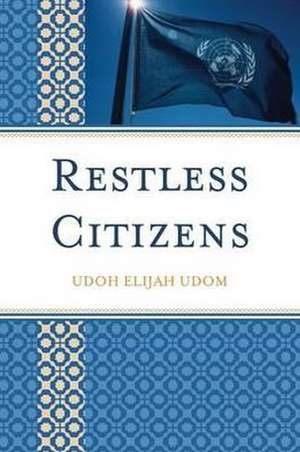
Restless Citizens
Autor Udoh Elijah Udomen Limba Engleză Paperback – 23 sep 2010
Excerpted from the foreword by David Antill, School of Law, University of Leicester - UK
Words: 60
Preț: 270.64 lei
Preț vechi: 369.35 lei
-27%
Puncte Express: 406
Carte tipărită la comandă
Livrare economică 05-19 decembrie
Livrare prin curier în România Termenul estimat este afișat lângă disponibilitate.
Transport gratuit de la 400.00 lei Plată online sau ramburs, în funcție de opțiunile comenzii.
Retur gratuit în 14 zile Comandă securizată și suport în română.
Specificații
ISBN-13: 9780761852247
ISBN-10: 0761852247
Pagini: 190
Dimensiuni: 156 x 230 x 13 mm
Greutate: 0.34 kg
Editura: Bloomsbury Publishing
Colecția Hamilton Books
Locul publicării:New York, United States
ISBN-10: 0761852247
Pagini: 190
Dimensiuni: 156 x 230 x 13 mm
Greutate: 0.34 kg
Editura: Bloomsbury Publishing
Colecția Hamilton Books
Locul publicării:New York, United States
V-ar putea interesa
-
 Emergency Sex (And Other Desperate Measures)Andrew Thomson-25%Preț: 83.61 lei111.94 lei
 -
 Imperfect Unions: Security Institutions Over Time and SpaceHelga Haftendorn-28%Preț: 520.65 lei725.88 lei
 -
 -28%Preț: 508.72 lei708.04 lei
 -
 Challenges for the New PeacekeepersTrevor Findlay-13%Preț: 316.08 lei362.95 lei
 -
 -30%Preț: 582.52 lei831.27 lei
 -
 -31%Preț: 744.62 lei1078.69 lei
 -
 -9%Preț: 362.04 lei398.69 lei
 -
 The Kosovo Report: Conflict, International Response, Lessons LearnedIndependent International Commission on Kosovo-34%Preț: 699.01 lei1054.42 lei
 -
 The UNHCR and World Politics: A Perilous PathGil Loescher-31%Preț: 598.85 lei871.14 lei
 -
 -20%Preț: 508.41 lei636.88 lei
 -
 -19%Preț: 351.80 lei435.85 lei
 -
 The Oxford Handbook on the United NationsThomas G. Weiss-8%Preț: 292.34 lei318.14 lei
 -
 -30%Preț: 422.50 lei606.29 lei
 -
 The Procedure of the UN Security CouncilLoraine Sievers-30%Preț: 1078.98 lei1531.10 lei
 -
 What's Wrong with the United Nations and How to Fix ItThomas G WeissPreț: 192.60 lei
Cuprins
Chapter 1 Foreword
Chapter 2 Prologue
Chapter 3 Acknowledgements
Part 4 Part I Introduction
Chapter 5 Chapter 1: Why I Wrote this Book
Chapter 6 Chapter 2: Becoming an International Civil Servant
Chapter 7 Chapter 3: Distressed Organizations
Chapter 8 Chapter 4: Leadership
Part 9 Part II Living with Insecurity
Chapter 10 Chapter 5: Insecurity of Life at the Duty Station
Chapter 11 Chapter 6: Insecurity of Personal Property
Chapter 12 Chapter 7: Financial Insecurity
Chapter 13 Chapter 8: Job Insecurity
Chapter 14 Chapter 9: Locally Recruited Staff
Chapter 15 Chapter 10: The Myth of Overprotection
Part 16 Part III Effects of UN Assignment on Private Life
Chapter 17 Chapter 11: The Single Life
Chapter 18 Chapter 12: Parenting
Part 19 Part IV Official Travel
Chapter 20 Chapter 15: Working in Diversity
Chapter 21 Chapter 16: Discrimination, Labeling, and Xenophobia
Chapter 22 Chapter 17: Language Proficiency
Chapter 23 Chapter 18: Change and Reform
Chapter 24 Chapter 19: Health of UN Employees
Chapter 25 Chapter 20: Deskilling
Part 26 Part VI Life after the United Nations
Chapter 27 Chapter 21: Retirement
Chapter 28 Chapter 22 Statelessness
Chapter 29 Chapter 23: Conclusion
Chapter 2 Prologue
Chapter 3 Acknowledgements
Part 4 Part I Introduction
Chapter 5 Chapter 1: Why I Wrote this Book
Chapter 6 Chapter 2: Becoming an International Civil Servant
Chapter 7 Chapter 3: Distressed Organizations
Chapter 8 Chapter 4: Leadership
Part 9 Part II Living with Insecurity
Chapter 10 Chapter 5: Insecurity of Life at the Duty Station
Chapter 11 Chapter 6: Insecurity of Personal Property
Chapter 12 Chapter 7: Financial Insecurity
Chapter 13 Chapter 8: Job Insecurity
Chapter 14 Chapter 9: Locally Recruited Staff
Chapter 15 Chapter 10: The Myth of Overprotection
Part 16 Part III Effects of UN Assignment on Private Life
Chapter 17 Chapter 11: The Single Life
Chapter 18 Chapter 12: Parenting
Part 19 Part IV Official Travel
Chapter 20 Chapter 15: Working in Diversity
Chapter 21 Chapter 16: Discrimination, Labeling, and Xenophobia
Chapter 22 Chapter 17: Language Proficiency
Chapter 23 Chapter 18: Change and Reform
Chapter 24 Chapter 19: Health of UN Employees
Chapter 25 Chapter 20: Deskilling
Part 26 Part VI Life after the United Nations
Chapter 27 Chapter 21: Retirement
Chapter 28 Chapter 22 Statelessness
Chapter 29 Chapter 23: Conclusion
Recenzii
The world is full of restless citizens and Dr. Udom in this eminently readable book paints the picture of international civil servants at the end of the twentieth century. The picture is sometimes gloomy and often exhilarating. The UN is a product of ourworld and not surprisingly it replicates the characteristics of our world. I have had the privilege of observing the international civil service from the perspective of an academic in African universities and have had the privilege of working within the system for nearly twenty years, but most importantly to observe the actors for more than a decade since retirement. The world has significantly changed but one thing is clear that the UN and its staff are necessary to the maintenance of international peace even if it is relative. I would recommend everyone to read this book, especially prospective, active, and retired servants of the non-existent world government.
This book is unique in focusing on the UN employees, especially those who do vital humanitarian work in war-torn and dysfunctional states. In striking contrast to the popular image of international officials as overpaid, underemployed, lazy, and privileged persons engaged in useless bureaucratic work, Udoh Udom presents a startling picture of an overworked and overstressed group of people struggling with insecurities of life, property, finance, and marriage, suffering from family separation, loneliness, and statelessness. This is a welcome antidote to the distorted image of a dedicated band of workers peddled by the right wing media. It should appeal to all with interest in international agencies, global development, and humanitarian work.
This book is unique in focusing on the UN employees, especially those who do vital humanitarian work in war-torn and dysfunctional states. In striking contrast to the popular image of international officials as overpaid, underemployed, lazy, and privileged persons engaged in useless bureaucratic work, Udoh Udom presents a startling picture of an overworked and overstressed group of people struggling with insecurities of life, property, finance, and marriage, suffering from family separation, loneliness, and statelessness. This is a welcome antidote to the distorted image of a dedicated band of workers peddled by the right wing media. It should appeal to all with interest in international agencies, global development, and humanitarian work.