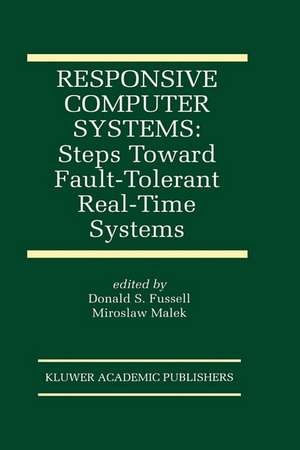
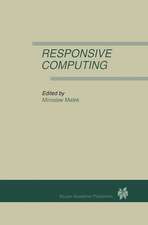
Responsive Computer Systems: Steps Toward Fault-Tolerant Real-Time Systems: The Springer International Series in Engineering and Computer Science, cartea 297
Editat de Donald Fussell, Miroslaw Maleken Limba Engleză Paperback – 31 aug 1995
Audience: An interesting and important road map to some of the most important emerging issues in computing, suitable as a secondary text for graduate level courses on responsive computer systems and as a reference for industrial practitioners.
Din seria The Springer International Series in Engineering and Computer Science
- 18%
 Preț: 1263.85 lei
 - 18%
 Preț: 921.36 lei
 - 20%
 Preț: 633.65 lei
 - 20%
 Preț: 665.64 lei
 - 20%
 Preț: 662.69 lei
 - 24%
 Preț: 876.97 lei
 - 20%
 Preț: 663.58 lei
 - 20%
 Preț: 950.07 lei
 - 20%
 Preț: 665.12 lei
 - 18%
 Preț: 903.90 lei
 - 20%
 Preț: 950.72 lei
 - 18%
 Preț: 985.84 lei
 - 15%
 Preț: 621.23 lei
 - 18%
 Preț: 979.41 lei
 - 18%
 Preț: 907.54 lei
 - 18%
 Preț: 1173.85 lei
 - 15%
 Preț: 663.24 lei
 - 18%
 Preț: 976.26 lei
 - 18%
 Preț: 904.83 lei
 - 18%
 Preț: 904.83 lei
 - 20%
 Preț: 1325.05 lei
 - 20%
 Preț: 1725.82 lei
 - 20%
 Preț: 1326.15 lei
 - 20%
 Preț: 989.14 lei
 -
 Preț: 381.30 lei
 - 20%
 Preț: 635.71 lei
 - 18%
 Preț: 1193.58 lei
 - 20%
 Preț: 622.65 lei
 - 20%
 Preț: 1319.14 lei
 - 18%
 Preț: 974.15 lei
 - 20%
 Preț: 670.15 lei
 - 15%
 Preț: 664.58 lei
 - 18%
 Preț: 1179.97 lei
 - 15%
 Preț: 670.25 lei
 - 15%
 Preț: 663.36 lei
 - 20%
 Preț: 620.83 lei
 - 18%
 Preț: 990.04 lei
 - 15%
 Preț: 660.75 lei
 - 18%
 Preț: 1266.48 lei
Preț: 1276.40 lei
Preț vechi: 1595.50 lei
-20%
Puncte Express: 1915
Carte tipărită la comandă
Livrare economică 08-22 decembrie
Livrare prin curier în România Termenul estimat este afișat lângă disponibilitate.
Transport gratuit pentru acest produs Plată online sau ramburs, în funcție de opțiunile comenzii.
Retur gratuit în 14 zile Comandă securizată și suport în română.
Specificații
ISBN-13: 9780792395638
ISBN-10: 0792395638
Pagini: 292
Ilustrații: XX, 268 p. 19 illus.
Dimensiuni: 155 x 235 x 16 mm
Greutate: 0.45 kg
Ediția:Softcover reprint of the original 1st ed. 1995
Editura: Springer
Colecția The Springer International Series in Engineering and Computer Science
Seria The Springer International Series in Engineering and Computer Science
Locul publicării:New York, NY, United States
ISBN-10: 0792395638
Pagini: 292
Ilustrații: XX, 268 p. 19 illus.
Dimensiuni: 155 x 235 x 16 mm
Greutate: 0.45 kg
Ediția:Softcover reprint of the original 1st ed. 1995
Editura: Springer
Colecția The Springer International Series in Engineering and Computer Science
Seria The Springer International Series in Engineering and Computer Science
Locul publicării:New York, NY, United States
V-ar putea interesa
-
 Error Coding for EngineersA. Houghton-15%Preț: 664.25 lei781.46 lei
 -
 Error-Control Coding for Data NetworksIrving S. Reed-20%Preț: 1038.95 lei1298.69 lei
 -
 Responsive ComputingMiroslaw Malek-20%Preț: 660.74 lei825.93 lei
 -
 -20%Preț: 926.47 lei1158.09 lei
 -
 Moving Hadoop to the CloudBill Havanki-20%Preț: 203.98 lei254.98 lei
 -
 Applied Text Analysis with PythonBenjamin Bengfort-20%Preț: 344.74 lei430.92 lei
 -
 -20%Preț: 595.49 lei744.37 lei
 -
 -20%Preț: 755.18 lei943.98 lei
 -
 -20%Preț: 623.04 lei778.80 lei
 -
 Corpus-Based Studies on Language Varieties: Experiences Et ReferencesFrancisco Alonso Almeida-20%Preț: 702.84 lei878.55 lei
 -
 Service AvailabilityMiroslaw Malek-20%Preț: 331.19 lei413.99 lei
 -
 Service AvailabilityMiroslaw Malek-20%Preț: 331.19 lei413.99 lei
 -
 Data Mining: Theory, Methodology, Techniques, and ApplicationsGraham J. Williams-20%Preț: 322.43 lei403.04 lei
 -
 Discrete Geometry for Computer ImageryAchille Braquelaire-20%Preț: 333.06 lei416.32 lei
 -
 Service AvailabilityTakashi Nanya-20%Preț: 332.03 lei415.04 lei
 -
 Service AvailabilityMiroslaw Malek-20%Preț: 328.20 lei410.26 lei
 -
 Übersetzung als KulturvermittlungCamilla Badstübner-Kizik-23%Preț: 481.94 lei625.90 lei
 -
 Interacciones / WechselwirkungenMaría Ángeles Recio Ariza-27%Preț: 1016.29 lei1392.18 lei
 -
 Translation and MeaningBarbara Lewandowska-Tomaszczyk-23%Preț: 636.81 lei827.03 lei
 -
 Fundamentals of Business Process ManagementMarlon DumasPreț: 474.18 lei
 -
 ConditionPeter Bürgisser-20%Preț: 956.68 lei1195.85 lei
 -
 Applied Parallel ComputingYuefan Deng-20%Preț: 651.35 lei814.19 lei
Public țintă
ResearchCuprins
1 A Tight Lower Bound for Processor Coordination.- 1 Introduction.- 2 Overview.- 3 The Problem.- 4 The Bermuda Triangle.- 5 The Lower Bound.- 6 Generalizing to the Partially Synchronous Model.- References.- 2 Self-Stabilizing Real-Time Decision Systems.- 1 Introduction.- 2 Related Work.- 3 A Model of Computation.- 4 Definitions and Notation.- 5 Terminating Self-Stabilizing Programs.- 6 Boolean (Finite State) Programs.- 7 Non-Terminating Self-Stabilizing Programs.- 8 Self-Stabilization and Informed Decisions.- 9 Acknowledgements.- References.- 3 Management and Scheduling of Tests for Locating Failures Dependent Upon Operation-Time in Responsive Systems.- 1 Introduction.- 2 Definitions and Notation.- 3 Assignment and Scheduling of Multiple Test Sets.- 4 The Analysis of Fault Location.- 5 A priori information analysis.- 6 Conclusion.- References.- 4 Adding Robustness in Dynamic Preemptive Scheduling.- 1 Introduction.- 2 Terminology and Assumptions.- 3 Schedulability analysis.- 4 The RED scheduling strategy.- 5 Performance Evaluation.- 6 Related Work.- 7 Conclusions.- References.- 5 Static Deadlock Analysis for CSP-Type Communications.- 1 Introduction.- 2 The Sequence Condition.- References.- 6 Comparing How Well Asynchronous Atomic Broadcast Protocols Perform.- 1 Introduction.- 2 Assumptions.- 3 Overview of Broadcast Protocols.- 4 Simulation Results.- 5 Relative Performance.- 6 Conclusion.- References.- 7 Hard Real-Time Reliable Multicast in the Dedos System.- 1 Introduction.- 2 System architecture and failure assumptions.- 3 Protocol description.- 4 Protocol analysis.- 5 Conclusion.- References.- 8 Speculative Algorithms for Concurrency Control in Responsive Databases.- 1 Introduction.- 2 RTDBMS Concurrency Control.- 3 A Generic SCC-nS Algorithm.- 4 SCC-NS Family Members.- 5 Conclusion.- References.- 9 Autonomous Transaction Managers in Responsive Computing.- 1 Introduction.- 2 System Structure and Notation.- 3 Synchronization of the Local Schedules.- 4 Effects of Transaction Aborts.- 5 Synchronization of CSR Schedules.- 6 A Pragmatic Restriction.- 7 Further Observations.- 8 Conclusions.- 9 Appendix.- References.- 10 Adaptable Fault Tolerance for Real-Time Systems.- 1 Introduction.- 2 The Three-level Framework.- 3 FERT Specification Language.- 4 Support for Scheduling.- 5 Conclusions and Discussion.- References.- 11 Fault-Tolerant Automatic Control.- 1 Introduction to the Software Fault-Tolerance Problem.- 2 The Simplex Architecture.- 3 Laboratory Experiments.- 4 Conclusion.- References.- 12 Design and Performance Evaluation of A Fault-Tolerant, Hard-Real-Time, Parallel Processor.- 1 Introduction.- 2 FTPP Overview.- 3 Overview of FTPP Scheduling.- 4 OS Performance Measurements.- 5 NE Contention Model.- 6 Conclusions.- References.