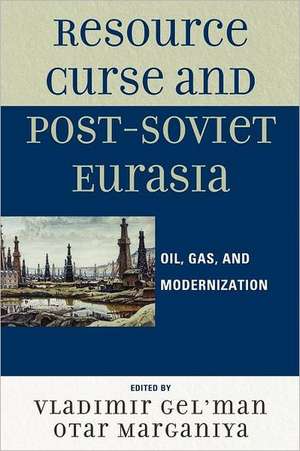
Resource Curse and Post-Soviet Eurasia: Oil, Gas, and Modernization
Autor Vladimir Gel'man, Otar Marganiya Contribuţii de Nikolay Dobronravin, Andrey Scherbak, Dmitry Travin, Andrey Zaostrovtseven Limba Engleză Paperback – 8 dec 2011
Resource Curse and Post-Soviet Eurasia: Oil, Gas, and Modernization is an in-depth analysis of the impact of oil and gas abundance on political, economic, and social developments of Russia and other post-Soviet states and nations (such as Kazakhstan and Azerbaijan). The chapters of the book systematically examine various effects of "resource curse" in different arenas such as state building, regime changes, rule of law, property rights, policy-making, interest representation, and international relations in theoretical, historical, and comparative perspectives. The authors analyze the role of oil and gas dependency in the evolution and subsequent collapse of the Soviet Union, authoritarian drift of post-Soviet countries, building of predatory state and pendulum-like swings of Russia from "state capture" of 1990s to "business capture" of 2000s, uneasy relationships between the state and special interest groups, and numerous problems of "geo-economics" of pipelines in post-Soviet Eurasia.
Preț: 343.67 lei
Preț vechi: 482.99 lei
-29%
Puncte Express: 516
Carte tipărită la comandă
Livrare economică 23 noiembrie-07 decembrie
Livrare prin curier în România Termenul estimat este afișat lângă disponibilitate.
Transport gratuit de la 400.00 lei Plată online sau ramburs, în funcție de opțiunile comenzii.
Retur gratuit în 14 zile Comandă securizată și suport în română.
Specificații
ISBN-13: 9780739143742
ISBN-10: 0739143743
Pagini: 226
Ilustrații: 9 BW Illustrations, 22 Tables
Dimensiuni: 155 x 233 x 15 mm
Greutate: 0.34 kg
Editura: Bloomsbury Publishing
Colecția Lexington Books
Locul publicării:New York, United States
ISBN-10: 0739143743
Pagini: 226
Ilustrații: 9 BW Illustrations, 22 Tables
Dimensiuni: 155 x 233 x 15 mm
Greutate: 0.34 kg
Editura: Bloomsbury Publishing
Colecția Lexington Books
Locul publicării:New York, United States
Cuprins
Chapter 1. Introduction: Resource Curse and Post-Soviet Eurasia
Chapter 2. Resource Curse: Rethinking the Soviet Experience
Chapter 3. The Impact of the "Oil Shock" on the Post-Soviet Regime Changes
Chapter 4. Oil Boom: Is It Devastating to the Property Rights and the Rule of Law?
Chapter 5. The Logic of Crony Capitalism: Big Oil, Big Politics, and Big Business in Russia
Chapter 6. Oil Boom and Government Finance in Russia: Stabilization Fund and Its Fate
Chapter 7. Oil, Gas, Transit, and Boundaries: Problems of "Transport Curse"
Chapter 8. Oil, Gas, and Modernization of Global South: African Lessons for Post-Soviet States
Chapter 9. Conclusion: Oil, Gas, Russia and 2008-2009 Economic Crisis
Chapter 2. Resource Curse: Rethinking the Soviet Experience
Chapter 3. The Impact of the "Oil Shock" on the Post-Soviet Regime Changes
Chapter 4. Oil Boom: Is It Devastating to the Property Rights and the Rule of Law?
Chapter 5. The Logic of Crony Capitalism: Big Oil, Big Politics, and Big Business in Russia
Chapter 6. Oil Boom and Government Finance in Russia: Stabilization Fund and Its Fate
Chapter 7. Oil, Gas, Transit, and Boundaries: Problems of "Transport Curse"
Chapter 8. Oil, Gas, and Modernization of Global South: African Lessons for Post-Soviet States
Chapter 9. Conclusion: Oil, Gas, Russia and 2008-2009 Economic Crisis
Recenzii
This collection of writings about the 'Resource Curse' by scholars from Russia who are familiar with Western and Russian literature provides valuable perspectives on the discussion about Eurasia in Eurasia. The 'multicolored and multifaceted patchwork' promised in the introduction is a plan more than overfulfilled.
This is an elegantly written and eminently researched volume on Russia's key dilemma: the oil curse. These modern Russian scholars sensibly suggest that Russia's energy curse is severe but not insurmountable. This is the best book on oil and Russia to date and an enjoyable read.
Several major themes explored in this well-written, well-researched volume on the causes, mechanisms, and consequences of Eurasia's resource curse relate to the relationship among resource dependency, economic development, and the institutional environment....A worthwhile read. The introduction is exceptional in putting the subject matter into perspective....Summing Up: Highly recommended.
This book is relevant both for those interested in the development of the energy-rich countries of post - Soviet Eurasia and for those interested in the debate about the existence and effects of the resource curse. Its multidisciplinary approach is sensible. Its gloomy view of future prospects echoes that of a wide stratum of the present-day Russian intelligentsia. The contributors are familiar with both the English and Russian literatures on the subjects they discuss. Their conclusions are thought-provoking. Let us hope that they are also action-provoking.
In the words of Gel'man, the book offers 'a kind of multicolored and multifaceted patchwork, which is not only designed to sew interdisciplinary scholarly pluralism into a coherent picture, but also stimulate cross-fertilization aimed to supplement the research contribution of each of the chapters' (p. 11). Overall, the book appeals by continuing the analysis of the resource-regime interconnection in a worldwide comparative perspective and aims to make a contribution not only to area studies but also to 'intensive discussions on the causes, mechanisms, and consequences of the resource curse in general' (p. 18). It seems to fulfill this task.
This is an elegantly written and eminently researched volume on Russia's key dilemma: the oil curse. These modern Russian scholars sensibly suggest that Russia's energy curse is severe but not insurmountable. This is the best book on oil and Russia to date and an enjoyable read.
Several major themes explored in this well-written, well-researched volume on the causes, mechanisms, and consequences of Eurasia's resource curse relate to the relationship among resource dependency, economic development, and the institutional environment....A worthwhile read. The introduction is exceptional in putting the subject matter into perspective....Summing Up: Highly recommended.
This book is relevant both for those interested in the development of the energy-rich countries of post - Soviet Eurasia and for those interested in the debate about the existence and effects of the resource curse. Its multidisciplinary approach is sensible. Its gloomy view of future prospects echoes that of a wide stratum of the present-day Russian intelligentsia. The contributors are familiar with both the English and Russian literatures on the subjects they discuss. Their conclusions are thought-provoking. Let us hope that they are also action-provoking.
In the words of Gel'man, the book offers 'a kind of multicolored and multifaceted patchwork, which is not only designed to sew interdisciplinary scholarly pluralism into a coherent picture, but also stimulate cross-fertilization aimed to supplement the research contribution of each of the chapters' (p. 11). Overall, the book appeals by continuing the analysis of the resource-regime interconnection in a worldwide comparative perspective and aims to make a contribution not only to area studies but also to 'intensive discussions on the causes, mechanisms, and consequences of the resource curse in general' (p. 18). It seems to fulfill this task.