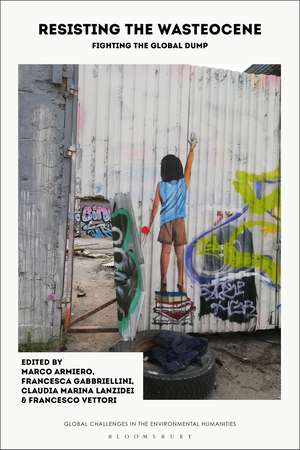
Resisting the Wasteocene: Fighting the Global Dump: Global Challenges in the Environmental Humanities
Editat de Dr Marco Armiero, Francesca Gabbriellini, Claudia Marina Lanzidei, Francesco Vettorien Limba Engleză Hardback – 18 feb 2027
Across case studies from Eastern Europe, Bangladesh, China, Senegal, Cuba, Italy, and more-and drawing on history, anthropology, cultural studies, and geography-it maps the toxic infrastructures that silence and normalize injustice. With its global, interdisciplinary scope and provocative critique of Anthropocene discourse, this volume makes the Wasteocene visible while opening possible pathways for resisting and escaping it.

Preț: 566.07 lei
Preț vechi: 831.66 lei
-32% Precomandă
Puncte Express: 849
Carte nepublicată încă
Livrare prin curier în România Precomanda se expediază când titlul devine disponibil.
Transport gratuit pentru acest produs Plată online sau ramburs, în funcție de opțiunile comenzii.
Retur gratuit în 14 zile Comandă securizată și suport în română.
Doresc să fiu notificat când acest titlu va fi disponibil:
Se trimite...
Specificații
ISBN-13: 9781350546431
ISBN-10: 1350546437
Pagini: 272
Ilustrații: 8 bw illus
Dimensiuni: 156 x 234 mm
Greutate: 0.5 kg
Editura: Bloomsbury Publishing
Colecția Bloomsbury Academic
Seria Global Challenges in the Environmental Humanities
Locul publicării:London, United Kingdom
ISBN-10: 1350546437
Pagini: 272
Ilustrații: 8 bw illus
Dimensiuni: 156 x 234 mm
Greutate: 0.5 kg
Editura: Bloomsbury Publishing
Colecția Bloomsbury Academic
Seria Global Challenges in the Environmental Humanities
Locul publicării:London, United Kingdom
Cuprins
1. Introduction, Marco Armiero (University of Santiago de Compostela, Spain)
2. Organizing the Human: Subverting the Wasteocene, Melanie Samson (University of Johannesburg, South Africa)
3. Commoning, Consumption, and the Body on Montevideo's Waste-scape, Patrick O'Hare (University of St Andrews, UK)
4. Circular Logics: Proposals and Counter-Proposals for Extended Producer Responsibility, Christine Hegel (Western Connecticut State University, USA) and Taylor Cass Talbott (International Alliance of Waste Pickers, North America)
5. Decolonizing the Wasteocene: the Black female collectivity of Brazilian waste pickers, Dieric Guimarães (Federal University of Bahia, Brazil) and Flavia Maximo
6. The Dump in Cuba, Claudia Lanzidei (Independent Researcher, Italy)
7. Waste as a lens: Unpicking toxic narratives of climate migrants in Dakar and Saint Louis, Senegal, Sarah Walker (University of Bologna, Italy)
8. Green Ship Recycling: A Toxic Narrative of the Wasteocene? Camelia Dewan (Uppsala University, Sweden)
9. Wasting Peace: Environmental Violence and its Vicissitudes in Post-war Bosnia and Herzegovina, Damir Arsenijevic (University of Tuzla, Bosnia and Herzegovina)
10. Culinary Garbo-politics: Marginalized communities, discarded foods, and repressive governmentalities in India, Sayan Dey (Bayan College, Oman) & Tias Maity (Alliance University, Bangalore)
11. The Socialist Experience of Waste and Recycling from Soviet Ukraine to State-Socialist Hungary, Viktor Pál (University of Ostrava, Czechia) and Tetiana Perga (National Academy of Sciences of Ukraine)
12. In the cracks of the Wasteocene. Building circular communities through solidarity networks in central Italy, Francesco Vettori (University of Bologna, Italy)
13. Wasteocene as Method: Reimagining Narratives, Value(s) and Commons, Julie Sze (University of California, Davis, USA)
14. The Waste of the West? Sandra Swart (Stellenbosch University, South Africa)
15. What Would a Multispecies Wasteocene Look Like? Lingjing Wu (Renmin University of China)
16. Wasting the World. Class, Capital & Cheap Toxification in the Capitalist World-Ecology, Jason Moore (Binghamton University, USA)
17. Conclusion, Claudia Marina Lanzidei (Independent Researcher, Italy) and Francesco Vettori (University of Bologna, Italy)
2. Organizing the Human: Subverting the Wasteocene, Melanie Samson (University of Johannesburg, South Africa)
3. Commoning, Consumption, and the Body on Montevideo's Waste-scape, Patrick O'Hare (University of St Andrews, UK)
4. Circular Logics: Proposals and Counter-Proposals for Extended Producer Responsibility, Christine Hegel (Western Connecticut State University, USA) and Taylor Cass Talbott (International Alliance of Waste Pickers, North America)
5. Decolonizing the Wasteocene: the Black female collectivity of Brazilian waste pickers, Dieric Guimarães (Federal University of Bahia, Brazil) and Flavia Maximo
6. The Dump in Cuba, Claudia Lanzidei (Independent Researcher, Italy)
7. Waste as a lens: Unpicking toxic narratives of climate migrants in Dakar and Saint Louis, Senegal, Sarah Walker (University of Bologna, Italy)
8. Green Ship Recycling: A Toxic Narrative of the Wasteocene? Camelia Dewan (Uppsala University, Sweden)
9. Wasting Peace: Environmental Violence and its Vicissitudes in Post-war Bosnia and Herzegovina, Damir Arsenijevic (University of Tuzla, Bosnia and Herzegovina)
10. Culinary Garbo-politics: Marginalized communities, discarded foods, and repressive governmentalities in India, Sayan Dey (Bayan College, Oman) & Tias Maity (Alliance University, Bangalore)
11. The Socialist Experience of Waste and Recycling from Soviet Ukraine to State-Socialist Hungary, Viktor Pál (University of Ostrava, Czechia) and Tetiana Perga (National Academy of Sciences of Ukraine)
12. In the cracks of the Wasteocene. Building circular communities through solidarity networks in central Italy, Francesco Vettori (University of Bologna, Italy)
13. Wasteocene as Method: Reimagining Narratives, Value(s) and Commons, Julie Sze (University of California, Davis, USA)
14. The Waste of the West? Sandra Swart (Stellenbosch University, South Africa)
15. What Would a Multispecies Wasteocene Look Like? Lingjing Wu (Renmin University of China)
16. Wasting the World. Class, Capital & Cheap Toxification in the Capitalist World-Ecology, Jason Moore (Binghamton University, USA)
17. Conclusion, Claudia Marina Lanzidei (Independent Researcher, Italy) and Francesco Vettori (University of Bologna, Italy)
Recenzii
Resisting the Wasteocene is more than a book-it is an invitation to participate in a profound conversation with some of the most creative minds among us.