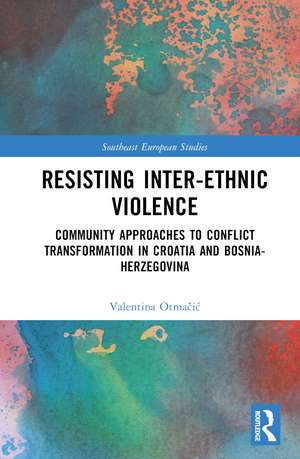
Resisting Inter-Ethnic Violence: Community Approaches to Conflict Transformation in Croatia and Bosnia-Herzegovina: Southeast European Studies
Autor Valentina Otmačićen Limba Engleză Hardback – 2 dec 2024
This volume will contribute to the ongoing debates of scholars and practitioners on the causes and consequences of violent conflicts, and the related practical approaches to violence prevention and peacebuilding. Highly relevant to scholars and students in peace and conflict studies, political science, international relations, security studies, history, sociology, and social psychology, it willalso be of great interest to policy makers and practitioners in conflict management, conflict transformation and local governance.
Din seria Southeast European Studies
- 9%
 Preț: 1331.96 lei
 -
 Preț: 397.12 lei
 -
 Preț: 415.97 lei
 -
 Preț: 430.28 lei
 - 18%
 Preț: 1115.65 lei
 -
 Preț: 421.21 lei
 - 18%
 Preț: 1059.16 lei
 - 18%
 Preț: 1057.86 lei
 - 18%
 Preț: 1055.31 lei
 -
 Preț: 459.46 lei
 -
 Preț: 414.40 lei
 -
 Preț: 419.12 lei
 - 18%
 Preț: 1057.86 lei
 -
 Preț: 419.64 lei
 -
 Preț: 425.04 lei
 -
 Preț: 433.72 lei
 -
 Preț: 400.78 lei
 -
 Preț: 423.12 lei
 - 18%
 Preț: 1119.00 lei
 - 18%
 Preț: 1247.84 lei
 - 18%
 Preț: 1058.11 lei
 - 15%
 Preț: 433.41 lei
 - 15%
 Preț: 459.55 lei
 -
 Preț: 402.32 lei
 -
 Preț: 413.05 lei
 -
 Preț: 405.33 lei
 - 18%
 Preț: 1064.05 lei
 -
 Preț: 438.69 lei
 -
 Preț: 425.04 lei
 -
 Preț: 407.17 lei
 - 18%
 Preț: 1299.03 lei
 -
 Preț: 428.67 lei
 - 18%
 Preț: 1149.96 lei
 - 18%
 Preț: 1056.72 lei
 - 18%
 Preț: 1057.86 lei
Preț: 1056.72 lei
Preț vechi: 1288.68 lei
-18%
Puncte Express: 1585
Carte tipărită la comandă
Livrare economică 30 noiembrie-14 decembrie
Livrare prin curier în România Termenul estimat este afișat lângă disponibilitate.
Transport gratuit pentru acest produs Plată online sau ramburs, în funcție de opțiunile comenzii.
Retur gratuit în 14 zile Comandă securizată și suport în română.
Specificații
ISBN-13: 9781032762807
ISBN-10: 1032762802
Pagini: 188
Dimensiuni: 156 x 234 mm
Greutate: 0.42 kg
Ediția:1
Editura: Taylor & Francis
Colecția Routledge
Seria Southeast European Studies
Locul publicării:Oxford, United Kingdom
ISBN-10: 1032762802
Pagini: 188
Dimensiuni: 156 x 234 mm
Greutate: 0.42 kg
Ediția:1
Editura: Taylor & Francis
Colecția Routledge
Seria Southeast European Studies
Locul publicării:Oxford, United Kingdom
Public țintă
Postgraduate and Undergraduate AdvancedNotă biografică
Valentina Otmačić is a scholar and practitioner in the fields of conflict transformation, peace and human rights. Affiliated to the Center for Peace and Conflict Studies of the University of Rijeka (Croatia), she holds a Ph.D. in Peace Studies from the University of Bradford (UK).
Cuprins
1. Introduction: the importance of oases of peace in the deserts of war 2. On the road to violence: tracing the evolution of ethnic violence and segregation in the former Yugoslavia 3. Alternative voices: collective struggles of resistance to ethnic violence and segregation 4. Gorski kotar (Croatia): where the only intolerance is towards war 5. Tuzla (Bosnia-Herzegovina): citizen’s option as an antidote to ethnic violence 6. The courage not to hate: comparative analysis of the cases of Gorski kotar and Tuzla 7. Conclusions: towards a framework of constructive community resistance to ethnic(ized) violence
Recenzii
In this excellent comparative study Valentina Otmačić explores the processes through which ordinary people create effective mechanisms for the prevention of inter-ethnic violence. This is an empirically rich, innovative, and analytically rigorous study that makes an important contribution to peace studies.
Siniša Malešević, University College, Dublin and CNAM, Paris
For many years, the analytical framework of choice for scholars of ex-Yugoslavia has been ethnic nationalism as seen through the prism of violence and trauma. Through sensitive ethnography and incisive analysis, this important book challenges and indeed, elevates our understanding of the local-level processes where destructive outcomes of conflict not only have but can be averted.
Daphne Winland, York University
Valentina Otmačić makes an important contribution to the literature of political violence by focusing on the ways that some communities, which she calls the oases of peace, resisted the divisions and the violence that ensued in other communities during the same time.
Mila Dragojević, the University of the South
Otmačić’s study is innovative in its theoretical considerations, but it is also ethnographically rich. Moreover, it furthers our understanding of the dynamics of conflict transformation and should, for this reason, be considered required reading for researchers and students of peace and conflict studies, particularly but not only in the post-Yugoslav space.
Tamara Banjeglav, Institute of Culture and Memory Studies, Research Centre of the Slovenian Academy of Sciences and Arts (ZRC SAZU), Ljubljana, Slovenia
La obra desafía la visión mainstream de las guerras que descuartizaron Yugoslavia como luchas étnicas consecuencia de antagonismos históricos de corte nacionalista y religioso. Para ello, el libro ofrece una visión más compleja y completa a la comprensión convencional del derecho, la ciencia política y las humanidades acerca de la paz y la violencia al aportar ideas previamente inexploradas sobre las dinámicas locales de colaboración interétnica.
The work challenges the mainstream view of the wars of dissolution of Yugoslavia as ethnic conflicts resulting from historical antagonisms of a nationalist and religious nature. To this end, the book offers a more complex and comprehensive perspective than the conventional understanding in law, political science, and the humanities regarding peace and violence, by providing previously unexplored insights into the local dynamics of interethnic collaboration.
- Jose Angel Ruiz Jimenez, Profesor Titular de Universidad, Universidad de Granada, IPAZ
Siniša Malešević, University College, Dublin and CNAM, Paris
For many years, the analytical framework of choice for scholars of ex-Yugoslavia has been ethnic nationalism as seen through the prism of violence and trauma. Through sensitive ethnography and incisive analysis, this important book challenges and indeed, elevates our understanding of the local-level processes where destructive outcomes of conflict not only have but can be averted.
Daphne Winland, York University
Valentina Otmačić makes an important contribution to the literature of political violence by focusing on the ways that some communities, which she calls the oases of peace, resisted the divisions and the violence that ensued in other communities during the same time.
Mila Dragojević, the University of the South
Otmačić’s study is innovative in its theoretical considerations, but it is also ethnographically rich. Moreover, it furthers our understanding of the dynamics of conflict transformation and should, for this reason, be considered required reading for researchers and students of peace and conflict studies, particularly but not only in the post-Yugoslav space.
Tamara Banjeglav, Institute of Culture and Memory Studies, Research Centre of the Slovenian Academy of Sciences and Arts (ZRC SAZU), Ljubljana, Slovenia
La obra desafía la visión mainstream de las guerras que descuartizaron Yugoslavia como luchas étnicas consecuencia de antagonismos históricos de corte nacionalista y religioso. Para ello, el libro ofrece una visión más compleja y completa a la comprensión convencional del derecho, la ciencia política y las humanidades acerca de la paz y la violencia al aportar ideas previamente inexploradas sobre las dinámicas locales de colaboración interétnica.
The work challenges the mainstream view of the wars of dissolution of Yugoslavia as ethnic conflicts resulting from historical antagonisms of a nationalist and religious nature. To this end, the book offers a more complex and comprehensive perspective than the conventional understanding in law, political science, and the humanities regarding peace and violence, by providing previously unexplored insights into the local dynamics of interethnic collaboration.
- Jose Angel Ruiz Jimenez, Profesor Titular de Universidad, Universidad de Granada, IPAZ
Descriere
This book analyses the 1991 to 1995 war experiences of communities who resisted identity-based violence and segregation in Croatia and Bosnia-Herzegovina. It will interest scholars in peace and conflict studies, security studies and social psychology, as well as policy makers in conflict management and local governance.