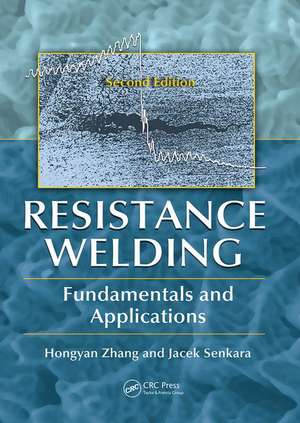
Resistance Welding: Fundamentals and Applications, Second Edition
Autor Hongyan Zhang, Jacek Senkaraen Limba Engleză Paperback – 31 mar 2017
New to the Second Edition:
- Significant addition of the metallurgical aspects of materials involved in resistance welding, such as steels, aluminum and magnesium alloys, zinc, and copper
- Electric current waveforms commonly used in resistance welding, including single-phase AC, single-phase DC, three-phase DC, and MFDC
- Magnesium welding in terms of cracking and expulsion
- The effect of individual welding parameters
- 2-D and 3-D lobe diagrams
- New materials for the ultrasonic evaluation of welds, including A-scan, B-scan, and in-line A-scan
To obtain a broad understanding of this area, readers previously had to scour large quantities of research on resistance welding and essential related subjects, such as statistical analysis. This book collects the necessary information in one source for students, researchers, and practitioners in the sheet metal industry. It thoroughly reviews state-of-the-art results in resistance welding research and gives you a solid foundation for solving practical problems in a scientific and systematic manner.
Preț: 799.39 lei
Preț vechi: 974.86 lei
-18%
Puncte Express: 1199
Carte tipărită la comandă
Livrare economică 20 noiembrie-04 decembrie
Livrare prin curier în România Termenul estimat este afișat lângă disponibilitate.
Transport gratuit pentru acest produs Plată online sau ramburs, în funcție de opțiunile comenzii.
Retur gratuit în 14 zile Comandă securizată și suport în română.
Specificații
ISBN-13: 9781138075245
ISBN-10: 1138075248
Pagini: 472
Ilustrații: 223; 43 Tables, black and white; 372 Illustrations, black and white
Dimensiuni: 178 x 254 x 25 mm
Greutate: 0.87 kg
Ediția:2. Auflage
Editura: CRC Press
Colecția CRC Press
ISBN-10: 1138075248
Pagini: 472
Ilustrații: 223; 43 Tables, black and white; 372 Illustrations, black and white
Dimensiuni: 178 x 254 x 25 mm
Greutate: 0.87 kg
Ediția:2. Auflage
Editura: CRC Press
Colecția CRC Press
V-ar putea interesa
-
 The Aerial Photo SourcebookMary Rose Collins-30%Preț: 502.83 lei720.37 lei
 -
 Mechanics of MachineryMahmoud A. Mostafa-15%Preț: 545.20 lei641.41 lei
 -
 Motor Fleet Safety and Security ManagementDaniel E. Della-Giustina-15%Preț: 693.79 lei816.23 lei
 -
 -18%Preț: 695.24 lei847.85 lei
 -
 Electric Safety: Practice and StandardsMohamed A. El-Sharkawi-15%Preț: 544.48 lei640.56 lei
Public țintă
Professional Practice & DevelopmentCuprins
Welding Metallurgy. Electrothermal Processes of Welding. Weld Discontinuities. Mechanical Testing. Resistance Welding Process Monitoring and Control. Weld Quality and Inspection. Expulsion in Resistance Spot Welding. Influence of Mechanical Characteristics of Welding Machines. Numerical Simulation in Resistance Spot Welding. Statistical Design, Analysis, and Inference in Resistance Welding Research. Index.
Notă biografică
Dr. Hongyan Zhang is an associate professor in the Department of Mechanical, Industrial, and Manufacturing Engineering at the University of Toledo. He has published over 70 peer-reviewed journal and conference papers and contributed to a number of American Welding Society Standards. His research interests include materials, forming, welding, and mechanical fastening; manufacturing process monitoring and control; failure analysis; structural optimization; and hybrid propulsion systems.
Dr. Jacek Senkara is a professor of the Production Engineering Faculty at Warsaw University of Technology. He has published roughly 100 scientific and technical papers in professional journals and conference proceedings and served as a principal investigator for a number of government, industry, and university-supported research projects. His research interests include materials aspects of welding and welding-related processes, along with the surface modification of materials.
Dr. Jacek Senkara is a professor of the Production Engineering Faculty at Warsaw University of Technology. He has published roughly 100 scientific and technical papers in professional journals and conference proceedings and served as a principal investigator for a number of government, industry, and university-supported research projects. His research interests include materials aspects of welding and welding-related processes, along with the surface modification of materials.
Recenzii
"The second edition has made a great book even better. It remains a significant, practical aid to anyone interested in a better understanding of resistance welding science and it should be considered for their library."
—Welding Journal, February 2013Praise for the First Edition:
"The chapters are easy to comprehend, and the topics are presented in a 'big picture' basis. … General concepts are the highlight. … There are 20 to 40 references at the end of each chapter, and most of the chapters begin with a good literature, which then allows this book to be used as an introduction to welding at the graduate level in an engineering discipline."
—JOM Online, March 2006
"[this book] will almost certainly find its way into the library of anyone who needs or wants to understand the physics behind resistance spot welding … [It offers] a detailed analysis of the physics involved in the resistance welding process that is, for the most part, remarkably easy to understand. … They [the authors] have also reinforced their methodical explanations with nearly 300 original graphics … For both the student and process user, there is a lot of basic information presented in an easy-to-read fashion … For theoretical studies or laboratory work, there is a bounty of information beyond the excellent compilation of reference materials. It might be too soon to proclaim this work as historically significant, but it seems a virtual certainty that it will be viewed as such. In any case, the authors have certainly done a great service to the resistance welding industry."
—David Beneteau, CenterLine Ltd., Windsor, Ontario, Canada
—Welding Journal, February 2013Praise for the First Edition:
"The chapters are easy to comprehend, and the topics are presented in a 'big picture' basis. … General concepts are the highlight. … There are 20 to 40 references at the end of each chapter, and most of the chapters begin with a good literature, which then allows this book to be used as an introduction to welding at the graduate level in an engineering discipline."
—JOM Online, March 2006
"[this book] will almost certainly find its way into the library of anyone who needs or wants to understand the physics behind resistance spot welding … [It offers] a detailed analysis of the physics involved in the resistance welding process that is, for the most part, remarkably easy to understand. … They [the authors] have also reinforced their methodical explanations with nearly 300 original graphics … For both the student and process user, there is a lot of basic information presented in an easy-to-read fashion … For theoretical studies or laboratory work, there is a bounty of information beyond the excellent compilation of reference materials. It might be too soon to proclaim this work as historically significant, but it seems a virtual certainty that it will be viewed as such. In any case, the authors have certainly done a great service to the resistance welding industry."
—David Beneteau, CenterLine Ltd., Windsor, Ontario, Canada
Descriere
Drawing on state-of-the-art research results, this second edition presents fundamental aspects of important processes in resistance welding and discusses their implications on real-world welding applications. This updated edition incorporates many new features: more metallurgical aspects of materials, such as steels, aluminum and magnesium alloys, zinc, and copper; commonly used electric current waveforms; and magnesium welding in terms of cracking and expulsion. Along with new 2-D and 3-D lobe diagrams, it discusses the effect of individual welding parameters and new materials for the ultrasonic evaluation of welds.