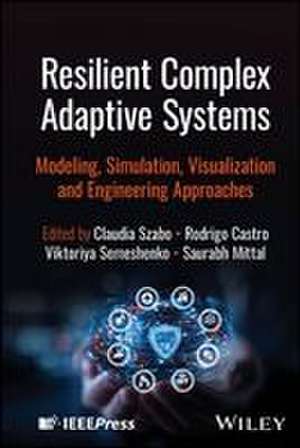
Resilient Complex Adaptive Systems: Modeling, Simu lation, Visualization and Engineering Approaches
Editat de Claudia Szabo, Rodrigo Castro, Viktoriya Semeshenko, Saurabh Mittalen Limba Engleză Hardback – 8 oct 2026
Resilient Complex Adaptive Systems: Modeling, Simulation, Visualization and Engineering Approaches demonstrates how modeling, simulation, and visualization facilitate the analysis, design, implementation, and deployment of resilient CAS. Across 17 chapters, this edited volume examines existing research from multiple perspectives, addressing emergent behavior, control and decision making, and utilization of advanced analytics using AI and machine learning with practical examples throughout.
The volume captures lessons learned from CAS modeling across application domains including economics, crisis management, biology, Internet of Things, defense, and ecology. Four structured goals guide readers from domain-specific MS&V foundations through emergent behavior design approaches and AI/ML-enabled analytics to the formulation of functional and resilient CAS engineering principles.
Readers will also find:
- Approaches for leveraging AI and machine learning to support control and decision making within resilient complex adaptive systems
- Multi-domain case studies spanning economics, defense, ecology, biology, and crisis management that illustrate CAS modeling techniques
- Methods for designing emergent behavior properties in systems of interacting agents using state-of-the-art simulation frameworks
- Engineering approaches that extend acquired modeling knowledge toward building functional CAS with targeted resilience characteristics
- Visualization techniques that support analysis of global-level properties arising from agent-based complex adaptive system interactions
Preț: 772.15 lei
Preț vechi: 1002.80 lei
-23% Nou
Puncte Express: 1158
Carte disponibilă
Livrare economică 13-27 noiembrie
Livrare prin curier în România Termenul estimat este afișat lângă disponibilitate.
Transport gratuit pentru acest produs Plată online sau ramburs, în funcție de opțiunile comenzii.
Retur gratuit în 14 zile Comandă securizată și suport în română.
Specificații
ISBN-13: 9781394326273
ISBN-10: 1394326270
Pagini: 576
Dimensiuni: 161 x 239 x 40 mm
Greutate: 0.92 kg
Editura: John Wiley & Sons, Inc.
ISBN-10: 1394326270
Pagini: 576
Dimensiuni: 161 x 239 x 40 mm
Greutate: 0.92 kg
Editura: John Wiley & Sons, Inc.
Notă biografică
Claudia Szabo, PhD, is a Professor leading the Complex Systems Research group at the University of Adelaide. She has authored over 100 papers spanning simulation, model driven engineering, systems of systems, self-adaptive systems, reinforcement learning, and multi-agent systems.
Rodrigo Castro, PhD, is a Professor in the Department of Computer Science at the University of Buenos Aires. He leads the Discrete Event Simulation Laboratory and is Deputy Director of the Computer Science Institute. He has over 30 years' experience in the software industry with over 100 publications in modeling and simulation, including DEVS, Modelica, AI, hybrid and complex adaptive systems, spanning socio-natural and cyber-physical applications.
Viktoriya Semeshenko, PhD, is a Researcher leading the Complex Systems and Networks Laboratory (CSNetlab) at the Interdisciplinary Institute of Political Economy, University of Buenos Aires. She has authored over 30 publications applying network science, complexity, ABM and System Dynamics to socioeconomic systems, labor markets, and AI-driven structural change.
Saurabh Mittal, PhD, is a Director, JSE/SCARS at FlightSafety International. Previously, he was a Complex Systems Engineering - SME at Modern Technology Solution, Inc. and spent a decade as M&S SME at the MITRE Corporation. He has co-authored over 100 publications including 5 books covering DEVS, complex systems M&S, cyber-physical systems and cloud-enabled simulation systems.
Rodrigo Castro, PhD, is a Professor in the Department of Computer Science at the University of Buenos Aires. He leads the Discrete Event Simulation Laboratory and is Deputy Director of the Computer Science Institute. He has over 30 years' experience in the software industry with over 100 publications in modeling and simulation, including DEVS, Modelica, AI, hybrid and complex adaptive systems, spanning socio-natural and cyber-physical applications.
Viktoriya Semeshenko, PhD, is a Researcher leading the Complex Systems and Networks Laboratory (CSNetlab) at the Interdisciplinary Institute of Political Economy, University of Buenos Aires. She has authored over 30 publications applying network science, complexity, ABM and System Dynamics to socioeconomic systems, labor markets, and AI-driven structural change.
Saurabh Mittal, PhD, is a Director, JSE/SCARS at FlightSafety International. Previously, he was a Complex Systems Engineering - SME at Modern Technology Solution, Inc. and spent a decade as M&S SME at the MITRE Corporation. He has co-authored over 100 publications including 5 books covering DEVS, complex systems M&S, cyber-physical systems and cloud-enabled simulation systems.
Cuprins
List of Contributors xvii
Foreword xxiii
About the Editors xxv
Notes on Contributors xxvii
Preface xxxviii
Part I RCAS Foundations 1
1 Modeling and Simulation of Resilient Complex Adaptive Systems 3
Claudia Szabo, Rodrigo Castro, Saurabh Mittal, and Viktoriya Semeshenko
2 Emergent Behavior in Resilient Complex Adaptive Systems: Challenges, Metrics, and Engineering Approach 31
Saurabh Mittal, Claudia Szabo, Rodrigo Castro, and Viktoriya Semeshenko
3 Epistemology of Resilient Complex Adaptive System Simulations 63
Andreas Tolk
Part II Modeling Formalisms and Their Applications 95
4 From ABM Back to Real Data: Time Series Visualization and Model Selection in the K+S Agent-based Model 97
Giovanni Dosi, Marcelo Pereira, Gabriel Petrini, Andrea Roventini, and Maria Enrica Virgillito
5 Self-aware Models with Explanatory Capabilities: Learning Explanatory Models from Simulation Experiments 143
Levent Yilmaz
6 Multi-agent Reinforcement Learning for Decision-making in Contested Environments 169
Ishan Honhaga, Anh Viet Do, Eyoel Teffera, Ant Perry, Rob Baker, and Claudia Szabo
7 Intersectoral Labor Mobility in Argentina: Evolution and Resilience 183
Viktoriya Semeshenko and Sergio A. DeRaco
8 A Novel Integrated Agent-based Computational Economics and Multi-agent Reinforcement Learning Framework: Application to Macrocrisis Phenomena 203
Rodrigo Castro, Viktoriya Semeshenko, and Pablo Mira
9 DEVS as a Method to Design Resilient Complex Adaptive Systems 231
Hazel Griffith, Cristina Ruiz-Martin, and Gabriel Wainer
10 A Framework for Characterizing, Understanding, and Predicting Behavior in Complex Edge Computing Systems 271
Kevin S. Chan and Frank T. Johnsen
Part III RCAS Engineering 309
11 Resilience-aware Development Tools: Translating Resilience Concepts into Engineering Practice 311
Kelly J. Neville, Tracy Sanders, Emily Barrett, Theresa Fersch, Glenn Lematta, Xuan Chau, Andrew Langone, and Emily S. Patterson
12 Artificial Intelligence Networks: Structure, Dynamics, and Economics 339
Oscar M. Granados and Nicolás Dela Peña
13 Resilient Complex Adaptive Systems: A Communications Perspective 365
Bradley Fraser and Rhett Hull
14 Scalable Rigidity Maintenance Strategies for Networked Multirobot Systems: Overcoming Decentralized Coordination Challenges 395
J. Francisco Presenza, Ezequiel Pecker-Marcosig, Ignacio Mas, J. Ignacio Alvarez-Hamelin, and Juan I. Giribet
Part IV Digital Twins and Socio-ecological Applications 425
15 Immersive and Cognitive Urban Digital Twins for Sustainable and Resilient Smart Territories 427
Mamadou K. Traoré, Mama Diakité, and Zeeshan Ali
16 The Role of Digital Twins in Improving River Water Quality 441
Souvik Barat, Shankar Kausley, Puneet Singh Thakur, Surabhi Shrivastava, Vinay Kulkarni, and Beena Rai
17 Integrating Simulation and Real-world Models for Harmful Algal and Cyanobacterial Blooms Management 469
José L. Risco-Mart¿¿n, Roberto Dom¿¿nguez, Román Cárdenas, Eva Besada-Portas, and Segundo Esteban
18 Optimal Strategies to Contain and Prevent the Spread of Diseases in Group-structured Populations 491
VarunK. Rao, Siddharth Patwardhan, and Filippo Radicchi
Part V Next Steps 503
19 Research Agenda for Resilient Complex Adaptive Systems 505
Claudia Szabo, Rodrigo Castro, Saurabh Mittal, and Viktoriya Semeshenko
References 519
Acronyms 523
Index 525
Foreword xxiii
About the Editors xxv
Notes on Contributors xxvii
Preface xxxviii
Part I RCAS Foundations 1
1 Modeling and Simulation of Resilient Complex Adaptive Systems 3
Claudia Szabo, Rodrigo Castro, Saurabh Mittal, and Viktoriya Semeshenko
2 Emergent Behavior in Resilient Complex Adaptive Systems: Challenges, Metrics, and Engineering Approach 31
Saurabh Mittal, Claudia Szabo, Rodrigo Castro, and Viktoriya Semeshenko
3 Epistemology of Resilient Complex Adaptive System Simulations 63
Andreas Tolk
Part II Modeling Formalisms and Their Applications 95
4 From ABM Back to Real Data: Time Series Visualization and Model Selection in the K+S Agent-based Model 97
Giovanni Dosi, Marcelo Pereira, Gabriel Petrini, Andrea Roventini, and Maria Enrica Virgillito
5 Self-aware Models with Explanatory Capabilities: Learning Explanatory Models from Simulation Experiments 143
Levent Yilmaz
6 Multi-agent Reinforcement Learning for Decision-making in Contested Environments 169
Ishan Honhaga, Anh Viet Do, Eyoel Teffera, Ant Perry, Rob Baker, and Claudia Szabo
7 Intersectoral Labor Mobility in Argentina: Evolution and Resilience 183
Viktoriya Semeshenko and Sergio A. DeRaco
8 A Novel Integrated Agent-based Computational Economics and Multi-agent Reinforcement Learning Framework: Application to Macrocrisis Phenomena 203
Rodrigo Castro, Viktoriya Semeshenko, and Pablo Mira
9 DEVS as a Method to Design Resilient Complex Adaptive Systems 231
Hazel Griffith, Cristina Ruiz-Martin, and Gabriel Wainer
10 A Framework for Characterizing, Understanding, and Predicting Behavior in Complex Edge Computing Systems 271
Kevin S. Chan and Frank T. Johnsen
Part III RCAS Engineering 309
11 Resilience-aware Development Tools: Translating Resilience Concepts into Engineering Practice 311
Kelly J. Neville, Tracy Sanders, Emily Barrett, Theresa Fersch, Glenn Lematta, Xuan Chau, Andrew Langone, and Emily S. Patterson
12 Artificial Intelligence Networks: Structure, Dynamics, and Economics 339
Oscar M. Granados and Nicolás Dela Peña
13 Resilient Complex Adaptive Systems: A Communications Perspective 365
Bradley Fraser and Rhett Hull
14 Scalable Rigidity Maintenance Strategies for Networked Multirobot Systems: Overcoming Decentralized Coordination Challenges 395
J. Francisco Presenza, Ezequiel Pecker-Marcosig, Ignacio Mas, J. Ignacio Alvarez-Hamelin, and Juan I. Giribet
Part IV Digital Twins and Socio-ecological Applications 425
15 Immersive and Cognitive Urban Digital Twins for Sustainable and Resilient Smart Territories 427
Mamadou K. Traoré, Mama Diakité, and Zeeshan Ali
16 The Role of Digital Twins in Improving River Water Quality 441
Souvik Barat, Shankar Kausley, Puneet Singh Thakur, Surabhi Shrivastava, Vinay Kulkarni, and Beena Rai
17 Integrating Simulation and Real-world Models for Harmful Algal and Cyanobacterial Blooms Management 469
José L. Risco-Mart¿¿n, Roberto Dom¿¿nguez, Román Cárdenas, Eva Besada-Portas, and Segundo Esteban
18 Optimal Strategies to Contain and Prevent the Spread of Diseases in Group-structured Populations 491
VarunK. Rao, Siddharth Patwardhan, and Filippo Radicchi
Part V Next Steps 503
19 Research Agenda for Resilient Complex Adaptive Systems 505
Claudia Szabo, Rodrigo Castro, Saurabh Mittal, and Viktoriya Semeshenko
References 519
Acronyms 523
Index 525