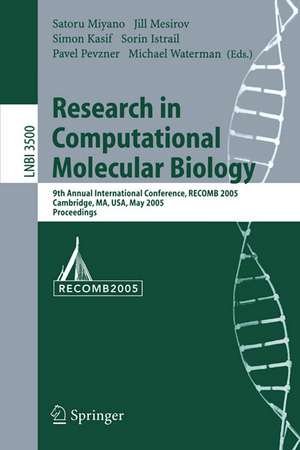
Research in Computational Molecular Biology
Editat de Satoru Miyano, Jill Mesirov, Simon Kasif, Sorin Istrail, Pavel Pevzner, Michael Watermanen Limba Engleză Paperback – 28 apr 2005
Preț: 641.91 lei
Preț vechi: 802.39 lei
-20%
Puncte Express: 963
Carte tipărită la comandă
Livrare economică 08-22 iunie
Specificații
ISBN-13: 9783540258667
ISBN-10: 3540258663
Pagini: 652
Ilustrații: XVII, 632 p.
Dimensiuni: 155 x 235 x 35 mm
Greutate: 0.97 kg
Ediția:2005
Editura: Springer
Locul publicării:Berlin, Heidelberg, Germany
ISBN-10: 3540258663
Pagini: 652
Ilustrații: XVII, 632 p.
Dimensiuni: 155 x 235 x 35 mm
Greutate: 0.97 kg
Ediția:2005
Editura: Springer
Locul publicării:Berlin, Heidelberg, Germany
V-ar putea interesa
-
 Weapons of Math DestructionCathy O'Neil-32%Preț: 59.85 lei88.41 lei
 -
 An Introduction to Quantum ComputingPhillip Kaye-23%Preț: 417.70 lei540.40 lei
 -
 -27%Preț: 343.56 lei468.04 lei
 -
 Algorithmic PuzzlesAnany Levitin-32%Preț: 222.42 lei325.10 lei
 -
 Algorithms UnlockedThomas H. Cormen-27%Preț: 181.37 lei248.88 lei
 -
 Computational Genome AnalysisRichard C Deonier-15%Preț: 582.25 lei685.00 lei
 -
 Computational Methods in Molecular BiologyS.L. Salzberg-23%Preț: 498.33 lei647.19 lei
 -
 Concentration of Measure for the Analysis of Randomized AlgorithmsDevdatt P. Dubhashi-20%Preț: 306.07 lei382.59 lei
 -
 Bioinformatics for BiologistsPavel Pevzner-8%Preț: 479.08 lei520.73 lei
 -
 -9%Preț: 843.32 lei926.73 lei
 -
 -20%Preț: 300.78 lei375.97 lei
 -
 -18%Preț: 1170.25 lei1427.14 lei
 -
 Combinatorial Pattern MatchingAlexander S. Kulikov-20%Preț: 322.59 lei403.23 lei
 -
 Applications of Evolutionary ComputationGiovanni Squillero-20%Preț: 320.50 lei400.63 lei
 -
 Digital Logic for ComputingJohn Seiffertt-20%Preț: 487.41 lei609.27 lei
 -
 Algorithmic Aspects of Cloud ComputingTimos Sellis-20%Preț: 316.83 lei396.04 lei
 -
 Algorithms and ComplexityDimitris Fotakis-20%Preț: 332.81 lei416.02 lei
 -
 -20%Preț: 319.10 lei398.88 lei
 -
 Experimental and Efficient AlgorithmsSotiris E. Nikoletseas-20%Preț: 641.69 lei802.12 lei
 -
 Spatial Information TheoryAnthony G. Cohn-20%Preț: 333.02 lei416.28 lei
 -
 Graph TransformationsAndrea Corradini-20%Preț: 332.01 lei415.02 lei
 -
 Parameterized and Exact ComputationHans L. Bodlaender-20%Preț: 321.94 lei402.43 lei
 -
 Provenance and Annotation of DataIan Foster-20%Preț: 322.59 lei403.23 lei
 -
 Graph-Theoretic Concepts in Computer ScienceFedor V. Fomin-20%Preț: 326.05 lei407.56 lei
 -
 Algorithms and ComputationTetsuo Asano-20%Preț: 330.75 lei413.43 lei
 -
 -20%Preț: 326.42 lei408.02 lei
 -
 Algorithmics of Matching Under PreferencesDavid Manlove-20%Preț: 1068.15 lei1335.19 lei
Public țintă
ResearchCuprins
Efficient Algorithms for Detecting Signaling Pathways in Protein Interaction Networks.- Efficient Algorithms for Detecting Signaling Pathways in Protein Interaction Networks.- Towards an Integrated Protein-Protein Interaction Network.- The Factor Graph Network Model for Biological Systems.- Pairwise Local Alignment of Protein Interaction Networks Guided by Models of Evolution.- Finding Novel Transcripts in High-Resolution Genome-Wide Microarray Data Using the GenRate Model.- Efficient Calculation of Interval Scores for DNA Copy Number Data Analysis.- Keynote.- A Regulatory Network Controlling Drosophila Development.- Keynote.- Yeast Cells as a Discovery Platform for Neurodegenerative Disease.- RIBRA–An Error-Tolerant Algorithm for the NMR Backbone Assignment Problem.- Avoiding Local Optima in Single Particle Reconstruction.- A High-Throughput Approach for Associating microRNAs with Their Activity Conditions.- RNA-RNA Interaction Prediction and Antisense RNA Target Search.- Consensus Folding of Unaligned RNA Sequences Revisited.- Keynote.- Discovery and Annotation of Genetic Modules.- Efficient q-Gram Filters for Finding All ?-Matches over a Given Length.- A Polynomial Time Solvable Formulation of Multiple Sequence Alignment.- A Fundamental Decomposition Theory for Phylogenetic Networks and Incompatible Characters.- Reconstruction of Reticulate Networks from Gene Trees.- A Hybrid Micro-Macroevolutionary Approach to Gene Tree Reconstruction.- Constructing a Smallest Refining Galled Phylogenetic Network.- Keynote.- Mapping Molecular Landscapes Inside Cells.- Information Theoretic Approaches to Whole Genome Phylogenies.- Maximum Likelihood of Evolutionary Trees Is Hard.- Graph Theoretical Insights into Evolution of Multidomain Proteins.- Peptide Sequence Tags for FastDatabase Search in Mass-Spectrometry.- A Hidden Markov Model Based Scoring Function for Mass Spectrometry Database Search.- EigenMS: De Novo Analysis of Peptide Tandem Mass Spectra by Spectral Graph Partitioning.- Keynote.- Biology as Information.- Using Multiple Alignments to Improve Gene Prediction.- Learning Interpretable SVMs for Biological Sequence Classification.- Segmentation Conditional Random Fields (SCRFs): A New Approach for Protein Fold Recognition.- Rapid Protein Side-Chain Packing via Tree Decomposition.- Recognition of Binding Patterns Common to a Set of Protein Structures.- Predicting Protein-Peptide Binding Affinity by Learning Peptide-Peptide Distance Functions.- Keynote.- Amino Acid Sequence Control of the Folding of the Parallel ?-Helix, the Simplest ?-Sheet Fold.- A Practical Approach to Significance Assessment in Alignment with Gaps.- Alignment of Optical Maps.- Keynote.- Engineering Gene Regulatory Networks: A Reductionist Approach to Systems Biology.- Modeling the Combinatorial Functions of Multiple Transcription Factors.- Predicting Transcription Factor Binding Sites Using Structural Knowledge.- Motif Discovery Through Predictive Modeling of Gene Regulation.- HAPLOFREQ – Estimating Haplotype Frequencies Efficiently.- Improved Recombination Lower Bounds for Haplotype Data.- A Linear-Time Algorithm for the Perfect Phylogeny Haplotyping (PPH) Problem.- Keynote.- Human Genome Sequence Variation and the Inherited Basis of Common Disease.- Stability of Rearrangement Measures in the Comparison of Genome Sequences.- On Sorting by Translocations.