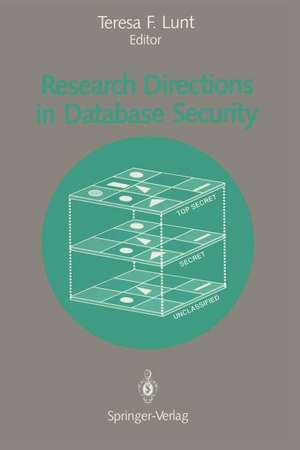
Research Directions in Database Security
Editat de Teresa F. Lunten Limba Engleză Paperback – 16 apr 1992
Preț: 321.39 lei
Preț vechi: 401.74 lei
-20%
Puncte Express: 482
Carte tipărită la comandă
Livrare economică 23 noiembrie-07 decembrie
Livrare prin curier în România Termenul estimat este afișat lângă disponibilitate.
Transport gratuit de la 400.00 lei Plată online sau ramburs, în funcție de opțiunile comenzii.
Retur gratuit în 14 zile Comandă securizată și suport în română.
Specificații
ISBN-13: 9780387977362
ISBN-10: 0387977368
Pagini: 280
Ilustrații: XIV, 265 p. 2 illus.
Dimensiuni: 155 x 235 x 16 mm
Greutate: 0.43 kg
Ediția:Softcover reprint of the original 1st ed. 1992
Editura: Springer
Locul publicării:New York, NY, United States
ISBN-10: 0387977368
Pagini: 280
Ilustrații: XIV, 265 p. 2 illus.
Dimensiuni: 155 x 235 x 16 mm
Greutate: 0.43 kg
Ediția:Softcover reprint of the original 1st ed. 1992
Editura: Springer
Locul publicării:New York, NY, United States
V-ar putea interesa
-
 Hacking Exposed 7Stuart McClure-34%Preț: 294.94 lei450.08 lei
 -
 -43%Preț: 297.38 lei523.56 lei
 -
 Cyber GuerillaJelle Van Haaster-36%Preț: 207.70 lei323.08 lei
 -
 CryptoSteven Levy-20%Preț: 121.81 lei152.26 lei
 -
 -40%Preț: 46.49 lei77.11 lei
 -
 Computer Forensics For DummiesCarol Pollard-20%Preț: 167.68 lei209.59 lei
 -
 Malware Analyst's Cookbook and DVDMichael Ligh-20%Preț: 411.12 lei513.90 lei
 -
 Computer Security 3eDieter Gollmann-20%Preț: 453.20 lei566.50 lei
 -
 The Art of DeceptionKevin D. Mitnick-20%Preț: 65.28 lei81.60 lei
 -
 Hackers. 25th Anniversary EditionSteven Levy-20%Preț: 152.27 lei190.33 lei
 -
 -35%Preț: 325.22 lei496.70 lei
 -
 -18%Preț: 231.07 lei282.91 lei
 -
 Seven Deadliest Web Application AttacksMike Shema-33%Preț: 110.10 lei165.20 lei
 -
 Information Security and Cryptology -- ICISC 2012Taekyoung Kwon-20%Preț: 333.82 lei417.28 lei
Public țintă
ResearchCuprins
1 Workshop Summary.- 1.1 Introduction.- 1.2 Labels.- 1.3 Aggregation.- 1.4 Discretionary Security.- 1.5 The Homework Problem.- 1.6 Classification Semantics.- 1.7 Assurance.- 1.8 New Approaches.- 1.9 Classifying Metadata.- 1.10 Conclusions.- 1.11 References.- 2 SeaView.- 2.1 Introduction.- 2.2 Multilevel Security.- 2.3 Multilevel Relations.- 2.4 Discretionary Security.- 2.5 Multilevel SQL.- 2.6 The SeaView Verification.- 2.7 The SeaView Design.- 2.8 Data Design Considerations.- 2.9 Conclusions.- 2.10 References.- 3 A1 Secure DBMS Architecture.- 3.1 Introduction.- 3.2 The A1 Secure DBMS Modes of Operation.- 3.3 The A1 Secure DBMS Security Policy Overview.- 3.4 A1 Secure DBMS Architecture.- 3.5 Why is ASD Needed.- 3.6 For Further Information.- 3.7 References.- 4 An Investigation of Secure Distributed DBMS Architectures.- 4.1 Introduction.- 4.2 Concept of Operation.- 4.3 Security Policy Overview.- 4.4 Architecture Definition.- 4.5 Discretionary Access Control Enforcement.- 4.6 Summary and Conclusions.- 4.7 References.- 5 LOCK Data Views.- 5.1 Introduction.- 5.2 LOCK Security Policy Overview.- 5.3 Pipelines.- 5.4 Conclusions.- 5.5 References.- 6 Sybase Secure SQL Server.- 6.1 Introduction.- 6.2 Terms and Definitions.- 6.3 Objectives.- 6.4 B2 Design Philosophy.- 6.5 Flow of Control.- 6.6 Trusted Operations.- 6.7 Auditing.- 6.8 Conclusions.- 7 An Evolution of Views.- 7.1 Introduction.- 7.2 References.- 8 Discussion: Pros and Cons of the Various Approaches.- 8.1 Introduction.- 8.2 Inference Problem.- 8.3 Aggregation Problem.- 8.4 Retrospective.- 8.5 References.- 9 The Homework Problem.- 10 Report on the Homework Problem.- 10.1 Introduction.- 10.2 The Example Database.- 10.3 Summary.- 11 Classifying and Downgrading: Is a Human Needed in the Loop.- 11.1 Introduction.- 11.2 The Issue.- 11.3 The Answer.- 11.4 Structured Data.- 11.5 Security Semantics of an Application.- 11.6 Types of Security Semantics.- 11.7 Textual Data.- 11.8 Summary.- 11.9 References.- 12 Session Report: The Semantics of Data Classification.- 12.1 Introduction.- 12.2 References.- 13 Inference and Aggregation.- 13.1 Introduction.- 13.2 Database Inference.- 13.3 The Inference Problem.- 13.4 Analysis of Logical Inference Problems.- 13.5 General Discussion.- 13.6 References.- 14 Dynamic Classification and Automatic Sanitization.- 14.1 Introduction.- 14.2 Sanitization.- 14.3 Initial Overclassification.- 14.4 Initial Underclassification.- 14.5 Discovered Misclassification.- 14.6 Automatic Classification.- 14.7 References.- 15 Presentation and Discussion on Balanced Assurance.- 15.1 Introduction.- 15.2 References.- 16 Some Results from the Entity/Relationship Multilevel Secure DBMS Project.- 16.1 Project Goals and Assumptions.- 16.2 A Multilevel Entity/Relationship Model.- 16.3 Results of Research.- 16.4 Conclusions.- 16.5 References.- 17 Designing a Trusted Application Using an Object-Oriented Data Model.- 17.1 Introduction.- 17.2 The Object-Oriented Data Model.- 17.3 The SMMS as an Object-Oriented Database.- 17.4 Conclusion and Future Directions.- 17.5 References.- 18 Foundations of Multilevel Databases.- 18.1 Introduction.- 18.2 Definitional Preliminaries.- 18.3 Model Theoretic Approach.- 18.4 Proof Theoretic Approach.- 18.5 Environments and Fixed Points.- 18.6 Environments and Inference.- 18.7 Handling Negative and Indefinite Information.- 18.8 Formal Semantics of Time.- 18.9 Other Related Topics.- 18.10 Conclusion.- 18.11 References.- 19 An Application Perspective on DBMS Security Policies.- 19.1 Introduction.- 19.2 Problems with Automatic Polyinstantiation.- 19.3 Problems withView-Based Controls and Constraints.- 19.4 Requirement for Transaction Authorizations.- 19.5 Summary.- 19.6 References.- 20 New Approaches to Database Security: Report on Discussion.- 20.1 Introduction.- 20.2 Report on Discussion.- 20.3 Conclusion.- 20.4 References.- 21 Metadata and View Classification.- 21.1 Introduction.- 21.2 Justification for Metadata Protection.- 21.3 Metadata Classification Approaches.- 21.4 Metadata Protection Schemes.- 21.5 User Access to Metadata.- 21.6 Affect of User Session Level on Data Classification.- 22 Database Security Research at NCSC.- 22.1 Introduction.- 22.2 Sponsored Research Projects.- 22.3 The Future.- 22.4 Discussion Topics.- 23 Position Paper on DBMS Security.- 23.1 Introduction.- 23.2 Conclusions.