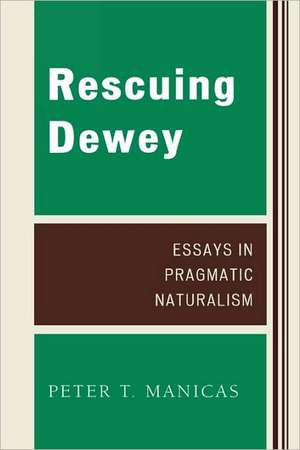
Rescuing Dewey: Essays in Pragmatic Naturalism: Studies in Ethics and Economics
Autor Peter T. Manicasen Limba Engleză Hardback – 7 aug 2008
While it is true that Dewey rejected insurrectionary politics and was no "fire-eating leftist," his analysis of the present was radical in the sense that it went straight to the roots. Peter T. Manicas examines how this made Dewey's politics similar to those of Marx in many crucial ways and the positive effort of these essays places Dewey's naturalism at the forefront, resolving some of the tensions and misunderstandings stemming from his body of work. Doing so requires serious reconsideration of some of his most characteristic views on philosophy-especially of logic and epistemology-science, and democracy.

Preț: 731.06 lei
Preț vechi: 1149.70 lei
-36%
Puncte Express: 1097
Carte tipărită la comandă
Livrare economică 20 noiembrie-04 decembrie
Livrare prin curier în România Termenul estimat este afișat lângă disponibilitate.
Transport gratuit pentru acest produs Plată online sau ramburs, în funcție de opțiunile comenzii.
Retur gratuit în 14 zile Comandă securizată și suport în română.
Specificații
ISBN-13: 9780739125151
ISBN-10: 073912515X
Pagini: 323
Dimensiuni: 162 x 238 x 30 mm
Greutate: 0.66 kg
Editura: Bloomsbury Publishing
Colecția Lexington Books
Seria Studies in Ethics and Economics
Locul publicării:New York, United States
ISBN-10: 073912515X
Pagini: 323
Dimensiuni: 162 x 238 x 30 mm
Greutate: 0.66 kg
Editura: Bloomsbury Publishing
Colecția Lexington Books
Seria Studies in Ethics and Economics
Locul publicării:New York, United States
V-ar putea interesa
-
 The True BelieverEric HofferPreț: 94.94 lei
 -
 Pluralism: Against the Demand for ConsensusNicholas Rescher-29%Preț: 461.62 lei647.84 lei
 -
 Contemporary Political Philosophy: An IntroductionWill Kymlicka-21%Preț: 405.79 lei510.84 lei
 -
 Preț: 358.72 lei
 -
 Why Read Mill Today?John SkorupskiPreț: 226.50 lei
 -
 A World beyond Politics? – A Defense of the Nation–StatePierre Manent-23%Preț: 428.89 lei557.00 lei
 -
 -42%Preț: 125.62 lei216.35 lei
 -
 General Theory of Law and StateHans KelsenPreț: 379.00 lei
 -
 The Function of CriticismTerry EagletonPreț: 111.49 lei
 -
 Sexuality in the Field of VisionJacqueline RosePreț: 102.14 lei
 -
 The Metastases of EnjoymentSlavoj ZizekPreț: 128.24 lei
 -
 Preț: 266.12 lei
 -
 For They Know Not What They DoSlavoj ZizekPreț: 147.42 lei
 -
 Infancy and HistoryGiorgio AgambenPreț: 92.46 lei
 -
 Strategy of DeceptionPaul VirilioPreț: 78.33 lei
Cuprins
Chapter 1 Table of Contents
Chapter 2 Acknowledgments
Chapter 3 Introduction
Part 4 I: Pragmatism and Science
Chapter 5 1. Pragmatic Philosophy of Science and the Charge of Scientism
Chapter 6 2. John Dewey and American Psychology
Chapter 7 3. John Dewey and American Social Science
Chapter 8 4. Culture and Nature
Part 9 II: Not Another Epistemology
Chapter 10 5. Naturalism and Subjectivism
Chapter 11 6. Naturalizing Epistemology: Recent Developments in Psychology and the Sociology of Knowledge
Part 12 III: Democracy
Chapter 13 7. American Democracy: A New Spirit in the World
Chapter 14 8. John Dewey: Anarchism and the Political State
Chapter 15 9. Philosophy and Politics: A Historical Approach to Marx and Dewey
Chapter 16 10. John Dewey and Problem of Justice
Chapter 17 11. Liberalism's Discontent: America in Search for the Past that Never Was
Part 18 IV: Why Not Dewey?
Chapter 19 12. The Evasion of Philosophy
Chapter 20 13. Democratic Hope
Chapter 21 14. Analytic Pragmatism
Chapter 22 15. Post-Modern Pragmatism
Chapter 23 References
Chapter 24 Index
Chapter 2 Acknowledgments
Chapter 3 Introduction
Part 4 I: Pragmatism and Science
Chapter 5 1. Pragmatic Philosophy of Science and the Charge of Scientism
Chapter 6 2. John Dewey and American Psychology
Chapter 7 3. John Dewey and American Social Science
Chapter 8 4. Culture and Nature
Part 9 II: Not Another Epistemology
Chapter 10 5. Naturalism and Subjectivism
Chapter 11 6. Naturalizing Epistemology: Recent Developments in Psychology and the Sociology of Knowledge
Part 12 III: Democracy
Chapter 13 7. American Democracy: A New Spirit in the World
Chapter 14 8. John Dewey: Anarchism and the Political State
Chapter 15 9. Philosophy and Politics: A Historical Approach to Marx and Dewey
Chapter 16 10. John Dewey and Problem of Justice
Chapter 17 11. Liberalism's Discontent: America in Search for the Past that Never Was
Part 18 IV: Why Not Dewey?
Chapter 19 12. The Evasion of Philosophy
Chapter 20 13. Democratic Hope
Chapter 21 14. Analytic Pragmatism
Chapter 22 15. Post-Modern Pragmatism
Chapter 23 References
Chapter 24 Index
Recenzii
This study is stunningly good in more ways than it is possible to summarize briefly: above all, an author, whose erudition is as wide-ranging as his acumen is deep-cutting, has written a timely work in which historical contextualization and philosophical probity are perfectly balanced. John Dewey is rescued by Peter T. Manicas from narrow and reductive readings; thereby he is made available as a truly contemporary contributor to intellectual debates of broad human significance and debates concerning democratic practices and political deliberation, as much as science and inquiry. Dewey's pragmatic naturalism has no more informed, insightful, and indeed eloquent champion than Peter Manicas; and here Manicas is unquestionably at the top of his game.
This collection of essays is an important contribution to this debate and will undoubtedly inspire further discussion about the proper placement of Dewey in the history of political thought.
Peter T. Manicas offers his readers a wide-ranging and highly original tour of Dewey's work, set against the backdrop of more than a century of developments in epistemology, political philosophy, and sociology. Confidently evoking a huge cast of characters, and taking on Dewey's friends as well as his foes, he provides fresh insights into the complexities of Dewey's thought and its continuing relevance for democratic life.
This collection of essays is an important contribution to this debate and will undoubtedly inspire further discussion about the proper placement of Dewey in the history of political thought.
Peter T. Manicas offers his readers a wide-ranging and highly original tour of Dewey's work, set against the backdrop of more than a century of developments in epistemology, political philosophy, and sociology. Confidently evoking a huge cast of characters, and taking on Dewey's friends as well as his foes, he provides fresh insights into the complexities of Dewey's thought and its continuing relevance for democratic life.