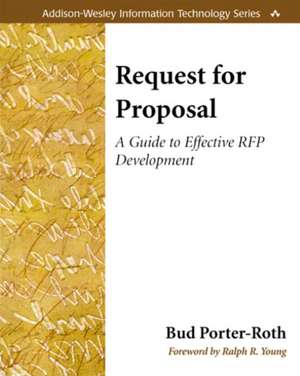
Request for Proposal
Autor Debbie Lafferty, Bud Porter-Rothen Limba Engleză Paperback – 21 dec 2001
Considerăm că succesul oricărei achiziții majore, fie că vorbim de sectorul public sau privat, depinde critic de claritatea documentației inițiale. În Request for Proposal, abordarea este una eminamente practică, axată pe raportul direct dintre structura logică a documentului și calitatea răspunsurilor primite de la furnizori. Nu este un volum de teorie managerială, ci un manual tehnic care oferă specificații concrete și exemple de limbaj pentru fiecare secțiune a unui RFP. Complementar lui The Complete Guide to RFPs for Libraries, care se concentrează pe nevoile specifice ale instituțiilor de învățământ și bibliotecilor, volumul semnat de Bud Porter-Roth acoperă zona achizițiilor de tehnologie și servicii la nivel generalist, fiind aplicabil oricărui domeniu de business. Observăm o progresie logică a conținutului: de la faza de planificare și identificare a furnizorilor, până la analiza anatomică a cerințelor tehnice și a criteriilor de evaluare. Structura cărții permite o navigare rapidă, capitolele fiind organizate pentru a servi drept liste de verificare. Recomandăm atenția sporită acordată anexelor, unde autorii au inclus calendare de proiect și instrumente de analiză care pot fi implementate imediat. Stilul de redactare este precis, eliminând jargonul inutil în favoarea unor instrucțiuni care să prevină erorile comune de interpretare. Prin compararea exemplelor de bune practici cu cele deficitare, autorii oferă un filtru de calitate esențial pentru orice responsabil de achiziții care dorește să obțină soluții optime la prețuri competitive.
Preț: 332.22 lei
Preț vechi: 415.28 lei
-20%
Carte în stoc
Livrare din stoc 05 septembrie
Specificații
ISBN-10: 0201775751
Pagini: 336
Ilustrații: illustrations
Dimensiuni: 195 x 235 x 19 mm
Greutate: 0.64 kg
Ediția:1
Editura: Pearson Education
Locul publicării:Boston, United States
V-ar putea interesa
-
 Mastering the Requirements ProcessAdrian Reed-20%Preț: 340.05 lei425.06 lei
 -
 Thinking, Fast and SlowDaniel Kahneman-27%Preț: 88.62 lei121.40 leiRecomandat
 -
 Preț: 106.10 lei
 -
 Million Dollar Consulting ProposalsAlan WeissPreț: 145.62 lei
 -
 Writing Business Bids and Proposals For DummiesCharlie DivinePreț: 146.52 lei
 -
 How to Measure Anything in Project ManagementDouglas W. HubbardPreț: 345.57 lei
 -
 Dashboards That DeliverAndy CotgreavePreț: 209.70 lei
 -
 Microsoft 365 PowerPoint For DummiesDoug Lowe-20%Preț: 141.80 lei177.26 lei
 -
 SharePoint For DummiesKen Withee-20%Preț: 118.48 lei148.10 lei
 -
 Grant Writing with AI For DummiesSheryl Lindsell-RobertsPreț: 128.18 lei
 -
 Solopreneur Business For DummiesCarly RiesPreț: 111.69 lei
 -
 Agile Project Management For DummiesMark C LaytonPreț: 168.29 lei
 -
 Quick LeadershipSelena RezvaniPreț: 107.09 lei
 -
 Microsoft 365 Excel All-in-One For DummiesDavid H Ringstrom-20%Preț: 233.30 lei291.63 lei
 -
 The Consultant's HandbookSamir ParikhPreț: 175.30 lei
 -
 Coding For Dummies, All New EditionPaul McFedries-20%Preț: 114.90 lei143.62 lei
 -
 Agentic AI For DummiesPam Baker-20%Preț: 143.39 lei179.24 lei
 -
 The Essential Book of AIAnne Rooney-20%Preț: 74.07 lei92.59 lei
 -
 -8%Preț: 599.13 lei651.24 lei
 -
 ClickJake KnappPreț: 135.45 lei
De ce să citești această carte
Recomandăm această resursă specialiștilor în achiziții și managerilor de proiect care au nevoie de un sistem riguros pentru selecția furnizorilor. Cititorul câștigă acces la expertiza unui consultant de top, primind șabloane de limbaj și instrumente de analiză care reduc timpul de pregătire a documentației. Este o investiție în precizia procesului de selecție, asigurând un cadru echitabil și transparent pentru toate părțile implicate.
Despre autor
Bud Porter-Roth este un consultant de înaltă tehnologie recunoscut internațional, specializat în definirea nevoilor tehnologice și scrierea documentațiilor de tip RFP. Experiența sa practică este vastă, ocupând anterior funcții de manager de propuneri în cadrul unor organizații de prestigiu precum Ford Aerospace, Tandem Computers, Plexus Computers și TRW. Dincolo de activitatea de consultanță, acesta susține seminare pentru echipe de management și analiști de sistem, fiind o voce autoritară în domeniul managementului ofertelor și al achizițiilor strategice.
Descriere
The expert guide to writing successful RFPs -- from the world's leading RFP consultant!
- A systematic guide to constructing RFPs that encourage productive, useful vendor responses -- and avoiding the common pitfalls of RFP development.
- Detailed example language, analysis tools, and practical resources for jumpstarting RFP development.
- An invaluable resource for everyone creating RFPs in business or government for any purchase.
When done right, RFPs enable businesses and government agencies to fairly evaluate competing proposals while reviewing the broadest possible range of potential solutions. All too often, however, RFPs fail to meet these goals, because their creators simply don't understand how to create them effectively. In this book, the world's leading RFP consultant offers realistic, specific, start-to-finish guidance for every professional called upon to write RFPs. Bud Porter-Roth covers every step of the RFP process, offering specific language examples that demonstrate both best practices and worst practices to avoid. He shows how to ensure that RFPs contain information that is sufficiently accurate and detailed; how to ensure clarity of presentation, structure, and organization that encourages productive responses; and how to avoid the most common pitfalls of the RFP process. The book includes detailed coverage of writing each section of the typical RFP, including administrative, technical, management, pricing, and evaluation sections; as well as extensive practical guidance on planning and preparation. Appendices present complete RFP examples, preparation instructions, analysis tools, calendars, and other resources for jumpstarting RFP development.Bud Porter-Roth is a high-technology consultant who specializes in helping clients define their technology needs, writing RFPs for technology acquisition, reviewing and evaluating vendor proposals, and providing support through implementation. A frequent speaker on the topic of writing effective RFPs, he is author of Proposal Development, Third Edition: How to Respond & Win the Bid.
Cuprins
1. Introduction to Writing RFPs.
Introduction.What is Presented in this RFP Book?Different Types of RFPs.Request for Information (RFI).Request for Proposal (RFP).Why Write an RFP?RFP Development and Preparation.RFP Project Development.Evaluation Criteria.Reviewing the RFP.Anatomy of an RFP.Project Overview and Administrative Information.Technical Requirements.Management Requirements.Supplier Qualifications and References.Suppliers' Section.Pricing Section.Contracts and License Agreements Section.Appendices.RFP Activities.PreRFP Activities.Identifying Suppliers.Qualifying Suppliers.RFP Activities.PostRFP Activities.The Importance of the RFP from a Contract Perspective.Conclusion.
2. RFP Planning and Preparation.
Introduction.PreRFP Planning Considerations.Project Organization.Project Organization.Project Schedule.Technology and Supplier Education.Budget Development.The Project Acquisition Budget.Post-RFP Planning Considerations.Project Development and Implementation.Additional Post-RFP Activities.Conclusion.
3. RFP Administration Requirements Section Introduction.
How to use this Chapter.Anatomy of an Administration Section.RFP Overview.Supplier and Supplier Reference Information.Company Confidential Information.Intent to Bid.Proprietary Information Notice.Supplier Confidential Information.Subcontracting.RFP Contacts.RFP Questions and Answers.Responding to Supplier Questions.RFP Reference Library.RFP Schedule.PreProposal Conference.Proposal Format Requirements.The Cover Letter or Transmittal Letter.The Executive Summary Required in Proposals.Pricing Section (Cost Section).Best and Final Offers.Alternate Proposals.Compliance Matrix.Informational Paragraphs in the Administrative Section.Definition of Requirements.Production Environment for Hardware and Software Products.Errors or Omissions in Proposals.Proposal Evaluation Criteria.Proposal Costs and Expenses.Product Demonstrations.Notifying Winning and Losing Suppliers.Proposal Debriefing.What Should Not Appear in the Administrative Section.Conclusion.
4. RFP Technical Requirements Section.
Introduction.Writing Requirements for the Technical Section.Definition of a Requirement.Who Writes Requirements?How Do Suppliers Recognize Requirements in Your RFP?What Is the Difference between Specifications and Requirements?Requirements can Be Written as Questions, Statements, or Narrative Description.Qualities of Well Written Requirements.Requirements Must Reflect Real Products or Solutions.Requirements Must Be Unambiguous.Requirements Must Not Use Subjective Terms.Requirements Must Be Measurable.Requirements Must Be Meaningful.Requirements Must Be Complete.Requirements Must Not Include the Solution.Requirements Must Not Include Unnecessary Characteristics.Developing Technical Requirements.Illustrating Requirements.Anatomy of a Technical Section.Current Business Environment.Current Technical Environment.Proposed Technical Environment.A Note on Hardware Requirements.A Note on System Software Requirements.Application Requirements.Conclusion.Suggested Readings.
5. Management Requirements Section.
Introduction.Writing Requirements for the Management Section.Examples of Poorly Written Requirements.Anatomy of a Management Section.Project Plan.Project Schedule.Site Preparation Plan and Personnel Responsibilities.Project Staffing Requirements.Roles and Responsibilities.Design, Development, and Implementation.Project Change Control.Delivery and Installation.Testing.System Maintenance and Support.Training.Documentation.Standards.Project Cutover.Supplier Issues and Concerns.Conclusion.
6. Pricing.
Introduction.Anatomy of a Pricing Section.Introduction.Hardware.System Software.Application Software.Custom Software Development.Consumables.Project Implementation and Management Services.Maintenance and Support.Training.Documentation.Other Costs Not Specifically Requested.Organizing the Price Section.Validating Prices.Other Pricing Notes.Contracts and License Agreements Section.Fixed Price Contract.Time and Materials (T&M).Associated Contract Considerations.Evaluation of Price Proposals.Conclusion.
7. Evaluation Guidelines.
Introduction.The Evaluation Team.Evaluation Considerations.Evaluation Criteria in the RFP.Getting Started Evaluating Proposals.Requests for Clarification.Other Considerations for the Evaluation Team.Anatomy of an Evaluation Section.Technical Evaluation.Management Evaluation.Price Evaluation.Oral Presentations and Demonstrations.The Evaluation Process.Introduction.Preliminary Evaluation.Second Round of Evaluations.Detailed Evaluations.The Shortlist.Developing the Scoring Methodology.Evaluation Report.Conclusion.
Appendix A. Administrative Information.
Appendix B. Supplier Information.
Appendix C. Proposal Preparation Instructions.
Appendix D. Budget Planning and Investment Analysis.
Appendix E. Nondisclosure Agreement.
Appendix F. Proprietary Notice.
Appendix G. Notice of Intent to Bid.
Appendix H. Questions and Answers.
Appendix I. Compliance Matrix.
Appendix J. Preliminary Evaluation Checklist.
Appendix K. RFP Reverse Planning Calendar. 0201775751T12102001
Notă biografică
Bud Porter-Roth is a technology consultant who specializes in helping clients develop and write effective RFPs, evaluate vendor proposals, and implement joint projects. As a result of hisreal-world expertise, Mr. Porter-Roth frequently writes and lectures on RFPs. He is also the author of Proposal Development: How to Respond and Win the Bid (PSI Research-Oasis Press, 1998).
0201775751AB11202001
Textul de pe ultima copertă
Praise for Request for Proposal
“Bud Porter-Roth is an expert in the field of preparing RFPs, and we could not have successfully completed our project without his skill and knowledge. This book is a clear guide to an otherwise complex and difficult process. If you can’t hire Bud Porter-Roth to write your RFP, then you should buy this book.”
—Lori Deibel, Manager, Library Services“This book is priceless. It is a must for a novice writing an RFP.”
—Doris Lopez, Senior Systems Engineer, O-Cedar Brands, Inc.“This book brings a structure to a process that is too often unstructured. There have been no standards (outside of government) that I know of that apply to RFP preparation. I also believe that vendors (sellers) would welcome a more uniform and consistent style of RFP.”
—Frank Tillman, API Systems Group“This book provides overall coverage on a subject that deserves some real guidance. I like very much the sentiment concerning the RFP as the basis for a team and the idea that the RFP is the beginning, not the end. His emphasis on the need for clarity in the RFP and for measurable requirements needs to be heard and understood by many within the target audience. He takes an excellent position on ‘Why Write an RFP’.”
—Patricia Oberndorf, SEI“This book is well written and insightful. It provides good information on what makes a good requirement, how proposals are evaluated, and what precautions to take to prevent early elimination.”
—Linda Fernandez“Just a note to tell you thank you for providing some tips on how to structure an RFP. I work for a small company who does not have a specific template for this purpose and found your guidance a very useful starting point.”
—Dan SaloDespite its importance as an initial step in the development of major technical projects, the Request for Proposal (RFP) process rarely receives the professional attention it deserves. Used by government agencies and by private corporations to solicit proposals from contractors and vendors, the RFP document is the foundation for a successful project. A clearly written and properly organized RFP clarifies technical goals, communicates administrative and financial expectations, and sets the tone for good communication and a trusting and productive relationship between customer and contractor.
This experience-based handbook offers a systematic, comprehensive, and professional approach to writing RFPs. It guides you step-by-step—from initial planning to selecting the winning proposal—through the RFP process, demonstrating the most effective ways of structuring the document and expressing technical, administrative, and financial requirements. Request for Proposal: A Guide to Effective RFP Development focuses on the major goals of the RFP process—to elicit high-quality responses from potential contractors and promote effective communication between the client and the chosen vendor.
You will be able to:
- Plan and organize the RFP effort
- Outline each RFP section
- Develop, write, and review all requirements, including those that are administrative, technical, and managerial
- Set realistic pricing requirements
- Pre-screen a vendor list to select appropriate vendors
- Set up objective evaluation criteria for selecting the best solution
- Prepare for post-RFP activities such as site visits, reference checks, and implementation activities
In addition, this book includes several templates you can adapt for your own organization’s RFP efforts. Request for Proposal gives numerous examples of both effective and poorly-written RFP requirements that illustrate the author’s points and provide solid advice to help you avoid common pitfalls and implement best practices.
For anyone with the responsibility of writing RFPs or responding to them, this book is are source you will want to keep close at hand.