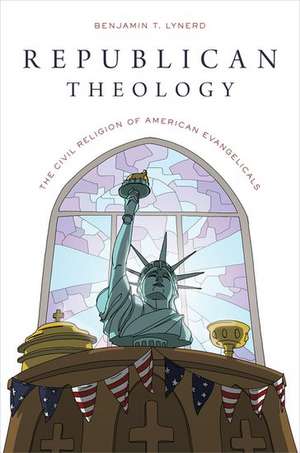
Republican Theology: The Civil Religion of American Evangelicals
Autor Benjamin T. Lynerden Limba Engleză Paperback – 25 sep 2014
Preț: 336.55 lei
Preț vechi: 417.07 lei
-19%
Puncte Express: 505
Carte tipărită la comandă
Livrare economică 27 noiembrie-08 decembrie
Livrare prin curier în România Termenul estimat este afișat lângă disponibilitate.
Transport gratuit de la 400.00 lei Plată online sau ramburs, în funcție de opțiunile comenzii.
Retur gratuit în 14 zile Comandă securizată și suport în română.
Specificații
ISBN-13: 9780199363568
ISBN-10: 0199363560
Pagini: 260
Dimensiuni: 161 x 236 x 18 mm
Greutate: 0.35 kg
Editura: Oxford University Press
Colecția OUP USA
Locul publicării:New York, United States
ISBN-10: 0199363560
Pagini: 260
Dimensiuni: 161 x 236 x 18 mm
Greutate: 0.35 kg
Editura: Oxford University Press
Colecția OUP USA
Locul publicării:New York, United States
V-ar putea interesa
-
 Christians and the Color Line: Race and Religion after Divided by FaithJ. Russell Hawkins-19%Preț: 362.27 lei446.78 lei
 -
 The Oxford Handbook of Evangelical TheologyGerald R. McDermott-29%Preț: 388.96 lei546.46 lei
 -
 Dissent and the Bible in Britain, c.1650-1950Scott Mandelbrote-31%Preț: 964.86 lei1402.32 lei
 -
 -23%Preț: 271.36 lei353.70 lei
 -
 -18%Preț: 330.97 lei403.31 lei
 -
 -17%Preț: 199.88 lei239.64 lei
 -
 Evangelicals and American Foreign PolicyMark R. Amstutz-23%Preț: 334.62 lei436.51 lei
 -
 Preț: 114.55 lei
Recenzii
This timely book makes a solid historical contribution by documenting a long, reasonably flexible, yet still very coherent tradition of American 'republican theology.' Yet the book goes beyond history to also offer an unusually perceptive analysis of where 'republican theology' has functioned for the good of the nation-and for the Christian faith-and where it has not. This major book should have a major impact.
In Republican Theology, Benjamin Lynerd offers a trenchant analysis of the theological foundations and persistent cultural power of American evangelicalism's engagement with American politics. From John Witherspoon to Billy Graham, from Benjamin Rush to Jerry Falwell, and down to our own day, he guides the reader across the shifting terrain of American moral politics and explicates the significance of this potent political theology for the broad history of American public life.
In Republican Theology, Benjamin Lynerd offers a trenchant analysis of the theological foundations and persistent cultural power of American evangelicalism's engagement with American politics. From John Witherspoon to Billy Graham, from Benjamin Rush to Jerry Falwell, and down to our own day, he guides the reader across the shifting terrain of American moral politics and explicates the significance of this potent political theology for the broad history of American public life.
Notă biografică
Benjamin Lynerd holds the Benjamin Franklin Project Post-Doctoral Fellowship at the Illinois Institute of Technology in Chicago.