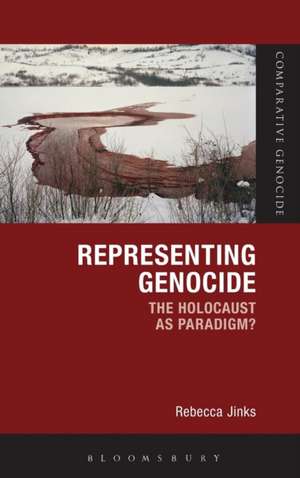
Representing Genocide: The Holocaust as Paradigm?: Comparative Genocide
Autor Dr Rebecca Jinksen Limba Engleză Hardback – 2 iun 2016
Representing Genocide pursues five thematic areas in turn: how genocides are recognised as such by western publics; the representation of the origins and perpetrators of genocide; how western witnesses represent genocide; representations of the aftermath of genocide; and western responses to genocide. Throughout, the book distinguishes between 'mainstream' and other, more nuanced and engaged, representations of genocide. It shows how these mainstream representations - the majority - largely replicate the representational framework of the Holocaust, including the way in which mainstream Holocaust representations resist recognising the rationality, instrumentality and normality of genocide, preferring instead to present it as an aberrant, exceptional event in human society. By contrast, the more engaged representations - often, but not always, originating from those who experienced genocide - tend to revolve around precisely genocide's ordinariness, and the structures and situations common to human society which contribute to and become involved in the violence.
Preț: 836.71 lei
Preț vechi: 1243.29 lei
-33%
Puncte Express: 1255
Carte tipărită la comandă
Livrare economică 12-26 noiembrie
Livrare prin curier în România Termenul estimat este afișat lângă disponibilitate.
Transport gratuit pentru acest produs Plată online sau ramburs, în funcție de opțiunile comenzii.
Retur gratuit în 14 zile Comandă securizată și suport în română.
Specificații
ISBN-13: 9781474256940
ISBN-10: 1474256945
Pagini: 280
Ilustrații: 13 bw illus
Dimensiuni: 156 x 234 x 28 mm
Greutate: 0.57 kg
Editura: Bloomsbury Publishing
Colecția Bloomsbury Academic
Seria Comparative Genocide
Locul publicării:London, United Kingdom
ISBN-10: 1474256945
Pagini: 280
Ilustrații: 13 bw illus
Dimensiuni: 156 x 234 x 28 mm
Greutate: 0.57 kg
Editura: Bloomsbury Publishing
Colecția Bloomsbury Academic
Seria Comparative Genocide
Locul publicării:London, United Kingdom
V-ar putea interesa
-
 NightElie Wiesel-21%Preț: 55.17 lei69.75 lei
 -
 -30%Preț: 539.78 lei775.24 lei
 -
 Golden HarvestJan T. Gross-19%Preț: 86.12 lei106.67 lei
 -
 Hitler - Films from GermanyK. MachtansPreț: 393.95 lei
 -
 Family Punishment in Nazi GermanyR. LoeffelPreț: 390.60 lei
 -
 Preț: 372.34 lei
 -
 Preț: 153.60 lei
 -
 Hitler, the Germans, and the Final SolutionIan KershawPreț: 149.46 lei
 -
 Who Will Write Our History?Samuel D. KassowPreț: 235.80 lei
 -
 -28%Preț: 74.44 lei102.92 lei
 -
 Preț: 161.53 lei
 -
 Children's Exodus: A History of the KindertransportVera K. Fast-22%Preț: 356.90 lei459.88 lei
Cuprins
1. Introduction
2. Recognising Genocide: The 'Genocidal Imaginary'
3. Explaining Genocide: Representations of the Origins and Perpetrators of Genocide
4. Witnessing Genocide: Western Protagonists in the Theatre of Genocide
5. Resolving Genocide: Representations of the Aftermath
6. Responding to Genocide: Attitudes and Platitudes
7. Conclusion
Bibliography
Index
2. Recognising Genocide: The 'Genocidal Imaginary'
3. Explaining Genocide: Representations of the Origins and Perpetrators of Genocide
4. Witnessing Genocide: Western Protagonists in the Theatre of Genocide
5. Resolving Genocide: Representations of the Aftermath
6. Responding to Genocide: Attitudes and Platitudes
7. Conclusion
Bibliography
Index
Recenzii
A useful introductory survey ... It is a timely contribution to an already growing body of scholarship.
Excellent ... this is a highly ambitious and innovative book, one that raises bold questions and offers equally thought-provoking answers ... a beautifully written, thought-provoking monograph, one that is likely to move comparative genocide studies in exciting new directions.
Accessible to non-specialists, Representing Genocide considers mass killings in Armenia, Cambodia, Bosnia and Rwanda, sharing knowledge that is little-known to the general public. Jinks considers expressive forms including novels, memoir, visual arts, comics and film, without getting lost in detailed textual analysis.
Jinks' study provides a thoroughly original and innovative examination of representations of genocides other than the Holocaust - an area that has demanded more attention for a long time. The impressive breadth and depth of research combines with a highly articulate and accessible writing style that opens its intriguing subject matter up to a wide audience. An excellent piece of scholarship that engages with diverse media forms to consider some of the crucial questions for genocide representation in the 21st century. Highly recommended.
Jinks' insightful book is the first of its kind to apply lessons learned from the history of Holocaust representation to deepen our grasp of its importance for the representation of other genocides. Breathtaking in both its geographical span and disciplinary scope, Jinks' rich and well-informed analyses of representations of genocide across nations, cultures, and disciplines offer an exemplary path toward understanding the impact of mass killings in our time.
Excellent ... this is a highly ambitious and innovative book, one that raises bold questions and offers equally thought-provoking answers ... a beautifully written, thought-provoking monograph, one that is likely to move comparative genocide studies in exciting new directions.
Accessible to non-specialists, Representing Genocide considers mass killings in Armenia, Cambodia, Bosnia and Rwanda, sharing knowledge that is little-known to the general public. Jinks considers expressive forms including novels, memoir, visual arts, comics and film, without getting lost in detailed textual analysis.
Jinks' study provides a thoroughly original and innovative examination of representations of genocides other than the Holocaust - an area that has demanded more attention for a long time. The impressive breadth and depth of research combines with a highly articulate and accessible writing style that opens its intriguing subject matter up to a wide audience. An excellent piece of scholarship that engages with diverse media forms to consider some of the crucial questions for genocide representation in the 21st century. Highly recommended.
Jinks' insightful book is the first of its kind to apply lessons learned from the history of Holocaust representation to deepen our grasp of its importance for the representation of other genocides. Breathtaking in both its geographical span and disciplinary scope, Jinks' rich and well-informed analyses of representations of genocide across nations, cultures, and disciplines offer an exemplary path toward understanding the impact of mass killings in our time.