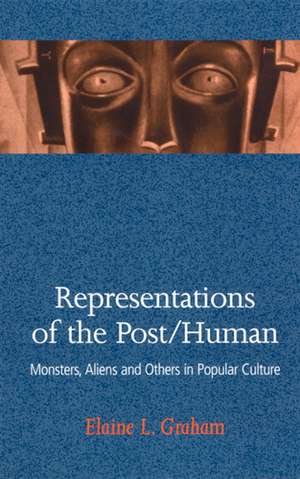
Representations of the Post/Human: Monsters, Aliens, and Others in Popular Culture
Autor Elaine L. Grahamen Limba Engleză Paperback – mar 2002
Microchips. Genetic modification of plants. Cloning. Advances in technology promise to shape our lives more profoundly than ever before. Exciting new discoveries in reproductive, genetic, and information technologies all serve to call into question the immutability of the boundaries between humans, animals, and machines. The category of the “posthuman” reflects the implications of such new technologies on contemporary culture, especially in their capacity to reconfigure the human body and to challenge our most fundamental understandings of human nature.
Elaine L. Graham explores these issues as they are expressed within popular culture and the creative arts. From the myth of Prometheus and the Gothic horror of Frankenstein’s monster to contemporary postmodern science fiction, a gallery of fantastic creatures haunts Western myth, religion, and literature. They serve to connect contemporary debates with enduring concerns about the potential—and the limits—of human creativity.
This book breaks new ground in drawing together a wide range of literature on new technologies and their ethical implications. In her explorations of the monstrous and the cyborg, Graham covers the Jewish legend of the golem, the Human Genome Project, Star Trek: Next Generation, Star Trek: Voyager, Fritz Lang’s Metropolis, Donna Haraway’s cyborg writing, andmany other related topics. This book will interest students in cultural studies, literature, ethics, religion, information technology, and the life sciences.
Elaine L. Graham explores these issues as they are expressed within popular culture and the creative arts. From the myth of Prometheus and the Gothic horror of Frankenstein’s monster to contemporary postmodern science fiction, a gallery of fantastic creatures haunts Western myth, religion, and literature. They serve to connect contemporary debates with enduring concerns about the potential—and the limits—of human creativity.
This book breaks new ground in drawing together a wide range of literature on new technologies and their ethical implications. In her explorations of the monstrous and the cyborg, Graham covers the Jewish legend of the golem, the Human Genome Project, Star Trek: Next Generation, Star Trek: Voyager, Fritz Lang’s Metropolis, Donna Haraway’s cyborg writing, andmany other related topics. This book will interest students in cultural studies, literature, ethics, religion, information technology, and the life sciences.
Preț: 319.66 lei
Puncte Express: 479
Carte tipărită la comandă
Livrare economică 21 noiembrie-05 decembrie
Livrare prin curier în România Termenul estimat este afișat lângă disponibilitate.
Transport gratuit de la 400.00 lei Plată online sau ramburs, în funcție de opțiunile comenzii.
Retur gratuit în 14 zile Comandă securizată și suport în română.
Specificații
ISBN-13: 9780813530598
ISBN-10: 0813530598
Pagini: 272
Dimensiuni: 152 x 229 x 15 mm
Greutate: 0.43 kg
Ediția:None
Editura: Rutgers University Press
Colecția Rutgers University Press
ISBN-10: 0813530598
Pagini: 272
Dimensiuni: 152 x 229 x 15 mm
Greutate: 0.43 kg
Ediția:None
Editura: Rutgers University Press
Colecția Rutgers University Press
V-ar putea interesa
-
 What is a Superhero?Robin S. Rosenberg-22%Preț: 273.48 lei352.51 lei
 -
 Preț: 152.05 lei
 -
 The Birth of Korean CoolEuny HongPreț: 98.21 lei
 -
 1000 Dot-To-Dot: AnimalsThomas PavittePreț: 92.42 lei
Notă biografică
Elaine L. Graham is Samuel Ferguson Professor of Social and Pastoral Theology at the University of Manchester (U.K.). She is the author of several books, including Transforming Practice: Pastoral Theology in an Age of Uncertainty.
Cuprins
Preface: On cathedrals, canals and computers
Introduction: Mapping the post/human
pt. I. Science/Fiction.
1. Representing the post/human.
2. The gates of difference
pt. II. Monstrosity, Genealogy and Representation.
3. What made Victor's creature monstrous?
4. Body of clay, body of glass.
5. In whose image? The politics of representation
pt. III. Post/Humanities.
6. Much ado about Data.
7. 'Nietzsche gets a modem': transhumanism and the technological sublime.
8. The end of the 'human'?
9. Cyborg writing.
10. Gods and monsters
Introduction: Mapping the post/human
pt. I. Science/Fiction.
1. Representing the post/human.
2. The gates of difference
pt. II. Monstrosity, Genealogy and Representation.
3. What made Victor's creature monstrous?
4. Body of clay, body of glass.
5. In whose image? The politics of representation
pt. III. Post/Humanities.
6. Much ado about Data.
7. 'Nietzsche gets a modem': transhumanism and the technological sublime.
8. The end of the 'human'?
9. Cyborg writing.
10. Gods and monsters
Recenzii
What does it mean to be human in light of the digital, cybernetic, and biomedical innovations being developed and used today? In Representations of the Post/Human, Elaine Graham addresses this question with clarity and power, giving us a thorough, compelling analysis of these technologies, as well as political debates that surround them.
Descriere
Microchips. Genetic modification of plants. Cloning. Advances in technology promise to shape our lives more profoundly than ever before. Exciting new discoveries in reproductive, genetic, and information technologies all serve to call into question the immutability of the boundaries between humans, animals, and machines. The category of the “posthuman” reflects the implications of such new technologies on contemporary culture, especially in their capacity to reconfigure the human body and to challenge our most fundamental understandings of human nature.