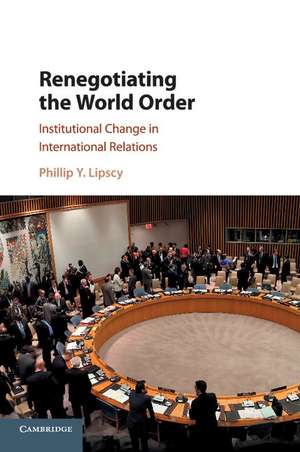
Renegotiating the World Order
Autor Phillip Y Lipscyen Limba Engleză Paperback – 14 iun 2018
Preț: 320.89 lei
Puncte Express: 481
Carte tipărită la comandă
Livrare economică 20 noiembrie-04 decembrie
Livrare prin curier în România Termenul estimat este afișat lângă disponibilitate.
Transport gratuit de la 400.00 lei Plată online sau ramburs, în funcție de opțiunile comenzii.
Retur gratuit în 14 zile Comandă securizată și suport în română.
Specificații
ISBN-13: 9781316604281
ISBN-10: 1316604284
Pagini: 342
Ilustrații: 32 b/w illus.
Dimensiuni: 152 x 229 x 18 mm
Greutate: 0.46 kg
Editura: Cambridge University Press
Locul publicării:New York, United States
ISBN-10: 1316604284
Pagini: 342
Ilustrații: 32 b/w illus.
Dimensiuni: 152 x 229 x 18 mm
Greutate: 0.46 kg
Editura: Cambridge University Press
Locul publicării:New York, United States
Cuprins
1. Introduction; 2. A theory of institutional change; 3. The International Monetary Fund and the World Bank; 4. Japan in the International Monetary Fund and the World Bank; 5. INTELSAT; 6. ICANN; 7. The League of Nations and the United Nations Security Council; 8. Policy area discipline: development institutions and regional integration projects; 9. China-Taiwan competition over international organizations: a placebo test; 10. Conclusion.
Recenzii
'Phillip Y. Lipscy shows, using rationalist theory, that variation in competition among international institutions explains variation in their willingness to undergo fundamental institutional change. Renegotiating the World Order is a theoretically innovative and empirically impressive book on an important topic.' Robert O. Keohane, Princeton University, New Jersey
'Why is it that some international institutional arrangements respond in flexible ways to changes in the distribution of power whereas others do not? Lipscy offers an original and persuasive answer to this question that troubles both policymakers and theorists. This book is a must read for anyone interested in understanding the past and future of international organizations.' Eric Voeten, Georgetown University, Washington DC
'How will rising states such at Brazil, China, and India seek to reshape the global order? Will they be responsible stakeholders working within the existing Western-led order, or will they be revisionists seeking to overturn it? … Lipscy provides the most elegant and systematic explanation yet for these diverse and shifting choices.' G. John Ikenberry, Foreign Affairs
'Lipscy's book provides well-written historical accounts with a compelling theory that provides both an academic case as well as fruitful insight for policy-makers.' Felicity Vabulas, Review of International Organizations
'Why is it that some international institutional arrangements respond in flexible ways to changes in the distribution of power whereas others do not? Lipscy offers an original and persuasive answer to this question that troubles both policymakers and theorists. This book is a must read for anyone interested in understanding the past and future of international organizations.' Eric Voeten, Georgetown University, Washington DC
'How will rising states such at Brazil, China, and India seek to reshape the global order? Will they be responsible stakeholders working within the existing Western-led order, or will they be revisionists seeking to overturn it? … Lipscy provides the most elegant and systematic explanation yet for these diverse and shifting choices.' G. John Ikenberry, Foreign Affairs
'Lipscy's book provides well-written historical accounts with a compelling theory that provides both an academic case as well as fruitful insight for policy-makers.' Felicity Vabulas, Review of International Organizations
Descriere
This book explains how countries renegotiate international institutions when rising powers such as Japan and China challenge the existing order.