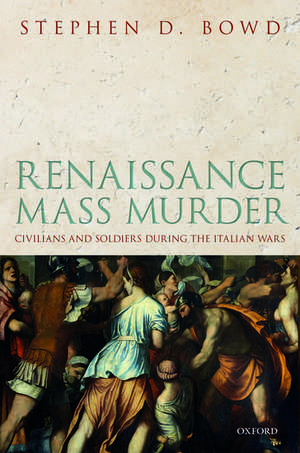
Renaissance Mass Murder: Civilians and Soldiers During the Italian Wars
Autor Stephen D. Bowden Limba Engleză Hardback – 22 noi 2018
Preț: 679.95 lei
Preț vechi: 864.47 lei
-21%
Puncte Express: 1020
Carte disponibilă
Livrare economică 05-11 noiembrie
Livrare prin curier în România Termenul estimat este afișat lângă disponibilitate.
Transport gratuit pentru acest produs Plată online sau ramburs, în funcție de opțiunile comenzii.
Retur gratuit în 14 zile Comandă securizată și suport în română.
Specificații
ISBN-13: 9780198832614
ISBN-10: 0198832613
Pagini: 304
Ilustrații: 16 black and white figures/illustrations
Dimensiuni: 164 x 241 x 24 mm
Greutate: 0.62 kg
Editura: OUP OXFORD
Colecția OUP Oxford
Locul publicării:Oxford, United Kingdom
ISBN-10: 0198832613
Pagini: 304
Ilustrații: 16 black and white figures/illustrations
Dimensiuni: 164 x 241 x 24 mm
Greutate: 0.62 kg
Editura: OUP OXFORD
Colecția OUP Oxford
Locul publicării:Oxford, United Kingdom
Recenzii
With this book, Bowd deftly achieves his goal of "bringing the modern reader closer to the forms of consciousness and experiences of civilians and soldiers during the Italian Wars without, at the same time, wrenching them out of their time or rendering them merely pitiable"...this is a laudable, impressive contribution to the thriving field of violence in early modern Italy.
This is a remarkable book that gives new and important insights into the nature of mass violence during the Italian Wars.
This is, in short, a work that offers new perspectives via the study of massacres on all manner of Renaissance sources and texts. Researchers on multiple themes will find inspiration here, whether in relation to the military revolution and the current scholarly interest in martial cultures, or when reconsidering the canonical literary works of Machiavelli and Guicciardini. There is food for thought here too on issues of the nation, religion and ethnicity in early modern European warfare. It is testimony to the strength of this book that it prompts as many new questions about these wars as it answers: it should be essential reading for scholars of early modern Europe.
This is a remarkable book that gives new and important insights into the nature of mass violence during the Italian Wars.
This is, in short, a work that offers new perspectives via the study of massacres on all manner of Renaissance sources and texts. Researchers on multiple themes will find inspiration here, whether in relation to the military revolution and the current scholarly interest in martial cultures, or when reconsidering the canonical literary works of Machiavelli and Guicciardini. There is food for thought here too on issues of the nation, religion and ethnicity in early modern European warfare. It is testimony to the strength of this book that it prompts as many new questions about these wars as it answers: it should be essential reading for scholars of early modern Europe.
Notă biografică
Stephen D. Bowd works at the University of Edinburgh and has published widely on the history of the Italian Renaissance and on culture, religion, and belief in Venice and its empire between 1400 and 1550.
Cuprins
- Part I: Introduction and Overview
- Introduction
- 1: A Brief History of the Italian Wars
- Part II: War and Mass Murder: Practices
- 2: Why Mass Murder Happened
- 3: The Experiences of Civilians
- Part III: War and Mass Murder: Theories
- 4: Civilians and Theories of War
- 5: The Machiavellian Massacre
- Part IV: War and Mass Murder: Representations
- 6: Remembering and Representing the Massacre
- 7: 'With Pain/Pen': The Poetic Massacre
- Conclusion