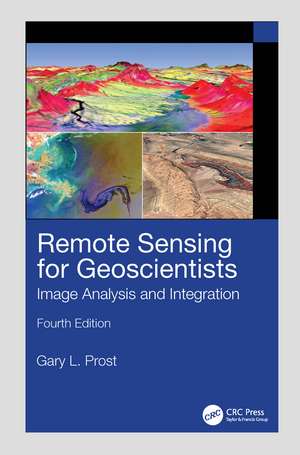
Remote Sensing for Geoscientists: Image Analysis and Integration
Autor Gary L. Prosten Limba Engleză Hardback – 16 iun 2025
New in the Fourth Edition:
- Thoroughly revised to address remote sensing technological advances achieved in recent years.
- Includes new examples of using remote sensing for successful projects in water, oil, gas, and mineral exploration and exploitation, forensic remote sensing, and environmental monitoring.
- Reviews the latest instrumentation, processing, and integrated analysis of imagery.
- Includes two new chapters, including one on clandestine geologic remote sensing and a new chapter on free Google Earth software to remotely sense anywhere on Earth and process imagery to highlight geologic features.
- Maintains a clear style and simple language understandable by the average person.
| Toate formatele și edițiile | Preț | Express |
|---|---|---|
| Paperback (1) | 646.32 lei 3-5 săpt. | |
| CRC Press – 12 dec 2019 | 646.32 lei 3-5 săpt. | |
| Hardback (1) | 1087.94 lei 3-5 săpt. | |
| CRC Press – 16 iun 2025 | 1087.94 lei 3-5 săpt. |
Preț: 1087.94 lei
Preț vechi: 1530.00 lei
-29%
Puncte Express: 1632
Preț estimativ în valută:
192.54€ • 225.02$ • 167.16£
192.54€ • 225.02$ • 167.16£
Carte disponibilă
Livrare economică 30 ianuarie-13 februarie
Preluare comenzi: 021 569.72.76
Specificații
ISBN-13: 9781041020066
ISBN-10: 1041020066
Pagini: 690
Ilustrații: 1280
Dimensiuni: 178 x 254 x 37 mm
Greutate: 1.44 kg
Ediția:4th edition
Editura: CRC Press
Colecția CRC Press
ISBN-10: 1041020066
Pagini: 690
Ilustrații: 1280
Dimensiuni: 178 x 254 x 37 mm
Greutate: 1.44 kg
Ediția:4th edition
Editura: CRC Press
Colecția CRC Press
Public țintă
Postgraduate, Professional Reference, and Undergraduate AdvancedCuprins
Section 1: Initiating Projects. 1. Project Flow and Obtaining Data. 2. Photointerpretation Tools and Techniques. 3. Remote Sensing Systems. Section 2: Remote Sensing in Geological Mapping and Resource Exploration. 4. Recognizing Rock Types. 5. Recognizing Structure. 6. Stratigraphic and Compositional Mapping. 7. Remote Geochemistry. 8. Modern Analogs. 9. Remote Sensing in Petroleum Exploration. 10. Remote Sensing in Mineral Exploration. Section 3: Exploitation, Hydrologic, and Engineering Remote Sensing. 11. Remote Sensing in Resource Exploration Projects. 12. Hydrology. 13. Logistics and Engineering. Section 4: Environmental Remote Sensing. 14. Environmental Baselines and Monitoring. 15. Geobotanical Remote Sensing. 16. Natural Disasters, Environmental Hazards, and Global Warming. Section 5: Astrogeology. 17. Mapping Planetary Structure. 18. Planetary Geologic Processes, Composition, and Stratigraphy. 19. Planetary Resources. Section 6: Remote Sensing, Geoscience, and Society. 20. Public Relations, the Media, and the Law. 21. Geographic Information Systems and Online Remote Sensing Resources. 22. Military and Clandestine Geologic Remote Sensing. 23. Geologic Remote Sensing in the Age of Google Earth. 24. Closing Thoughts.
Notă biografică
Gary L. Prost obtained his BSc in Geology from Northern Arizona University and a MSc and PhD Geology from Colorado School of Mines. He worked over 40 years in the minerals and energy industries for the U.S. Geological Survey, The Superior Oil (and Minerals) Company, Amoco Production Company, Shell Oil, Gulf Canada, and ConocoPhillips Canada. His remote sensing experience includes over 20 years spent in mineral and energy exploration, environmental monitoring, and geologic and hazards mapping in over 30 countries. He has written a geologic handbook for the general public and has published a series on self-guided geologic tours of the world. Now retired, Dr. Prost leads geologic tours for the public and professionals and is dedicated to making geology accessible to the average person.
Descriere
The new edition of the bestselling Remote Sensing for Geoscientists: Image Analysis and Integration expands the scope of remote sensing to cover image systems that did not exist 10 years ago when the third edition was published. It is thoroughly updated and provides examples of new capabilities using Google Earth© and various apps.
Recenzii
"… a well organized and highly readable overview of many of the most powerful and significant applications of "practical" remote sensing. … The book is sure to clarify concepts both old and new while stimulating interest in the new. … The great difficulty in a book of this type is to stay relevant in a world of ever changing technology. The author has done an excellent job in doing this, in a clear and readable manner. I feel that this book will become the standard reference for practitioners and students alike."
—Dr Ralph N.Baker, Independent Consulting Geologist, Houston, Texas
"… provides an earth scientist with a very efficient, one-stop information shop that covers not only the standard reflected light, thermal, and radar systems, but also the very important geophysical sensors such as potential field, EM, GPR, side-scan sonar, etc. … an important contribution for earth scientists trying to understand how remote sensing imagery and vegetation can be used to create better maps of the earth’s geology."
—James Ellis, Ellis GeoSpatial
"Dr. Prost has clearly and thoroughly explained the wide variety of methods and applications … Geoscientists will find this comprehensive guide to the interpretation and integration of remote sensing data to be a welcome addition to their personal libraries."
—Dr. Dietmar (Deet) Schumacher, Vice President for Geosciences and technology, E&P Field Services
"A new book by Prost is an amazing guide to the field of remote sensing, and it will remain so for years. Difficult to imagine, but the author was able to collect so huge amount of information that his writing can be judged as an ultimate reference volume irrespectively of which particular technique the reader is interested in. Well, it was almost impossible to achieve such brilliance, but this has been done successfully.
Speaking generally, the re
—Dr Ralph N.Baker, Independent Consulting Geologist, Houston, Texas
"… provides an earth scientist with a very efficient, one-stop information shop that covers not only the standard reflected light, thermal, and radar systems, but also the very important geophysical sensors such as potential field, EM, GPR, side-scan sonar, etc. … an important contribution for earth scientists trying to understand how remote sensing imagery and vegetation can be used to create better maps of the earth’s geology."
—James Ellis, Ellis GeoSpatial
"Dr. Prost has clearly and thoroughly explained the wide variety of methods and applications … Geoscientists will find this comprehensive guide to the interpretation and integration of remote sensing data to be a welcome addition to their personal libraries."
—Dr. Dietmar (Deet) Schumacher, Vice President for Geosciences and technology, E&P Field Services
"A new book by Prost is an amazing guide to the field of remote sensing, and it will remain so for years. Difficult to imagine, but the author was able to collect so huge amount of information that his writing can be judged as an ultimate reference volume irrespectively of which particular technique the reader is interested in. Well, it was almost impossible to achieve such brilliance, but this has been done successfully.
Speaking generally, the re