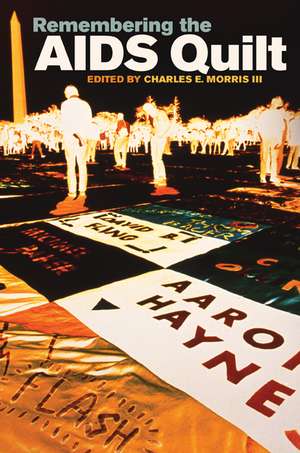
Remembering the AIDS Quilt: Rhetoric & Public Affairs
Editat de Charles E. Morris IIIen Limba Engleză Hardback – iun 2011
A collaborative creation unlike any other, the Names Project Foundation’s AIDS Memorial Quilt has played an invaluable role in shattering the silence and stigma that surrounded the epidemic in the first years of its existence. Designed by Cleve Jones, the AIDS Quilt is the largest ongoing community arts project in the world. Since its conception in 1987, the Quilt has transformed the cultural and political responses to AIDS in the U.S. Representative of both marginalized and mainstream peoples, the Quilt contains crucial material and symbolic implications for mourning the dead, and the treatment and prevention of AIDS. However, the project has raised numerous questions concerning memory, activism, identity, ownership, and nationalism, as well as issues of sexuality, race, class, and gender. As thought-provoking as the Quilt itself, this diverse collection of essays by ten prominent rhetorical scholars provides a rich experience of the AIDS Quilt, incorporating a variety of perspectives, critiques, and interpretations.
Din seria Rhetoric & Public Affairs
-
 Preț: 299.90 lei
 -
 Preț: 186.21 lei
 -
 Preț: 183.22 lei
 -
 Preț: 239.05 lei
 - 13%
 Preț: 372.05 lei
 -
 Preț: 177.90 lei
 - 13%
 Preț: 357.09 lei
 -
 Preț: 163.31 lei
 -
 Preț: 329.74 lei
 -
 Preț: 165.69 lei
 - 13%
 Preț: 443.59 lei
 -
 Preț: 135.29 lei
 -
 Preț: 334.30 lei
 -
 Preț: 138.35 lei
 - 13%
 Preț: 478.24 lei
 -
 Preț: 391.73 lei
 - 13%
 Preț: 371.43 lei
 - 13%
 Preț: 340.04 lei
 - 13%
 Preț: 357.09 lei
 - 13%
 Preț: 357.61 lei
 - 13%
 Preț: 359.84 lei
 - 13%
 Preț: 411.45 lei
 -
 Preț: 283.87 lei
 -
 Preț: 288.09 lei
 - 13%
 Preț: 355.87 lei
 -
 Preț: 267.85 lei
 -
 Preț: 224.97 lei
 -
 Preț: 440.60 lei
 -
 Preț: 342.81 lei
 - 5%
 Preț: 185.47 lei
 - 11%
 Preț: 471.68 lei
 -
 Preț: 390.24 lei
 - 13%
 Preț: 342.16 lei
Preț: 360.99 lei
Preț vechi: 414.94 lei
-13%
Puncte Express: 541
Carte indisponibilă temporar
Doresc să fiu notificat când acest titlu va fi disponibil:
Se trimite...
Specificații
ISBN-13: 9781611860078
ISBN-10: 1611860075
Pagini: 470
Dimensiuni: 152 x 229 x 28 mm
Greutate: 0.74 kg
Ediția:New.
Editura: Michigan State University Press
Colecția Michigan State University Press
Seria Rhetoric & Public Affairs
ISBN-10: 1611860075
Pagini: 470
Dimensiuni: 152 x 229 x 28 mm
Greutate: 0.74 kg
Ediția:New.
Editura: Michigan State University Press
Colecția Michigan State University Press
Seria Rhetoric & Public Affairs
Notă biografică
Charles E. Morris III teaches Rhetorical Criticism, Social Protest, and Public Memory in the Communication Department at Boston College. He is the editor of Queering Public Address, and co-editor of Readings on the Rhetoric of Social Protest.
Descriere
A collaborative creation unlike any other, the Names Project Foundation’s AIDS Memorial Quilt has played an invaluable role in shattering the silence and stigma that surrounded the epidemic in the first years of its existence. The Quilt contains crucial material and symbolic implications for mourning the dead, and the treatment and prevention of AIDS. However, the project has raised numerous questions concerning memory, activism, identity, as well as issues of sexuality, race, class, and gender. This diverse collection of essays by ten prominent rhetorical scholars provides a rich experience of the AIDS Quilt, incorporating a variety of perspectives, critiques, and interpretations.