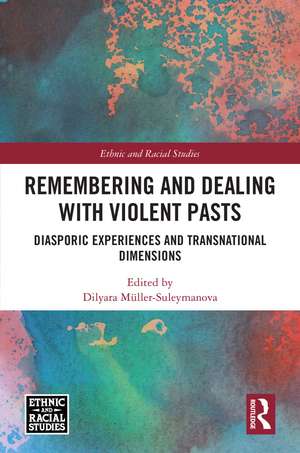
Remembering and Dealing with Violent Pasts: Diasporic Experiences and Transnational Dimensions: Ethnic and Racial Studies
Editat de Dilyara Müller-Suleymanovaen Limba Engleză Hardback – 25 mar 2026
Through biographical narratives, ethnographic observation, social-media analysis and studies of transnational art projects, contributors explore how memories of violence are both transmitted and silenced, as subsequent generations strive to piece together and reinterpret fragmented histories of trauma, loss, home and belonging. Readers will discover how both collective and individual memories of violence are reshaped by political discourses and policies of the country of settlement, by colonial legacies and emerging forms of generational activism – sparking new modes of commemoration and political engagement among subsequent generations.
Accessible yet deeply insightful, this collection speaks to all those interested in diaspora, forced migration, repercussions of violence and conflict, generations and memory. It invites readers to trace the journeys of those marked by violent pasts as they rebuild their lives within shifting political landscapes and changing cultures of remembrance.
The chapters in this book were originally published as a special issue in Ethnic and Racial Studies.
Din seria Ethnic and Racial Studies
-
 Preț: 246.09 lei
 -
 Preț: 309.71 lei
 -
 Preț: 469.39 lei
 -
 Preț: 437.36 lei
 -
 Preț: 435.62 lei
 -
 Preț: 473.49 lei
 - 15%
 Preț: 423.28 lei
 - 15%
 Preț: 455.18 lei
 -
 Preț: 419.64 lei
 - 18%
 Preț: 1112.72 lei
 -
 Preț: 411.72 lei
 -
 Preț: 301.45 lei
 -
 Preț: 304.58 lei
 - 15%
 Preț: 419.92 lei
 - 18%
 Preț: 1116.57 lei
 -
 Preț: 348.38 lei
 -
 Preț: 444.29 lei
 -
 Preț: 435.65 lei
 -
 Preț: 440.76 lei
 -
 Preț: 462.00 lei
 -
 Preț: 302.21 lei
 - 18%
 Preț: 1118.66 lei
 -
 Preț: 477.10 lei
 - 18%
 Preț: 1112.48 lei
 -
 Preț: 455.59 lei
 - 18%
 Preț: 1119.56 lei
 -
 Preț: 297.78 lei
 - 18%
 Preț: 1114.12 lei
 - 18%
 Preț: 778.48 lei
 - 18%
 Preț: 1144.63 lei
 - 18%
 Preț: 1113.77 lei
 -
 Preț: 462.43 lei
Preț: 1465.88 lei
Preț vechi: 1903.74 lei
-23%
Puncte Express: 2199
Carte tipărită la comandă
Livrare economică 19-25 noiembrie
Livrare prin curier în România Termenul estimat este afișat lângă disponibilitate.
Transport gratuit pentru acest produs Plată online sau ramburs, în funcție de opțiunile comenzii.
Retur gratuit în 14 zile Comandă securizată și suport în română.
Specificații
ISBN-13: 9781041195559
ISBN-10: 1041195559
Pagini: 224
Dimensiuni: 156 x 234 mm
Greutate: 0.57 kg
Ediția:1
Editura: Taylor & Francis
Colecția Routledge
Seria Ethnic and Racial Studies
Locul publicării:Oxford, United Kingdom
ISBN-10: 1041195559
Pagini: 224
Dimensiuni: 156 x 234 mm
Greutate: 0.57 kg
Ediția:1
Editura: Taylor & Francis
Colecția Routledge
Seria Ethnic and Racial Studies
Locul publicării:Oxford, United Kingdom
Public țintă
Postgraduate, Undergraduate Advanced, and Undergraduate CoreCuprins
Introduction: Remembering and dealing with violent past: diasporic experiences and transnational dimensions 1. Memories of violence in the Rwandan diaspora: intergenerational transmission and conflict transportation 2. Inherited traumas in diaspora: postmemory, past-presencing and mobilisation of second-generation Kurds in Europe 3. Dealing with a violent past and its remnants in the present: the challenges of remembering the wars in Chechnya in the Chechen Diaspora in the EU 4. Framing the present through the past: Ukrainian diaspora in France, Holodomor memory and the 2014 critical juncture 5. Diasporic group boundaries and solidarity in the making: collective memory in the anti-war protests in Sweden 6. The travelling art installation Prijedor ‘92: transnational memorialisation and the 1.5 generation 7. Biography, belonging and legacies of the Yugoslav disintegration wars in the lives of postmigrant youth in Switzerland 8. Ghostly ruins: conflict memories, narratives, and placemaking among Lebanese diasporas in Montreal
Notă biografică
Dilyara Müller-Suleymanova is an interdisciplinary social scientist whose work explores diaspora, memories, migration and intergenerational transmission, education, discrimination and inequality. Her research spans from minority communities in post-Soviet regions to diasporic groups in Europe, with a focus on belonging, exclusion, and the intergenerational impacts of displacement and violence.
Descriere
Drawing on eight case studies - from Rwandan, Bosnian and Kurdish diasporas to Ukrainian, Chechen and Lebanese diasporic communities across Europe and North America - this volume intricately explores the ways in which memories of violence are transmitted, transformed, and sometimes deliberately silenced in new homelands.