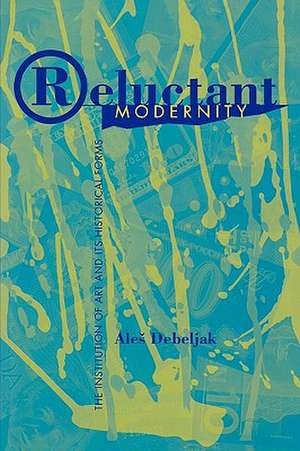
Reluctant Modernity: The Institution of Art and its Historical Forms: Postmodern Social Futures
Autor Aleš Debeljaken Limba Engleză Paperback – 2 iul 1998
Preț: 306.34 lei
Preț vechi: 388.50 lei
-21%
Puncte Express: 460
Carte tipărită la comandă
Livrare economică 30 noiembrie-14 decembrie
Livrare prin curier în România Termenul estimat este afișat lângă disponibilitate.
Transport gratuit de la 400.00 lei Plată online sau ramburs, în funcție de opțiunile comenzii.
Retur gratuit în 14 zile Comandă securizată și suport în română.
Specificații
ISBN-13: 9780847685837
ISBN-10: 0847685837
Pagini: 240
Dimensiuni: 147 x 228 x 13 mm
Greutate: 0.31 kg
Ediția:New.
Editura: Bloomsbury Publishing
Colecția Rowman & Littlefield
Seria Postmodern Social Futures
Locul publicării:New York, United States
ISBN-10: 0847685837
Pagini: 240
Dimensiuni: 147 x 228 x 13 mm
Greutate: 0.31 kg
Ediția:New.
Editura: Bloomsbury Publishing
Colecția Rowman & Littlefield
Seria Postmodern Social Futures
Locul publicării:New York, United States
V-ar putea interesa
-
 Creative Haven Dogs Color by Number Coloring BookDiego Jourdan Pereira-16%Preț: 55.93 lei66.67 lei
 -
 Preț: 51.24 lei
 -
 Painting Brilliant Skies and Water in PastelLiz Haywood-SullivanPreț: 181.09 lei
 -
 Giraffe Coloring Book for AdultsColoring Books, GiraffePreț: 54.07 lei
 -
 Turtles Adult Coloring BookColoring Book, Best TurtlesPreț: 82.76 lei
 -
 The Ravishing Letter R Coloring BookPeggy Louise ParrishPreț: 95.14 lei
 -
 The Tasteful Letter T Coloring BookParrusg, Peggy LouisePreț: 95.14 lei
 -
 The Classy Letter C Coloring BookPeggy Louise ParrishPreț: 93.57 lei
 -
 Coloring Animal MandalasWendy Piersall-19%Preț: 57.46 lei71.30 lei
 -
 David Bellamy's Arctic LightDavid BellamyPreț: 199.02 lei
 -
 SmugglersAles DebeljakPreț: 87.27 lei
 -
 Preț: 61.58 lei
Descriere
In this book, Ales Debeljak offers a refreshing alternative to postmodernists such as Baudrillard, who declare the death of art conceived as yet another source of rootless, circulating fictions. Inspired by the melancholy critical theory of Adorno and Benjamin, and drawing on Weber, Debeljak shows that with the dawning of modernity, art was made autonomous. Art production was effectively emancipated from the exigencies of everyday life and its guiding ideal of purposive rationality. The Renaissance brought on the first stage in a long, gradual withdrawal of art from the hitherto dominant mythological, religious, and aristocratic legitimization. Yet it was not until the 18th century that art assumed the separate status of a commodity to be bought and sold. However, art paid a price for its autonomy; through commodification art production ultimately become an extension of capitalist logic and control. The deterioration of bourgeois liberal individualism into the narcissism of mass society accompanied the decomposition of art into simplified mass art and commercialized kitsch. Maintaining its formal autonomy (museums, galleries, etc.), its content became the universal object of indirect corporate exploitation. Today postmodern art, argues Debeljak, is subjected to infinite reproducibility, total integration into mass society, and political resignation-no longer representing an alternative reality. The postmodern institution of art thus cannot be simply cured of modern structures and assumptions, but is, instead, fated to a continuous and painful relationship with modernity.
Cuprins
Chapter 1 Foreword
Chapter 2 Preface
Chapter 3 Acknowledgements
Chapter 4 Introduction
Chapter 5 Framing the Logic of Modernity
Chapter 6 The Bourgeois Public Sphere in Modernity
Chapter 7 The Institution of Art in Modernity
Chapter 8 The Dissolution of the Bourgeois Public Sphere
Chapter 9 The Institution of Art in Postmodernity
Chapter 10 References
Chapter 11 Index
Chapter 2 Preface
Chapter 3 Acknowledgements
Chapter 4 Introduction
Chapter 5 Framing the Logic of Modernity
Chapter 6 The Bourgeois Public Sphere in Modernity
Chapter 7 The Institution of Art in Modernity
Chapter 8 The Dissolution of the Bourgeois Public Sphere
Chapter 9 The Institution of Art in Postmodernity
Chapter 10 References
Chapter 11 Index
Recenzii
A major contribution to the critical analysis of the autonomy of art in contemporary capitalism. Ales Debeljak, following in the tradition of Adorno and Habermas, provides a penetrating and comprehensive inquiry in the contradictory character of art in modern society.
At last, a book which punctures the bolder claims of postmodernism, while retaining a shrewd perspective on the limitations of Modernist theories. Debeljak's book is an insightful addition to the literature. Required reading for serious social theorists.
Debeljak's work elegantly restates the importance of the autonomy and the critical potential of art. It also forcefully articulates the problem that postmodernism obviates critique and makes important contributions to our understanding of the development of the institution of art through an excellent account which links this development to the public sphere.
At last, a book which punctures the bolder claims of postmodernism, while retaining a shrewd perspective on the limitations of Modernist theories. Debeljak's book is an insightful addition to the literature. Required reading for serious social theorists.
Debeljak's work elegantly restates the importance of the autonomy and the critical potential of art. It also forcefully articulates the problem that postmodernism obviates critique and makes important contributions to our understanding of the development of the institution of art through an excellent account which links this development to the public sphere.