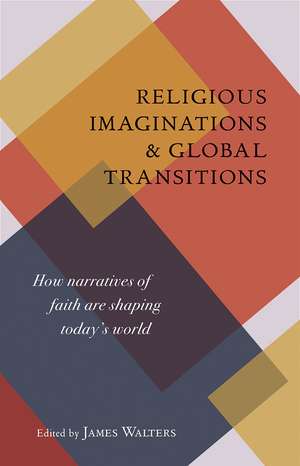
Religious Imaginations: How Narratives of Faith are Shaping Today’s World
Editat de James Waltersen Limba Engleză Hardback – 15 mar 2019
Observăm în volumul Religious Imaginations, editat de James Walters, o abordare proaspătă și necesară asupra modului în care narațiunile religioase nu sunt doar relicve ale trecutului, ci forțe active care modelează geopolitica actuală. Față de literatura existentă care tinde să izoleze religia în sfera privată, această lucrare demonstrează cum imaginația religioasă — de la fundamentalism la drepturile omului derivate din tradiția creștină — influențează direct tranzițiile globale, tehnologia și schimbările climatice.
Structura volumului este riguros organizată pentru a ghida cititorul de la concepte generale spre studii de caz specifice. Prima parte, dedicată tranzițiilor globale, beneficiază de contribuțiile unor autori de renume precum Karen Armstrong și Mona Siddiqui, care analizează etica și scripturile în context modern. Urmează o secțiune dedicată reimaginării doctrinei, unde sunt explorate momentele formative ale Islamului și relațiile interreligioase în spații urbane precum Kazan sau Moscova. Această progresie de la teorie la practică, incluzând perspective inedite despre rolul muzicii sau al diplomației, oferă o imagine de ansamblu asupra complexității credinței astăzi.
Cititorii familiarizați cu Politics and the Religious Imagination de John H.A. Dyck vor aprecia în acest nou volum extinderea analizei dincolo de cadrul politic pur, către o dimensiune mai profundă a identității și a modului în care comunitățile își „imaginează” viitorul într-o lume postcolonială. Religious Imaginations se distinge printr-un echilibru între rigoarea academică și relevanța practică pentru diplomație și leadership religios, evitând simplificările excesive și abordând frontal tensiunile dintre tradițiile iudaice, musulmane și creștine.
Preț: 246.98 lei
Preț vechi: 349.06 lei
-29%
Carte disponibilă
Livrare economică 10-24 noiembrie
Specificații
ISBN-10: 1909942200
Pagini: 320
Dimensiuni: 152 x 229 x 30 mm
Greutate: 0.51 kg
Editura: Gingko
Colecția Gingko
De ce să citești această carte
Această carte este esențială pentru profesioniștii din diplomație, sociologie și teologie care doresc să înțeleagă rolul religiei în conflictele și soluțiile globale contemporane. Cititorul câștigă o perspectivă interdisciplinară asupra modului în care credința influențează deciziile politice și sociale, oferind instrumente intelectuale pentru a naviga într-o lume marcată de diversitate religioasă și nevoia de dialog intercultural.
Despre autor
James Walters este un cercetător și editor recunoscut pentru munca sa în domeniul teologiei și al relațiilor interconfesionale. În cariera sa, s-a concentrat pe modul în care credința interacționează cu spațiul public, o temă centrală și în Religious Imaginations. Opera sa include lucrări diverse, de la explorări practice ale ministerului pastoral în A Christian Theology of Chaplaincy, până la analize profunde despre dialogul în contexte tensionate, așa cum regăsim în Loving Your Neighbour in an Age of Religious Conflict. Walters aduce în acest volum experiența sa în dezvoltarea programelor interreligioase la universități de top, consolidând punți între mediul academic și cel politic.
Descriere scurtă
Notă biografică
Cuprins
Religious Imaginations and Global Transitions
Craig Calhoun, The world is more than it may seem
Karen Armstrong, What can our scriptures tell us?
Mona Siddiqui, Time, space and the ethics of religious narratives
Anba Angaelos, Christian imagination in today’s world
Ophir Yarden - The Balfour Declaration: From Imagining a State to Re-imagining Majority-Minority Relations in Jewish Thought and the Jewish State
John Casson, Diplomacy and the religious imagination
Mena Mark Hanna, Music and the religious imagination
Reimagining Doctrine
Kamran Bashir: Reimagining the formative moments of Islam
Mohammed Nizami: Reimagining Doctrines: Maturing religious narratives for the formulation of an Islamic political theology
Abby Day, Believing in belief
Elena Arlyapova: Interreligious relations in contemporary Russia (on the materials of the cities of Moscow, Kazan and Ufa)
Challenges of Modern Faith
Eileen Barker, New religious movements as resources in a changing world
Thahir Jamal, Muslim movements as Interpreters of Islamic Principles: Imagination of a New social and political order in South India
Oliver Davies, Religions and the scientific imagination
Catriona Robertson, Who do you trust? Enabling cross-religious involvement in public life for a peaceful and equitable future
The Making of Modern Religion
Hussein Omar, The invention of ‘minority’ and the making of sectarianism in the Arab world
Adrian Gregory, The birth of Christian Zionism and the origins of the Balfour Declaration
Patrick Houlihan, Roman Catholicism and the origins of human rights
Global Issues in Interfaith Relations
Mohammed Gamal, Rethinking Islamic orthodoxy, with special reference to the theory of abrogation ‘naskh’
John Fahy, The field of interfaith in the Middle East
Dimitri Cavouras, Jabaliya Bedouins and St Catherine Monks: At the crossroad of dialogue yet at the mercy of geopolitics
Haydar al-Lami, Religious History and Imagined Identity: the case of Iraq-Iran War (1980-1988)
Faith and diplomacy
Fabio Petito & Scott Thomas, Religious Engagement in International Relations: From problem-solving theory to prophetic innovation
Jenna Reinbold, Human rights as a narrative of faith
Magdalena Delgado, Discerning the link between normative notions of Islam and Western populism
Religion and Sustainability
Khushwant Singh, Spiritual transitions: Natural development is like good medicine – It has no side effects
Emmanuel Karagiannis, Understanding the Islamic Perspective on Environment – Doctrine and Practice
Caleb Gordon, The Relationship of Ecological Science to Christian Narrative
Imagining Religious Leadership in the Future
Abu Bakr Muhammad, The role of religious leaders in ensuring a non-violent future
Roland Stolte, Introducing the Foundation House of One, Bangui, CAR
Megan Shore, Religious Leadership in South Africa’s transition