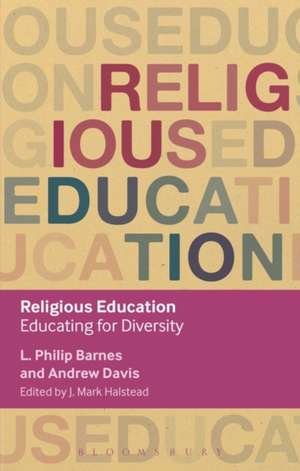
Religious Education: Educating for Diversity: Key Debates in Educational Policy
Autor Dr L. Philip Barnes, Andrew Davis Editat de J. Mark Halsteaden Limba Engleză Paperback – 27 aug 2015
Two eminent educators address this question and propose contrasting answers. Attention is given to the aims of education and the contribution of religious education to the curriculum; historical forms of religious education; the nature of diversity in society; the roots of prejudice; different methodologies in religious education and their philosophical and religious commitments; and to positive strategies to enable religious education to realise its potential and contribute to the social and moral aims of liberal education.
Preț: 246.34 lei
Preț vechi: 323.94 lei
-24%
Puncte Express: 370
Carte tipărită la comandă
Livrare economică 05-19 decembrie
Livrare prin curier în România Termenul estimat este afișat lângă disponibilitate.
Transport gratuit de la 400.00 lei Plată online sau ramburs, în funcție de opțiunile comenzii.
Retur gratuit în 14 zile Comandă securizată și suport în română.
Specificații
ISBN-13: 9781472571069
ISBN-10: 1472571061
Pagini: 160
Dimensiuni: 138 x 216 x 12 mm
Greutate: 0.21 kg
Editura: Bloomsbury Publishing
Colecția Bloomsbury Academic
Seria Key Debates in Educational Policy
Locul publicării:London, United Kingdom
ISBN-10: 1472571061
Pagini: 160
Dimensiuni: 138 x 216 x 12 mm
Greutate: 0.21 kg
Editura: Bloomsbury Publishing
Colecția Bloomsbury Academic
Seria Key Debates in Educational Policy
Locul publicării:London, United Kingdom
V-ar putea interesa
-
 The Homeschooling OptionL. RiveroPreț: 382.55 lei
 -
 Preț: 276.61 lei
 -
 Preț: 451.24 lei
 -
 Globalizing Education PolicyFazal Rizvi-8%Preț: 442.31 lei480.77 lei
 -
 Does Every Child Matter?: Understanding New Labour's Social ReformsCatherine A. SimonPreț: 383.23 lei
 -
 Debates in Religious EducationL. Philip BarnesPreț: 312.75 lei
 -
 -18%Preț: 1130.16 lei1378.24 lei
 -
 School Improvement: An Unofficial ApproachMartin Thrupp-22%Preț: 401.00 lei512.92 lei
 -
 Biology for the IB Diploma Study and Revision GuideAndrew DavisPreț: 351.30 lei
 -
 -20%Preț: 244.21 lei304.92 lei
 -
 Education in South-East AsiaDr Lorraine Pe Symaco-10%Preț: 349.88 lei389.92 lei
 -
 -18%Preț: 111.52 lei136.73 lei
Cuprins
Notes on Contributors
Series Editor's Preface
Foreword, J. Mark Halstead
Part I - Religious Education: Taking Religious Difference Seriously, L. Philip Barnes
Part II - Religious Education: A Pluralist Approach, Andrew Davis
Afterword, J. Mark Halstead
Bibliography
Index
Series Editor's Preface
Foreword, J. Mark Halstead
Part I - Religious Education: Taking Religious Difference Seriously, L. Philip Barnes
Part II - Religious Education: A Pluralist Approach, Andrew Davis
Afterword, J. Mark Halstead
Bibliography
Index
Recenzii
It is not difficult to agree that religious diversity should impact educational policy, especially in respect of religious education, but it is much more difficult to reach agreement on the nature of this impact. Acknowledging diversity about educational approaches to religious diversity is as important as acknowledging religious diversity itself. Putting Barnes, Davis and Halstead side-by-side is an excellent method for displaying the importance of this debate.