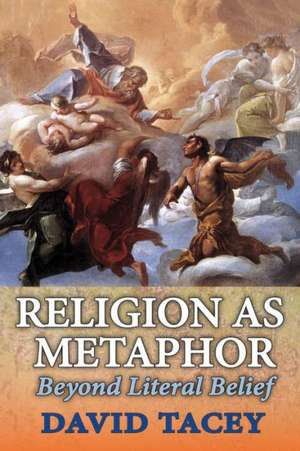
Religion as Metaphor: Beyond Literal Belief
Editat de David Taceyen Limba Engleză Hardback – 30 mai 2015
Bazându-ne pe analizele publicate de Routledge sub semnătura lui David Tacey, considerăm că Religion as Metaphor reprezintă o intervenție necesară în dialogul dintre teologie și raționalitate. Premisa centrală a lucrării este că insistența asupra literalismului istoric în interpretarea Scripturii nu doar că alienează intelectul modern, dar ocultează însăși semnificația spirituală a textelor. David Tacey propune o trecere de la „logos” înapoi la „mythos”, argumentând că relatările biblice despre miracole, precum Nașterea din Fecioară sau Învierea, funcționează ca structuri de gândire menite să rezoneze cu viața interioară, nu ca documente de arhivă.
Structura cărții urmărește o progresie logică, pornind de la critica „idolatriei gândirii literale” și ajungând la o analiză a lui Iisus ca metaforă a încarnării continue. Autorul utilizează instrumentele psihologiei abisale pentru a decripta ceea ce el numește „codul simbolic al sufletului”, oferind cititorului o metodă de a salva religia de propriile limitări dogmatice. Această abordare extinde cadrul propus de Thou Art That de Joseph Campbell cu date noi din psihologia analitică, oferind o rigoare academică sporită în examinarea simbolurilor iudeo-creștine. În contextul operei sale anterioare, Religion as Metaphor se situează la intersecția dintre interesul pentru sănătate mentală din Gods and Diseases și antologia The Jung Reader, rafinând conceptul de spiritualitate ca mișcare spontană în societatea contemporană. Apreciem în mod deosebit modul în care Tacey reușește să mențină relevanța sacrului fără a sacrifica onestitatea intelectuală, oferind o perspectivă în care limbajul religios este tratat cu aceeași profunzime ca poezia înaltă.
Preț: 1161.67 lei
Preț vechi: 1276.56 lei
-9%
Carte disponibilă
Livrare economică 12-26 mai
Livrare express 28 aprilie-02 mai pentru 34.73 lei
Specificații
ISBN-10: 1412856108
Pagini: 286
Dimensiuni: 152 x 229 x 25 mm
Greutate: 0.52 kg
Ediția:1
Editura: Taylor & Francis
Colecția Routledge
Locul publicării:Oxford, United Kingdom
V-ar putea interesa
-
 Prophecy and the Biblical ProphetsJohn F. a. Sawyer-15%Preț: 345.77 lei406.66 lei
 -
 -32%Preț: 401.01 lei585.82 lei
 -
 Jacob's Tears: The Priestly Work of ReconciliationMary DouglasPreț: 315.78 lei
 -
 Meeting God in PaulRowan WilliamsPreț: 77.84 lei
 -
 How to Read the Bible (Without Switching Off Your Brain)Simon J. TaylorPreț: 76.65 lei
 -
 The Tabloid BibleNick PagePreț: 136.54 lei
 -
 God With UsRowan WilliamsPreț: 74.23 lei
 -
 The Jung ReaderDavid TaceyPreț: 379.29 lei
 -
 Isaiah (2000): A CommentaryBrevard S. Childs-8%Preț: 403.52 lei438.61 lei
 -
 The Drama of DoctrineKEVIN J VANHOOZERPreț: 331.88 lei
 -
 The Gospel of John and Christian TheologyRichard BauckhamPreț: 243.03 lei
 -
 Powers, Weakness, and the Tabernacling of GodMarva J. DawnPreț: 125.37 lei
 -
 Dust and GloryDavid RuncornPreț: 76.50 lei
 -
 The Gospel of Thomas and Christian WisdomStevan L. DaviesPreț: 138.11 lei
 -
 Edge of the Sacred: Jung, Psyche, EarthDr David TaceyPreț: 128.23 lei
 -
 Unusual Bible Interpretations: JudgesRabbi Dr. Israel Drazin-17%Preț: 168.38 lei203.57 lei
De ce să citești această carte
Recomandăm această carte studenților la filozofie și teologie, precum și cititorilor interesați de psihologia religiei. Religion as Metaphor oferă o cale de mijloc între ateismul radical și fundamentalism, învățându-ne cum să recuperăm sensul transcendent al textelor sacre printr-o lentilă metaforică. Veți câștiga o înțelegere mai profundă a modului în care mitul și simbolul structurează experiența umană universală.
Despre autor
David Tacey este Profesor Emerit de Literatură la Universitatea La Trobe din Australia, fiind un specialist recunoscut în studiul spiritualității, al religiei și al impactului acestora asupra sănătății mentale. Opera sa este profund influențată de psihologia lui Carl Gustav Jung, fapt vizibil în lucrări precum The Jung Reader și The Darkening Spirit. Prin scrierile sale, Tacey explorează modul în care simbolurile ancestrale și miturile pot fi integrate în viața modernă pentru a vindeca fractura dintre rațiune și spirit, fiind o voce autoritară în analiza fenomenului spiritualității contemporane.
Descriere scurtă
Religion as Metaphor argues that despite what tradition tells us, if we "believe" religious language, we miss religion's spiritual meaning. Tacey argues that religious language was not designed to be historical reporting, but rather to resonate in the soul and direct us toward transcendent realities. Its impact was intended to be closer to poetry than theology. The book uses specific examples to make its case: Jesus, the Virgin Birth, the Kingdom of God, the Apocalypse, Satan, and the Resurrection.
Tacey shows that, with the aid of contemporary thought and depth psychology, we can re-read religious stories as metaphors of the spirit and the interior life. Moving beyond literal thinking will save religion from itself.
Cuprins
Acknowledgments
Personal Introduction
1. Miracles as Imagination
Mythos and History; The Miracles of Jesus;
Metaphor and Its Hazards; Preserving the
Spiritual Meaning
2. Religion as Metaphor
The Literary Mode of Scripture; Myth,
Metaphor and Jesus; Literal Thinking as Idolatry;
Religion as Unconscious Poetry; Pious Fraud;
The Greatest Story Ever Sold?
3. The Soul's Symbolic Code
Why Myth Matters; Myth as Ancient
Psychology; When Mythos became Logos;
The Ancestral Mind; Mythos, Soul, Eternity;
Mythos in Art and Entertainment; Mythos as a Structure of Thought; Mythos Downgraded; Myths, Dreams, Religions; Something Continues to Speak
4. Jesus the Metaphor
Imagination and Reality; Fear of Myth;
The Secret Life of Us; Personifying; Spirit
Personified in Jesus; Ongoing Incarnation;
The Messenger as the Message; An Eastern Moment in the West; Gnosticism and other Heresies;
Absolutism, Violence, and Conflict; When Jesus became God; Onward Christian Soldiers;
Jesus the Mirror of Our Projections
5. The Myth of the Virgin Birth
The Dead Hand of Patriarchy; Can We Be
"Moved" By Myths?; Sexual Politics and the
Uses of Myth; The Myth and its Background;
Divine Insemination; Spiritual Rebirth;
Institutional Literalism; The Less We Believe the Better
6. Waking Up
The Kingdom; Putting on the New Self;
Waking Up to a Higher Authority; Reversal of
the Ego's Values; Losing and Finding Life;
The Mustard Seed; Many are Called, Few Choose;
Completion, Not Perfection; Transformation,
Not Repentance; Jesus, Socrates, and Waking Up
7. Apocalypse
Apocalypse as Psychology; Coming of the New Self;
Destruction and Renewal; Spiritual Event and
Pathological Obsession; Violation of the Ego's
Boundaries; New Self as Original Self; Judgment;
Destruction and Punishment; God as Interruption;
Rapture; Founding a New Order
8. Satan and Literalism
Nicodemus and the Rebirth Story; Incest Fantasies
and Sexual Abuse; Satan as the Personification of
Literalism; The Sublimation of Base Instincts
9. Resurrection: Ascending to Where?
The Resurrection Conundrum; Joseph Campbell's
Straight Talking; Jung: Cutting through Spiritual
Materialism; Paul's Mysticism; The Parable of Emmaus;
Emmaus Never Happened, Emmaus Always Happens;
The Unacknowledged God in Our Midst
10. Psyche and Symbol
Dreaming the Myth Onward; Reworking
the Past; The Therapeutic Function of Myth;
Myth as Psychic Truth; Mystery Without Literalism;
Respect to a God Unknown; The Assumption
of Mary; Elevation of the Symbolic
11. After Belief
After Literalism; Faith Without Belief;
Vision and Uncommon Sense; Bultmann's
Progressive Thinking; Saving the Myths;
Throwing Out the Baby; Progressives in the
Rationalistic Mode; The Sea of Faith at Ebb Tide;
From Passive Belief to Active Faith;
Stages of Faith; Recreating the Fables
Conclusion: Unveiling the Soul
Rebirth of the Sacred; From the God-Shaped Hole; Depth Psychology as Midwife; Psyche as an Opening to Infinity
Index