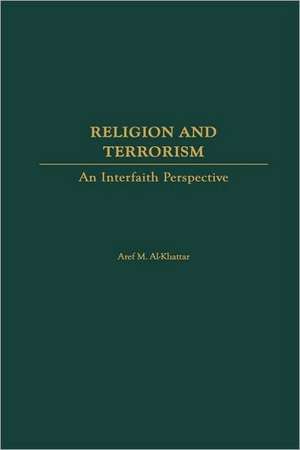
Religion and Terrorism: An Interfaith Perspective
Autor Aref M. Al-Khattaren Limba Engleză Hardback – 30 iun 2003
As the first researcher to apply the Techniques of Neutralization Theory, a traditional criminological theory, to explain such religion-terrorism, Al-Khattar examines the primary data to understand the motivations beyond the surface explanations offered by the perpetrators and adherents to their causes. Terrorists are considered as traditional criminals, despite their claims of nobler callings. Through utilization of this theoretical approach, the study offers practical suggestions on how this criminal behavior might be dealt with by law enforcement, society, and religious institutions themselves.
Preț: 447.21 lei
Preț vechi: 651.80 lei
-31%
Puncte Express: 671
Carte tipărită la comandă
Livrare economică 08-22 iulie
Livrare prin curier în România Termenul estimat este afișat lângă disponibilitate.
Transport gratuit pentru acest produs Plată online sau ramburs, în funcție de opțiunile comenzii.
Retur gratuit în 14 zile Comandă securizată și suport în română.
Specificații
ISBN-13: 9780275969233
ISBN-10: 0275969231
Pagini: 140
Dimensiuni: 150 x 232 x 14 mm
Greutate: 0.34 kg
Ediția:New.
Editura: Bloomsbury Publishing
Colecția Praeger
Locul publicării:New York, United States
ISBN-10: 0275969231
Pagini: 140
Dimensiuni: 150 x 232 x 14 mm
Greutate: 0.34 kg
Ediția:New.
Editura: Bloomsbury Publishing
Colecția Praeger
Locul publicării:New York, United States
V-ar putea interesa
-
 The InquisitionMichael BaigentPreț: 110.88 lei
 -
 The Broken Crescent: The "Threat" of Militant Islamic FundamentalismFereydoun Hoveyda-34%Preț: 198.17 lei300.20 lei
 -
 -31%Preț: 355.06 lei514.87 lei
 -
 -18%Preț: 1075.31 lei1311.35 lei
 -
 A New Age of GodJudy BellPreț: 87.61 lei
 -
 Preț: 165.71 lei
 -
 -18%Preț: 1074.12 lei1309.91 lei
 -
 Religious Fundamentalism and Political ExtremismAmi Pedahzur-18%Preț: 1213.42 lei1479.77 lei
 -
 Religious Fundamentalism and Political ExtremismAmi Pedahzur-15%Preț: 404.55 lei475.95 lei
 -
 Logistics of Warfare in the Age of the CrusadesJohn H. Pryor-18%Preț: 1206.27 lei1471.06 lei
 -
 Preț: 226.54 lei
 -
 Crusading and Warfare in Medieval and Renaissance EuropeNorman Housley-18%Preț: 690.76 lei842.39 lei
 -
 Jihad: A Commitment to Universal PeaceMarcel A. BoisardPreț: 50.38 lei
 -
 Deism and Social EthicsRobert CorfePreț: 149.55 lei
 -
 The Book of LyleDaniel Basil Lyle Ph. D.Preț: 102.99 lei
 -
 Top Heavy, Bottom FedTiffany Buckner- KameniPreț: 89.88 lei
 -
 From Genesis to DestinyGladwin B. WilliamsPreț: 101.55 lei
 -
 How to Share ChristOsburn, Justin M.Preț: 51.28 lei
 -
 Rescue of the Woman in the WildernessG, Nee CeePreț: 98.07 lei
 -
 Christian RelationshipsLuke GregoryPreț: 77.84 lei
 -
 Opus Dei Pirates and ParasitesHenares Jr, Dr Hilarion M.Preț: 76.72 lei
 -
 Hizmet in AfricaDavid ShinnPreț: 187.96 lei
 -
 Preț: 80.94 lei
 -
 Preț: 59.93 lei
Cuprins
Foreword
Preface
Introduction
Overview
General Information on Religion
Terrorism
Religion and Terrorism
Research of Terrorism
Religious Leaders Speak
Definitions
Jewish Justifications
Christian Justifications
Islamic Justifications
Policy Implications
Theoretical Understanding
Theoretical Framework
Conclusion and Recommendations
Appendix A: Methodology
References
Preface
Introduction
Overview
General Information on Religion
Terrorism
Religion and Terrorism
Research of Terrorism
Religious Leaders Speak
Definitions
Jewish Justifications
Christian Justifications
Islamic Justifications
Policy Implications
Theoretical Understanding
Theoretical Framework
Conclusion and Recommendations
Appendix A: Methodology
References