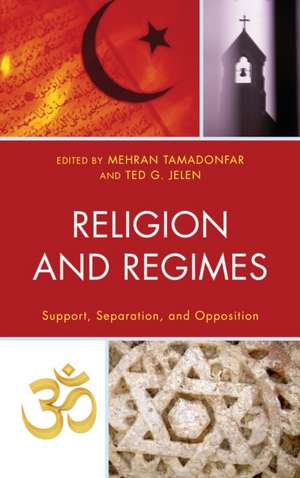
Religion and Regimes: Support, Separation, and Opposition
Editat de Mehran Tamadonfar, Ted G. Jelen Contribuţii de Rachel Blum, Clyde Wilcox, Christine A. Gustafson, Christopher Marsh, Elizabeth A. Oldmixon, Rebekah Samaniego, Ramazan Kilinç, Scott W. Hibbard, Paul Christopher Manuel, J. Christopher Soper, Joel Fetzer, Michele Dillonen Limba Engleză Paperback – 14 feb 2017
Preț: 382.42 lei
Preț vechi: 531.41 lei
-28%
Puncte Express: 574
Carte tipărită la comandă
Livrare economică 17 noiembrie-01 decembrie
Livrare prin curier în România Termenul estimat este afișat lângă disponibilitate.
Transport gratuit de la 400.00 lei Plată online sau ramburs, în funcție de opțiunile comenzii.
Retur gratuit în 14 zile Comandă securizată și suport în română.
Specificații
ISBN-13: 9781498550567
ISBN-10: 1498550568
Pagini: 288
Ilustrații: 7 Tables
Dimensiuni: 150 x 229 x 21 mm
Greutate: 0.43 kg
Editura: Bloomsbury Publishing
Colecția Lexington Books
Locul publicării:New York, United States
ISBN-10: 1498550568
Pagini: 288
Ilustrații: 7 Tables
Dimensiuni: 150 x 229 x 21 mm
Greutate: 0.43 kg
Editura: Bloomsbury Publishing
Colecția Lexington Books
Locul publicării:New York, United States
Cuprins
Introduction: Comparative Religious Politics
Mehran Tamadonfar and Ted G. Jelen
Chapter 1: A Tangled Web: Religion and the Regime in the United States
Rachel Blum and Clyde Wilcox
Chapter 2: Religion and Regimes in Brazil and Chile
Christine A. Gustafson
Chapter 3: From Atheism to Establishment? The Evolution of Church-State Relations in Russia
Christopher Marsh
Chapter 4: Israel as a Jewish and Democratic State
Elizabeth A. Oldmixon and Rebekah Samaniego
Chapter 5: International Context and State-Religion Regimes in France and Turkey
Ramazan Kilinç
Chapter 6: Religion and State In India: Ambiguity, Chauvinism, and Tolerance
Scott Hibbard
Chapter 7: The Roman Catholic Church and Political Regime in Portugal and Spain: Support, Opposition and Separation
Paul Christopher Manuel
Chapter 8: Democratization, Human Rights, and Religion-State Relations in Taiwan and Hong Kong
J. Christopher Soper and Joel S. Fetzer
Chapter 9: The Orphaned Irish: Church and State in Neo-Liberal Ireland
Michele Dillon
Chapter 10: Religion and Regime Change in Iran and Poland
Mehran Tamadonfar and Ted G. Jelen
Conclusion
Ted G. Jelen and Mehran Tamadonfar
Mehran Tamadonfar and Ted G. Jelen
Chapter 1: A Tangled Web: Religion and the Regime in the United States
Rachel Blum and Clyde Wilcox
Chapter 2: Religion and Regimes in Brazil and Chile
Christine A. Gustafson
Chapter 3: From Atheism to Establishment? The Evolution of Church-State Relations in Russia
Christopher Marsh
Chapter 4: Israel as a Jewish and Democratic State
Elizabeth A. Oldmixon and Rebekah Samaniego
Chapter 5: International Context and State-Religion Regimes in France and Turkey
Ramazan Kilinç
Chapter 6: Religion and State In India: Ambiguity, Chauvinism, and Tolerance
Scott Hibbard
Chapter 7: The Roman Catholic Church and Political Regime in Portugal and Spain: Support, Opposition and Separation
Paul Christopher Manuel
Chapter 8: Democratization, Human Rights, and Religion-State Relations in Taiwan and Hong Kong
J. Christopher Soper and Joel S. Fetzer
Chapter 9: The Orphaned Irish: Church and State in Neo-Liberal Ireland
Michele Dillon
Chapter 10: Religion and Regime Change in Iran and Poland
Mehran Tamadonfar and Ted G. Jelen
Conclusion
Ted G. Jelen and Mehran Tamadonfar
Recenzii
This important volume is a much needed contribution to the collective knowledge on comparative politics and religion. Religion and Regimes adds to the literature on religion and politics. . . .Empirically sound chapters successfully discuss case selection rationale and explain state-religion relations in the cases studied. . . .This book stands out with its compelling theoretical arguments. Contributors are no strangers to the literature on comparative politics and religion. Chapters offer valuable historical and contemporary contexts of the cases examined. . . .This book will be of great interest to all scholars and students of religion and politics. It is an accessible and informative study that will appeal to an interdisciplinary audience.
Religion and Regimes provides a historically rich analysis of religion and politics in a number of diverse countries located all over the world . . . The authors provide compelling comparisons that show how similar contexts can provide divergent long-term results. . . .By presenting a wide array of cases, the volume encourages the reader to compare and contrast-seeing the patterns that can and do emerge across diverse political and religious communities.
This book is highly informative for scholars and students interested in comparative politics and religion. In its explication of how religion affects politics, or the question of the role of religion in politics, it can be seen as an excellent source. In fact, one of the distinguishing features of the book is that, in all its chapters, the authors provide a brief historical background of the countries under analysis, which is extremely helpful in understanding the case studies..... For those who are eager to know market models of religion theory, this book is highly recommended. 'Religion and Regimes' is overall a useful resource for students and scholars.
For anyone interested in Church-state dynamics in the contemporary world this dazzling new volume, ably edited by Mehran Tamadonfar and Ted G. Jelen, will be most welcome. Religion and Regimes surveys a wide array of cases in Eurasia and the Western Hemisphere, setting present-day patterns of religious-political interaction in a historical context and showing how some assumptions about religion made at the dawn of the twentieth century, in one or another country, were abandoned over time. This is scholarship at a high level.
This new volume marks a major contribution to the literature on comparative politics and religion. Tamadonfar and Jelen succeed in their effort to tease out the core analytical importance of the regime for our understanding of how religious and state actors interact in different national contexts. Covering fifteen countries on four continents, the contributions to this volume have much to offer all students of religion and politics in our globalizing world.
Religion and Regimes provides a historically rich analysis of religion and politics in a number of diverse countries located all over the world . . . The authors provide compelling comparisons that show how similar contexts can provide divergent long-term results. . . .By presenting a wide array of cases, the volume encourages the reader to compare and contrast-seeing the patterns that can and do emerge across diverse political and religious communities.
This book is highly informative for scholars and students interested in comparative politics and religion. In its explication of how religion affects politics, or the question of the role of religion in politics, it can be seen as an excellent source. In fact, one of the distinguishing features of the book is that, in all its chapters, the authors provide a brief historical background of the countries under analysis, which is extremely helpful in understanding the case studies..... For those who are eager to know market models of religion theory, this book is highly recommended. 'Religion and Regimes' is overall a useful resource for students and scholars.
For anyone interested in Church-state dynamics in the contemporary world this dazzling new volume, ably edited by Mehran Tamadonfar and Ted G. Jelen, will be most welcome. Religion and Regimes surveys a wide array of cases in Eurasia and the Western Hemisphere, setting present-day patterns of religious-political interaction in a historical context and showing how some assumptions about religion made at the dawn of the twentieth century, in one or another country, were abandoned over time. This is scholarship at a high level.
This new volume marks a major contribution to the literature on comparative politics and religion. Tamadonfar and Jelen succeed in their effort to tease out the core analytical importance of the regime for our understanding of how religious and state actors interact in different national contexts. Covering fifteen countries on four continents, the contributions to this volume have much to offer all students of religion and politics in our globalizing world.