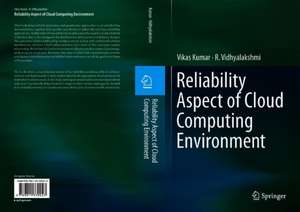
Reliability Aspect of Cloud Computing Environment
Autor Vikas Kumar, R. Vidhyalakshmien Limba Engleză Hardback – 21 noi 2018
The book offers a comprehensive review of the reliability models suitable for different services and deployments to help readers identify the appropriate cloud products for individual business needs.It also helps developers understand customer expectations and, most importantly, helps vendors to improve their service and support. As such it is a valuable resource for cloud customers, developers, vendors and the researchers.
Preț: 677.38 lei
Preț vechi: 846.72 lei
-20%
Puncte Express: 1016
Carte tipărită la comandă
Livrare economică 09-15 decembrie
Livrare prin curier în România Termenul estimat este afișat lângă disponibilitate.
Transport gratuit pentru acest produs Plată online sau ramburs, în funcție de opțiunile comenzii.
Retur gratuit în 14 zile Comandă securizată și suport în română.
Specificații
ISBN-13: 9789811330223
ISBN-10: 9811330220
Pagini: 184
Ilustrații: XI, 170 p. 24 illus., 5 illus. in color.
Dimensiuni: 160 x 241 x 16 mm
Greutate: 0.43 kg
Ediția:1st ed. 2018
Editura: Springer
Locul publicării:Singapore, Singapore
ISBN-10: 9811330220
Pagini: 184
Ilustrații: XI, 170 p. 24 illus., 5 illus. in color.
Dimensiuni: 160 x 241 x 16 mm
Greutate: 0.43 kg
Ediția:1st ed. 2018
Editura: Springer
Locul publicării:Singapore, Singapore
Cuprins
Chapter 1. Cloud Computing.- Chapter 2. Cloud Reliability.- Chapter 3. Reliability Metrics.- Chapter 4. Reliability Metrics Formulations.- Chapter 5. Reliability Model.- Chapter 6. Reliability Evaluation.
Notă biografică
Dr Oyenuga Michael Oyedele (PhD) is a Carbon Literacy Certificate recipient (Nottingham Business School, UK & PRME), he is African Group of Negotiators Experts Support (AGNES) certified Climate Governance, Diplomacy and Negotiations Leader and a Manaaki Scholar (New Zealand Government). He has established himself as a thought leader in consumer behaviour, digital sustainability, and climate-conscious economic policies. His academic journey, spanning multiple institutions across Nigeria, the United States, India and Malaysia has equipped him with a multidisciplinary perspective that uniquely positions him to drive conversations on sustainability, technology, and net zero policies. He is an Associate Professor and Assistant Dean of International Relations for the School of Business at Woxsen University, Hyderabad, India, Dr Rubee Singh (Ph.D.) is an assistant professor of HR at Institute of Business Management, GLA University, India. She is a post-doc (D. Litt.) researcher at Kumaun University, Nainital, India. She holds a PhD in management from Noida International University India, and an MBA in HR from Dr A.P. J Abdul Kalam Technical University, India. She has published 20 academic books, and more than 100+ research papers in SCI, ABDC-A, Scopus & UGC index journals. She has an excellent research track record with 1000+ citations on Google Scholar and H-index-20. Her areas of research are net zero, circular economy, digital CE, sustainability, digital HRM, sustainable HRM, industry 4.0, AI and CSR. She has been honoured with many prestigious awards, which include consecutive Best Researchers Award of the Year-2022-23, and 2023-24 by GLA University, Iconic Faculty Award 2019, International Young Researchers Award-2021, and Young Scientist Award 2020. Dr Stella Bolanle Apata (Ph.D.) is a trailblazer in the intersection of language education, AI, Sustainable Development Goals (SDGs) and sustainability. With an illustrious academic career and groundbreaking research, she champions the role of emerging technologies in driving Net Zero solutions. Her latest book delves into how AI, digital innovations, and green literacy can revolutionize industries, fostering a sustainable future. Backed by rigorous research and practical insights, this book is an essential guide for educators, policymakers, and business leaders committed to climate action. Dr. Apata’s visionary work cements her as a global thought leader, shaping a greener, tech-driven tomorrow. Dr Shahbaz Khan (Ph.D.) is an assistant professor at the Department of Industrial Engineering, University of Tabuk, Kingdom of Saudi Arabia. He has published more than 100+ research articles in many reputed journals including Scopus, SCI, and ABDC-A categories such as Business Strategy and Environment, Annals of Operation Research, Operations Management Research. He has an excellent research track record with 5000 citations on Google Scholar and H-index-37. Dr Khan was among the Top 2 % of Highly Cited Researchers in 2024 acknowledged by Stanford University and Elsevier scientists globally. He has obtained his PhD and M. Tech degree with specialization in Industrial and Production Engineering from Jamia Millia Islamia India. He is a gold medalist in M. Tech. He is a member of the International Association of Engineers, Thailand. His research interests are supply chain management, digital supply chain management, circular economy and sustainability, Industry 4.0, blockchain, artificial intelligence, benchmarking, and decision modeling for sustainable business. He has published five books including springer, Elsevier, Springer, and De Gruyter. Prof. Vikas Kumar (PhD) is a Deputy Vice-Chancellor Research and Innovation at University of Portsmouth, UK. Previously, he was an Associate Dean for Research Innovation and Enterprise at the Faculty of Business, Law and Social Sciences, Birmingham City University, UK. He is also a Professor of Operations and Supply Chain Management.
Textul de pe ultima copertă
This book presents both qualitative and quantitative approaches to cloud reliability measurements, together with specific case studies to reflect the real-time reliability applications. Traditional software reliability models cannot be used for cloud reliability evaluation due to the changes in the development architecture and delivery designs. The customer–vendor relationship mostly comes to a close with traditional software installations, whereas a SaaS subscription is just a start of the customer–vendor relationship. Reliability of cloud services is normally presented in terms of percentage, such as 99.9% or 99.99%. However, this type of reliability measurement provides confidence only in the service availability feature and may cover all the quality attributes of the product.
The book offers a comprehensive review of the reliability models suitable for different services and deployments to help readers identify the appropriate cloud products for individual business needs. It also helps developers understand customer expectations and, most importantly, helps vendors to improve their service and support. As such it is a valuable resource for cloud customers, developers, vendors and the researchers.
Caracteristici
Is a concise book focusing completely on reliability Covers both theoretical and practical aspects and is replete with case studies, making it suitable for researchers and practitioners alike Explains both qualitative and quantitative approaches for reliability measurements