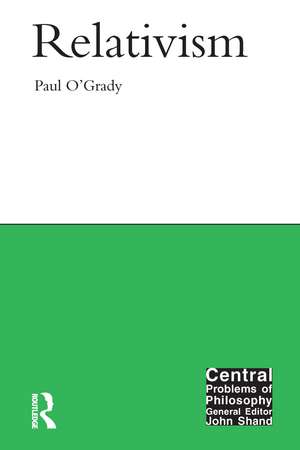
Relativism: Central Problems of Philosophy
Autor Paul O'Gradyen Limba Engleză Paperback – 30 sep 2002



Preț: 421.70 lei
Puncte Express: 633
Carte tipărită la comandă
Livrare economică 07-21 decembrie
Livrare prin curier în România Termenul estimat este afișat lângă disponibilitate.
Transport gratuit pentru acest produs Plată online sau ramburs, în funcție de opțiunile comenzii.
Retur gratuit în 14 zile Comandă securizată și suport în română.
Specificații
ISBN-13: 9781902683379
ISBN-10: 1902683374
Pagini: 208
Dimensiuni: 129 x 198 x 17 mm
Greutate: 0.38 kg
Ediția:1
Editura: Taylor & Francis
Colecția Routledge
Seria Central Problems of Philosophy
Locul publicării:Oxford, United Kingdom
ISBN-10: 1902683374
Pagini: 208
Dimensiuni: 129 x 198 x 17 mm
Greutate: 0.38 kg
Ediția:1
Editura: Taylor & Francis
Colecția Routledge
Seria Central Problems of Philosophy
Locul publicării:Oxford, United Kingdom
V-ar putea interesa
-
 Essential Schopenhauer, TheArthur SchopenhauerPreț: 72.86 lei
 -
 Truth, Meaning, ExperienceAnil Gupta-27%Preț: 494.57 lei680.39 lei
 -
 -30%Preț: 766.58 lei1095.88 lei
 -
 -10%Preț: 378.54 lei421.17 lei
 -
 Nietzsche and MoralityBrian Leiter-20%Preț: 359.91 lei448.48 lei
 -
 Visual Thinking in MathematicsMarcus Giaquinto-12%Preț: 375.34 lei424.60 lei
 -
 A Confusion of the Spheres: Kierkegaard and Wittgenstein on Philosophy and ReligionGenia Schönbaumsfeld-12%Preț: 377.68 lei428.07 lei
 -
 Philosophers Past and Present: Selected EssaysBarry Stroud-30%Preț: 656.11 lei936.00 lei
 -
 Frege's NotationsGregory LandiniPreț: 400.51 lei
 -
 Dramatizing the PoliticalI. MacKenziePreț: 401.31 lei
 -
 CausalityJudea Pearl-8%Preț: 489.51 lei532.08 lei
 -
 Open the Cage, Murphy!Paul O'Grady-18%Preț: 64.75 lei78.89 lei
 -
 At My Mother''s Knee...And Other Low JointsPaul O'Grady-17%Preț: 67.40 lei80.90 lei
 -
 The Devil Rides OutPaul O'Grady-17%Preț: 66.36 lei80.32 lei
 -
 After Finitude: An Essay on the Necessity of ContingencyDr Quentin Meillassoux-36%Preț: 116.45 lei180.74 lei
 -
 Merleau-Ponty: Key ConceptsRosalyn DiprosePreț: 343.69 lei
 -
 Alain Badiou: Key ConceptsA. J. BartlettPreț: 338.16 lei
 -
 Jurgen Habermas: Key ConceptsBarbara FultnerPreț: 344.07 lei
 -
 Do You Think You're Clever?John FarndonPreț: 71.79 lei
Cuprins
Preface 1. Introduction to relativism 2. Truth and logic 3. Ontological relativism 4. Epistemological relativism 5. Relativism about rationality 6. Evaluating relativism Further reading Bibliography Index
Descriere
The issue of relativism looms large in many discussions of knowledge, reality, society, religion, culture and gender. This book offers a path through these debates. It begins by clarifying what exactly relativism is and how it differs from scepticism and pluralism. It then examines five main types of cognitive relativism.