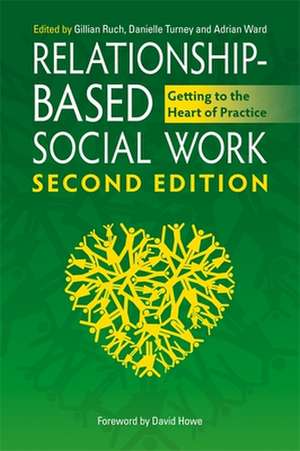
Relationship-Based Social Work, Second Edition: Getting to the Heart of Practice
Editat de Gillian Ruch, Danielle Turney, Adrian Ward Cuvânt înainte de David Howe Contribuţii de Ravi Kohli, Martin Smith, Clare Parkinson, Linnet McMahon, Robin Solomon, John Simmonds, Andrew Cooper, Jane Dutton, Anna Fairtlough, Jeremy Walshen Limba Engleză Paperback – 21 feb 2018
The book explores the ranges of emotions that practitioners may encounter with service users, and covers working in both short-term and long-term professional relationships. It also outlines key skills, such as how to establish rapport, and explores systemic issues, such as building appropriate support systems for practice, management and leadership.
Preț: 202.84 lei
Preț vechi: 270.72 lei
-25%
Puncte Express: 304
Carte disponibilă
Livrare economică 02-16 noiembrie
Livrare express 17-23 octombrie pentru 101.41 lei
Livrare prin curier în România Termenul estimat este afișat lângă disponibilitate.
Transport gratuit de la 400.00 lei Plată online sau ramburs, în funcție de opțiunile comenzii.
Retur gratuit în 14 zile Comandă securizată și suport în română.
Specificații
ISBN-13: 9781785922534
ISBN-10: 178592253X
Pagini: 320
Ilustrații: n/a
Dimensiuni: 152 x 228 x 20 mm
Greutate: 0.48 kg
Ediția:2nd edition
Editura: JESSICA KINGSLEY PUBLISHERS
Colecția Jessica Kingsley Publishers
Locul publicării:London, United Kingdom
ISBN-10: 178592253X
Pagini: 320
Ilustrații: n/a
Dimensiuni: 152 x 228 x 20 mm
Greutate: 0.48 kg
Ediția:2nd edition
Editura: JESSICA KINGSLEY PUBLISHERS
Colecția Jessica Kingsley Publishers
Locul publicării:London, United Kingdom
Recenzii
Relationship Based Social Work (2nd Edition) builds on the persuasive and powerful arguments presented in the first edition of this seminal text. The book will be valued as a resource and as emotional and theoretical sustenance for those who seek to maintain an emphasis on the relationships that are at the core of social work practice regardless of context or situation. Such a commitment can be beset by challenges, compromises and difficulties but this book provides reassurance and clarity to help guide practitioners, students and academics alike. This should be on every social work bookshelf.
In the current climate for child and family social work, it has never been more important to underpin practice with relevant theoretical knowledge that can be applied by practitioners in their everyday tasks. This book provides an accessible way of doing this. I will be making sure this valuable resource is available as essential reading across our organisation.
The central message of this book should make it a 'must read' for all social workers, managers and those concerned with and about social work. As with all great ideas and concepts, the joy is that at their heart they are simple. What this book does beautifully is unpack the simple idea, exploring the key components of how social workers should place relationship based social work at the centre of their practice. In a world too driven by technocratic responses, digital solutions and robotics, the one thing we can be sure of is that social workers will not be replaced by robots! This book explains why - you should read it.
In the current climate for child and family social work, it has never been more important to underpin practice with relevant theoretical knowledge that can be applied by practitioners in their everyday tasks. This book provides an accessible way of doing this. I will be making sure this valuable resource is available as essential reading across our organisation.
The central message of this book should make it a 'must read' for all social workers, managers and those concerned with and about social work. As with all great ideas and concepts, the joy is that at their heart they are simple. What this book does beautifully is unpack the simple idea, exploring the key components of how social workers should place relationship based social work at the centre of their practice. In a world too driven by technocratic responses, digital solutions and robotics, the one thing we can be sure of is that social workers will not be replaced by robots! This book explains why - you should read it.
Cuprins
Foreword, David Howe, Emeritus Professor of Social Work, University of East Anglia, UK. Introduction. Adrian Ward, The Tavistock Centre, UK, Gillian Ruch, University of Southampton, UK, and Danielle Turney, University of Bristol, UK. Section 1. Setting Out the Terrain: Historical Trends, Conceptual Models and Frameworks. 1. The Contemporary Context of Relationship-Based Practice. Danielle Turney and Gillian Ruch. 2. Theoretical Frameworks Informing Relationship-Based Practice. Gillian Ruch. 3. The Use of Self in Relationship-Based Practice. Adrian Ward. Section 2. Working with the Relationship in Practice. 4. Brief Encounters: Working in Complex, Short-Term Relationships. Ravi KS Kohli, University of Bedfordshire, UK and Jane Dutton, NHS Trust, UK. 5. Sustaining Relationships: Working with Strong Feelings I: Anger, Aggression and Hostility. Martin Smith, Buckinghamshire Social Services, UK. 6. Sustaining Relationships: Working with Strong Feelings II: Hopelessness, Despair and Depression. Clare Parkinson, University of East London, UK. 7. Sustaining Relationships: Working with Strong Feelings III: Love and Positive Feelings. Danielle Turney. 8. Long-Term Complex Relationships. Linnet McMahon, retired from University of Reading, UK. 9. Endings are Different from Outcomes: Working with Endings in Relationship-Based Practice. Robin Solomon, formerly of The Tavistock Centre, UK. Section 3. Sustaining, Supporting and Developing Relationship-Based Practice in a Reflective Context. 10. The Learning Relationship: Learning and Development for Relationship-Based Practice. Adrian Ward. 11. Service-User Perspectives on Relationships. Jeremy Walsh, South West London and St George's Mental Health NHS Trust. 12. Relating and Relationships in Supervision : Supportive and Companionable or Dominant and Submissive. John Simmonds, CoramBAAF, UK. 13. Professional Leadership for Relationship-based Practice, Anna Fairtlough, Goldsmiths University of London. 14. What Future? Organisational Forms, Relationship-Based Social Work Practice and the Changing World Order. Andrew Cooper, The Tavistock Centre, UK. Conclusion, Danielle Turney, Adrian Ward and Gillian Ruch. Bibliography. About the Contributors. Index.