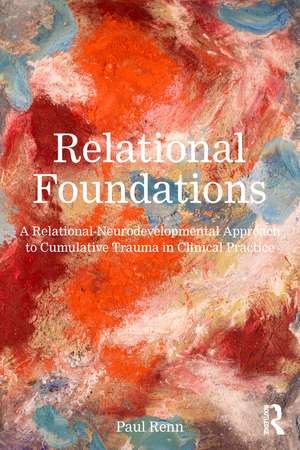
Relational Foundations: A Relational-Neurodevelopmental Approach to Cumulative Trauma in Clinical Practice
Autor Paul Rennen Limba Engleză Paperback – 10 sep 2026
Drawing on three decades of clinical practice, it brings psychoanalysis, attachment theory, infant observation, and neuroscience into close dialogue with the lived moment of therapeutic work. At its centre is the concept of cumulative relational trauma, offering a way to understand developmental harm as emerging through ongoing relational processes rather than discrete events. Structured in four parts, the volume addresses key clinical domains, including enactment, sexuality, power, forensic settings, and psychosis, while remaining grounded in practice. It shows how change unfolds through sustained relational engagement, affect regulation, and reparative processes over time.
Written for psychotherapists, clinicians, and scholars, this book offers an integrative, ethically attuned account of development that honours complexity.
Preț: 371.44 lei
Nou
Puncte Express: 557
Carte tipărită la comandă
Livrare economică 05-19 decembrie
Livrare prin curier în România Termenul estimat este afișat lângă disponibilitate.
Transport gratuit de la 400.00 lei Plată online sau ramburs, în funcție de opțiunile comenzii.
Retur gratuit în 14 zile Comandă securizată și suport în română.
Specificații
ISBN-13: 9781041334781
ISBN-10: 1041334788
Pagini: 266
Dimensiuni: 156 x 234 mm
Greutate: 0.49 kg
Ediția:1
Editura: Taylor & Francis
Colecția Routledge
Locul publicării:Oxford, United Kingdom
ISBN-10: 1041334788
Pagini: 266
Dimensiuni: 156 x 234 mm
Greutate: 0.49 kg
Ediția:1
Editura: Taylor & Francis
Colecția Routledge
Locul publicării:Oxford, United Kingdom
Public țintă
Postgraduate and Professional Practice & DevelopmentCuprins
PART I: ORIGINS – ATTACHMENT, DEVELOPMENT, AND THE INNER WORLD 1. Towards an Integrative Psychoanalysis of the Internal World 2. Attachment, Security, Separation, and Psychological Differentiation: Developmental Implications 3. The Procedural Past: Infant Observation and the Relational Foundations of Adult Psychotherapy PART II: CUMULATIVE TRAUMA, MEMORY, AND INTERGENERATIONAL TRANSMISSION 4. Stop Thief! But What Has Been Stolen and by Whom 5. The Concept of Cumulative Relational Trauma and the Processes of Intergenerational Transmission 6. Memory, Trauma, and Representation in Psychotherapy 7. Re-Reading Klein: The Formation of Internal Worlds Under Conditions of Cumulative Relational Trauma 8. Power, Security, and Recognition: Attachment, Authority, and Relational Trauma PART III: RELATIONAL PROCESS AND THE CLINICAL ENCOUNTER 9. The Therapeutic Relationship and the Process of Change: An Integrationist Perspective 10. A Relational Perspective on Enactments, Boundary Violations, and Self - Disclosure 11. Moments of Meeting: The Relational Challenges of Sexuality in the Consulting Room 12. Relational Perspectives on Psychosis and Anxiety 13. Working With the Patient’s Everyday Relational World: Procedural Templates, Enactment, and the Site of Change PART IV: INTEGRATION AND FUTURE DIRECTIONS 14. A Contemporary Relational Model: Integrating Attachment, Trauma, and Neuroscience Research 15. Cumulative Relational Trauma Revisited 16. Integrative Reflections on Relational Neuroscience 17. Conclusion – Towards a Relational-Neurodevelopmental Clinical Practice
Recenzii
"Renn offers something rare: a genuinely integrative account that bridges theory, research and the realities of therapeutic work. Across its four parts, the book demonstrates a sophisticated grasp of developmental and relational processes while remaining clinically alive and deeply attuned to human vulnerability. It is both conceptually ambitious and practically useful — a combination that will make it indispensable for clinicians, trainees and scholars alike."
Professor Peter Fonagy CBE FMedSci FBA FAcSS, Head of Division, Psychology and Language Sciences, UCL, and National Clinical Adviser for Children's Mental Health, NHS England
"This book is a gem. Renn skilfully bridges gaps between diverse ways of understanding and practising psychotherapy. He links mind and body, relational and traditional psychotherapy, attachment, neurobiology and the consulting room, the intrapsychic and sociopolitical, the past, present and future. He seamlessly explains complex ideas from very different traditions, somehow managing to show how they can be integrated. Renn not only gets to the heart of the curative processes in psychotherapy, he also gives hope for healing rifts in the world of psychotherapy. I highly recommend this book to all psychotherapists, wherever they are on their journeys."
Dr. Graham Music, Consultant Psychotherapist, Tavistock Centre, Trainer and Author
"Renn provides a masterly integration of diverse perspectives on how to understand and treat cumulative trauma, while paying due attention to the lifespan and intergenerational impacts of such trauma. Renn’s volume will be of value to novice, emerging and senior clinicians seeking a contemporary psychoanalytic, neuroscientific and attachment-oriented account of cumulative trauma. Rarely have John Bowlby and Melanie Klein appeared in the same book, with praise for what can be learned from each. This speaks to the vast range of Renn’s deep understanding of cumulative trauma. His clinical vignettes illustrate how a relational-neurodevelopmental framework can help transform this nuanced form of trauma through meaningful relational encounters."
Howard Steele, Professor of Psychology, The New School, New York City, and Editor, Attachment & Human Development
Professor Peter Fonagy CBE FMedSci FBA FAcSS, Head of Division, Psychology and Language Sciences, UCL, and National Clinical Adviser for Children's Mental Health, NHS England
"This book is a gem. Renn skilfully bridges gaps between diverse ways of understanding and practising psychotherapy. He links mind and body, relational and traditional psychotherapy, attachment, neurobiology and the consulting room, the intrapsychic and sociopolitical, the past, present and future. He seamlessly explains complex ideas from very different traditions, somehow managing to show how they can be integrated. Renn not only gets to the heart of the curative processes in psychotherapy, he also gives hope for healing rifts in the world of psychotherapy. I highly recommend this book to all psychotherapists, wherever they are on their journeys."
Dr. Graham Music, Consultant Psychotherapist, Tavistock Centre, Trainer and Author
"Renn provides a masterly integration of diverse perspectives on how to understand and treat cumulative trauma, while paying due attention to the lifespan and intergenerational impacts of such trauma. Renn’s volume will be of value to novice, emerging and senior clinicians seeking a contemporary psychoanalytic, neuroscientific and attachment-oriented account of cumulative trauma. Rarely have John Bowlby and Melanie Klein appeared in the same book, with praise for what can be learned from each. This speaks to the vast range of Renn’s deep understanding of cumulative trauma. His clinical vignettes illustrate how a relational-neurodevelopmental framework can help transform this nuanced form of trauma through meaningful relational encounters."
Howard Steele, Professor of Psychology, The New School, New York City, and Editor, Attachment & Human Development
Notă biografică
Paul Renn is a UKCP-accredited psychoanalytic psychotherapist, supervisor, and couples therapist in London. He has a background in the National Probation Service and is on the editorial board of Psychoanalytic Inquiry. He has published widely and is the author of The Silent Past and the Invisible Present (Routledge, 2012).
Descriere
This book develops a relational-neurodevelopmental framework for understanding how early experience becomes procedurally encoded, organised, and transmitted across generations. Written for psychotherapists, clinicians, and scholars, this book offers an integrative, ethically attuned account of development that honours complexity.