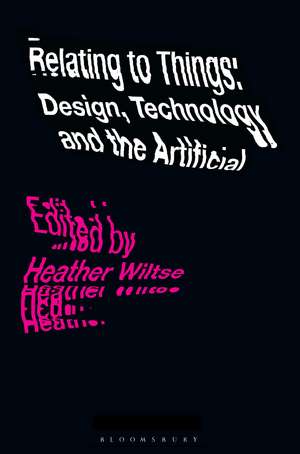
Relating to Things: Design, Technology and the Artificial
Editat de Heather Wiltseen Limba Engleză Hardback – 14 mai 2020
Case studies include Amazon's Alexa, the Internet of Things, Pokémon Go and Roomba the robot vacuum cleaner. Authors explore everything from the care work undertaken by objects, reciprocal human/machine learning, technological mediation as a form of control, and what it takes to reveal things that tend to be hidden and that often (by design) conceal the ways in which they use us.
As a whole, Relating to Things is a collaborative philosophical inquiry into the nature and consequences of contemporary technological things. It is a design inquiry into the current nature of the artificial, and possibilities for how things might be otherwise.
The eBook editions of this book are available open access under a CC BY-NC-ND 4.0 licence on bloomsburycollections.com.
Preț: 659.21 lei
Preț vechi: 1071.87 lei
-38%
Puncte Express: 989
Carte disponibilă
Livrare economică 29 octombrie-12 noiembrie
Livrare prin curier în România Termenul estimat este afișat lângă disponibilitate.
Transport gratuit pentru acest produs Plată online sau ramburs, în funcție de opțiunile comenzii.
Retur gratuit în 14 zile Comandă securizată și suport în română.
Specificații
ISBN-13: 9781350124257
ISBN-10: 1350124257
Pagini: 304
Ilustrații: 68 bw illus
Dimensiuni: 160 x 238 x 22 mm
Greutate: 0.64 kg
Editura: Bloomsbury Publishing
Colecția Bloomsbury Visual Arts
Locul publicării:London, United Kingdom
ISBN-10: 1350124257
Pagini: 304
Ilustrații: 68 bw illus
Dimensiuni: 160 x 238 x 22 mm
Greutate: 0.64 kg
Editura: Bloomsbury Publishing
Colecția Bloomsbury Visual Arts
Locul publicării:London, United Kingdom
V-ar putea interesa
-
 Don't Burn Anyone at the Stake TodayNaomi AldermanPreț: 121.01 lei
 -
 Shared WisdomAlex PentlandPreț: 148.26 lei
 -
 The Connectivity of ThingsSebastian Giessmann-16%Preț: 604.16 lei719.25 lei
 -
 Against the MachinePaul KingsnorthPreț: 193.37 lei
 -
 -21%Preț: 156.50 lei198.12 lei
 -
 Design Philosophy after the Technology TurnDr Fernando Secomandi-33%Preț: 554.31 lei821.31 lei
 -
 Designing the Domestic PosthumanColbey Emmerson Reid-21%Preț: 184.85 lei235.43 lei
 -
 Technocreep and the Politics of Things not SeenNassim ParvinPreț: 243.28 lei
 -
 Non-thingsByung-Chul HanPreț: 111.89 lei
 -
 Preț: 138.86 lei
 -
 The Care of Things: Ethics and Politics of Mainten anceDavid PontillePreț: 237.14 lei
 -
 Preț: 137.81 lei
 -
 Wise AnimalsTom Chatfield-39%Preț: 47.23 lei77.91 lei
 -
 A Studious Use: Designing From The UndercommonsGiovanni Marmont-19%Preț: 135.19 lei166.13 lei
 -
 -20%Preț: 86.40 lei107.33 lei
 -
 The ImmortalistsAleks KrotoskiPreț: 122.81 lei
 -
 The AI ConEmily M. BenderPreț: 151.96 lei
Cuprins
Introduction
Heather Wiltse (Umeå University, Sweden)
I: Caring for Things That Care for Us
1. Privacy as Care: An Interpersonal Model of Privacy Exemplified by Five Cases in the Internet of Things
Dylan Wittkower (Old Dominion University, USA)
2. Attachment to Things, Artifacts, Devices, Commodities: An Inconvenient Ethics of the Ordinary
Michel Puech (Paris-Sorbonne University, France)
3. The New Assisted Living: Caring for Alexa Caring for Us
Diane Michelfelder (Macalester College, USA)
II: Learning from Things That Learn from Us
4. Handling Things that Handle Us: Things Get to Know Who We Are and Tie Us Down to Who We Were
Bruno Gransche (University of Siegen, Germany)
5. Can Ethics be Learned? Videogames as an Ethical Sandbox
Fanny Verrax (independent scholar and consultant, France)
6. Casting Things as Partners in Design: Toward a More-than-Human Design Practice
Elisa Giaccardi (TU Delft, Netherlands)
III: Controlling Things That Control Us
7. Hostile Design and the Materiality of Surveillance
Robert Rosenberger (Georgia Institute of Technology, USA)
8. A Tool for the Impact and Ethics of Technology: The Case of Interactive Screens in Public Spaces
Steven Dorrestijn (Saxion University of Applied Sciences, Netherlands)
9. Postphenomenology of Augmented Reality
Galit Wellner (Tel Aviv University, Israel)
IV: Revealing Things That Reveal Us
10. Imagining Things: Unfolding the "of" in Philosophy of Technology, through Object-Oriented Ontology
Yoni Van Den Eede (Free University of Brussels, Belgium)
11. The Disappearing Acts of the Morse Things: A Design Inquiry into the Withdrawal of Things
Ron Wakkary (Simon Fraser University, Canada; TU Eindhoven, Netherlands), Sabrina Hauser (Simon Fraser University, Canada) and Doenja Oogjes (Simon Fraser University, Canada)
12. Revealing Relations of Fluid Assemblages
Heather Wiltse (Umeå University, Sweden)
13. Designing Networks that Reveal Themselves
Holly Robbins (TU Delft, Netherlands)
14. Reflection and Commentary
Erik Stolterman (Indiana University, USA)
Heather Wiltse (Umeå University, Sweden)
I: Caring for Things That Care for Us
1. Privacy as Care: An Interpersonal Model of Privacy Exemplified by Five Cases in the Internet of Things
Dylan Wittkower (Old Dominion University, USA)
2. Attachment to Things, Artifacts, Devices, Commodities: An Inconvenient Ethics of the Ordinary
Michel Puech (Paris-Sorbonne University, France)
3. The New Assisted Living: Caring for Alexa Caring for Us
Diane Michelfelder (Macalester College, USA)
II: Learning from Things That Learn from Us
4. Handling Things that Handle Us: Things Get to Know Who We Are and Tie Us Down to Who We Were
Bruno Gransche (University of Siegen, Germany)
5. Can Ethics be Learned? Videogames as an Ethical Sandbox
Fanny Verrax (independent scholar and consultant, France)
6. Casting Things as Partners in Design: Toward a More-than-Human Design Practice
Elisa Giaccardi (TU Delft, Netherlands)
III: Controlling Things That Control Us
7. Hostile Design and the Materiality of Surveillance
Robert Rosenberger (Georgia Institute of Technology, USA)
8. A Tool for the Impact and Ethics of Technology: The Case of Interactive Screens in Public Spaces
Steven Dorrestijn (Saxion University of Applied Sciences, Netherlands)
9. Postphenomenology of Augmented Reality
Galit Wellner (Tel Aviv University, Israel)
IV: Revealing Things That Reveal Us
10. Imagining Things: Unfolding the "of" in Philosophy of Technology, through Object-Oriented Ontology
Yoni Van Den Eede (Free University of Brussels, Belgium)
11. The Disappearing Acts of the Morse Things: A Design Inquiry into the Withdrawal of Things
Ron Wakkary (Simon Fraser University, Canada; TU Eindhoven, Netherlands), Sabrina Hauser (Simon Fraser University, Canada) and Doenja Oogjes (Simon Fraser University, Canada)
12. Revealing Relations of Fluid Assemblages
Heather Wiltse (Umeå University, Sweden)
13. Designing Networks that Reveal Themselves
Holly Robbins (TU Delft, Netherlands)
14. Reflection and Commentary
Erik Stolterman (Indiana University, USA)
Recenzii
This is one of the first collections to take seriously our changing relationship with non-human actors, yet in doing so it is also a profoundly human book. As disturbing as it is enlightening, Relating to Things is full of insight and curiosity about what it means to live in an increasingly sentient material world. Essential reading for anybody trying to make sense of the politics of relationality in design and the coming world of active objects.
Relating to Things is an extraordinarily rich exploration of how humans and technologies act, depend upon, and guide one another. Emerging at the intersection of philosophy of technology and design studies, this collection helps us to see how we have come to relate to our creations and how our freedom to design and redesign these relations can open the door to very different futures. This is an essential read for those wanting to gain a deeper sense of how to live with technologies that ask more, give more, take more, and share more with us every day.
Relating to Things is an extraordinarily rich exploration of how humans and technologies act, depend upon, and guide one another. Emerging at the intersection of philosophy of technology and design studies, this collection helps us to see how we have come to relate to our creations and how our freedom to design and redesign these relations can open the door to very different futures. This is an essential read for those wanting to gain a deeper sense of how to live with technologies that ask more, give more, take more, and share more with us every day.