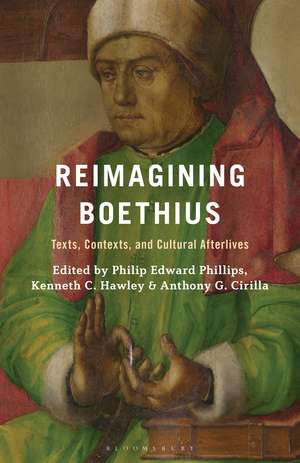
Reimagining Boethius: Texts, Contexts, and Cultural Afterlives
Editat de Philip Edward Phillips, Kenneth C. Hawley, Anthony G. Cirillaen Limba Engleză Hardback – 6 oct 2027
Drawing on rhetoric, manuscript studies, literary criticism, and intellectual history, the chapters trace the philosopher's evolving legacy through late antiquity, medieval scholasticism, vernacular devotional cultures, and early modern humanism. Contributors situate Boethius as a foundational figure whose works inspired wide-ranging intellectual, theological, and poetic adaptations. Four thematic sections collectively map how Boethian thought has been adopted, transformed, translated, contested, and reimagined by centuries of readers and interpreters.
Preț: 599.01 lei
Preț vechi: 880.20 lei
-32% Precomandă
Puncte Express: 899
Carte nepublicată încă
Livrare prin curier în România Precomanda se expediază când titlul devine disponibil.
Transport gratuit pentru acest produs Plată online sau ramburs, în funcție de opțiunile comenzii.
Retur gratuit în 14 zile Comandă securizată și suport în română.
Doresc să fiu notificat când acest titlu va fi disponibil:
Se trimite...
Specificații
ISBN-13: 9798216484820
Pagini: 304
Ilustrații: 4 b/w illus
Dimensiuni: 152 x 229 mm
Editura: Bloomsbury Publishing
Colecția Bloomsbury Academic
Locul publicării:New York, United States
Pagini: 304
Ilustrații: 4 b/w illus
Dimensiuni: 152 x 229 mm
Editura: Bloomsbury Publishing
Colecția Bloomsbury Academic
Locul publicării:New York, United States
Cuprins
List of Figures
Acknowledgements
Abbreviations
Introduction: Boethius and Boethian Studies
Philip Edward Phillips (Middle Tennessee State University, USA)
Section I: Revisiting Boethius's Philosophical and Theological Texts
1. The Secret Doctrine of Boethius's De fide and Hebdomads
Fabio Troncarelli (University of Tuscany, Italy)
2. Boethius, Scholarship, and De Hebdomadibus's Axioms
Siobhan Nash-Marshall (Manhattanville College, USA)
3. The Boethian Topos of Mentorship: Mapping a Middle Term Between Rhetoric and Philosophy
Anthony G. Cirilla (College of the Ozarks, USA)
4. Logica mundi: Boethian Cosmology in the Old English Solomon and Saturn Dialogues
Christina Heckman (Augusta University, USA)
Section II: Scholasticism and the Intellectual Legacy of Boethius
5. Series rerum: The Use and Transformation of Boethian Thought in Bernardus Silvestris
Jason M. Baxter (Benedictine College, USA)
6. The Fortune of Boethius's Concept of Eternity in the Scholastic Debate (13th-15th Centuries)
Margherita Belli (University of Cassino, Italy)
7. Imagining the University: Boethian Translatio Studii in De disciplina scolarium
Brooke Hunter (Vilanova University, USA)
Section III: Chaucer, Commentary, and Vernacular Transformations
8. Boethius and Chaucer: The Consolations of "Trouthe"
Megan E. Murton (Catholic University of America, USA)
9. A Neglected Witness of Chaucer's Boece in a Medieval Devotional Commentary on Boethius's De consolatione philosophiae
Elisabeth Dutton (University of Fribourg, Switzerland)
10. "Finding a Wise Meene": Framing Wisdom's Fragments in The Boke of Coumfort of Bois
Melinda Nielsen (Baylor University, USA)
Section IV: Early Modern Afterlives and Religious Reinterpretations
11. Valentin Weigel and Boethius: Mystical-Philosophical Concepts in Late Sixteenth-Century Protestant Thinking
Albrecht Classen (University of Arizona, USA)
12. The Philosopher's Vision: Experiencing Boethius's De consolatione philosophiae in Henry Vaughan's Silex Scintillans and Thalia Rediviva
Jonathan Nauman (Henry Vaughan Society)
Notes on Contributors
Bibliography
Index
Acknowledgements
Abbreviations
Introduction: Boethius and Boethian Studies
Philip Edward Phillips (Middle Tennessee State University, USA)
Section I: Revisiting Boethius's Philosophical and Theological Texts
1. The Secret Doctrine of Boethius's De fide and Hebdomads
Fabio Troncarelli (University of Tuscany, Italy)
2. Boethius, Scholarship, and De Hebdomadibus's Axioms
Siobhan Nash-Marshall (Manhattanville College, USA)
3. The Boethian Topos of Mentorship: Mapping a Middle Term Between Rhetoric and Philosophy
Anthony G. Cirilla (College of the Ozarks, USA)
4. Logica mundi: Boethian Cosmology in the Old English Solomon and Saturn Dialogues
Christina Heckman (Augusta University, USA)
Section II: Scholasticism and the Intellectual Legacy of Boethius
5. Series rerum: The Use and Transformation of Boethian Thought in Bernardus Silvestris
Jason M. Baxter (Benedictine College, USA)
6. The Fortune of Boethius's Concept of Eternity in the Scholastic Debate (13th-15th Centuries)
Margherita Belli (University of Cassino, Italy)
7. Imagining the University: Boethian Translatio Studii in De disciplina scolarium
Brooke Hunter (Vilanova University, USA)
Section III: Chaucer, Commentary, and Vernacular Transformations
8. Boethius and Chaucer: The Consolations of "Trouthe"
Megan E. Murton (Catholic University of America, USA)
9. A Neglected Witness of Chaucer's Boece in a Medieval Devotional Commentary on Boethius's De consolatione philosophiae
Elisabeth Dutton (University of Fribourg, Switzerland)
10. "Finding a Wise Meene": Framing Wisdom's Fragments in The Boke of Coumfort of Bois
Melinda Nielsen (Baylor University, USA)
Section IV: Early Modern Afterlives and Religious Reinterpretations
11. Valentin Weigel and Boethius: Mystical-Philosophical Concepts in Late Sixteenth-Century Protestant Thinking
Albrecht Classen (University of Arizona, USA)
12. The Philosopher's Vision: Experiencing Boethius's De consolatione philosophiae in Henry Vaughan's Silex Scintillans and Thalia Rediviva
Jonathan Nauman (Henry Vaughan Society)
Notes on Contributors
Bibliography
Index
Recenzii
The editors of Reimagining Boethius: Texts, Contexts, and Cultural Afterlives have revived and assembled an exceptional retrospective collection of essays, revised and updated from their original appearance in the preeminent peer-reviewed journal devoted to Boethian Studies, Carmina Philosophiae. Readers will find a veritable treasure trove of diverse and compelling case studies that examine Boethius's theological and logical texts in late antiquity and early medieval Europe, his literary and philosophical influence on scholasticism and Old and Middle English literature, and his role in the religious tensions of sixteenth- and seventeenth-century Christianity. Organized thematically to ensure coherence, clarity, and accessibility to a broader interdisciplinary readership, each of the chapters has been carefully selected based on its originality, sustained scholarly value, and contribution to the evolving understanding of Boethius's corpus and intellectual reception. This is an indispensable volume for anyone interested in the changing fortunes of medieval and early modern literary and cultural history, which continues to bear the stamp of Boethius's abiding and far-reaching influence.
Boethius's intellectual legacy endures-as does the community of scholars devoted to this eminent thinker. This volume stands as a powerful testament to that vitality. Gathering contributions from world-renowned experts that examine key aspects of both Boethius's own thought and its subsequent influence, it erects a worthy monument to the International Boethius Society.
Boethius's intellectual legacy endures-as does the community of scholars devoted to this eminent thinker. This volume stands as a powerful testament to that vitality. Gathering contributions from world-renowned experts that examine key aspects of both Boethius's own thought and its subsequent influence, it erects a worthy monument to the International Boethius Society.