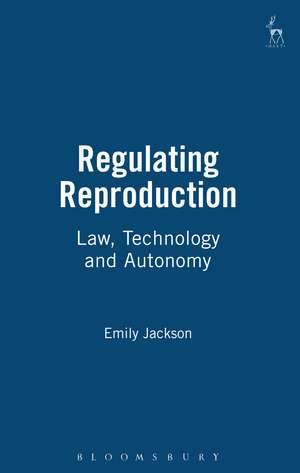
Regulating Reproduction: Law, Technology and Autonomy
Autor Emily Jacksonen Limba Engleză Hardback – 10 oct 2001
This book offers a readable and engaging account of the complex relationships between law, technology and reproduction. It will be useful for lecturers and students taking medical law or ethics courses. It should also be of interest to anyone with a more general interest in women's bodies and the law, or with the profound regulatory consequences of new technologies.
Preț: 409.17 lei
Preț vechi: 580.86 lei
-30%
Puncte Express: 614
Carte tipărită la comandă
Livrare economică 02-16 decembrie
Livrare prin curier în România Termenul estimat este afișat lângă disponibilitate.
Transport gratuit pentru acest produs Plată online sau ramburs, în funcție de opțiunile comenzii.
Retur gratuit în 14 zile Comandă securizată și suport în română.
Specificații
ISBN-13: 9781841130545
ISBN-10: 1841130540
Pagini: 376
Dimensiuni: 138 x 216 x 29 mm
Greutate: 0.6 kg
Editura: Bloomsbury Publishing
Colecția Hart Publishing
Locul publicării:London, United Kingdom
ISBN-10: 1841130540
Pagini: 376
Dimensiuni: 138 x 216 x 29 mm
Greutate: 0.6 kg
Editura: Bloomsbury Publishing
Colecția Hart Publishing
Locul publicării:London, United Kingdom
Cuprins
1. In Defence of Reproductive Autonomy
2. Birth Control
3. Abortion
4. Pregnancy and Childbirth
5. Reproductive Technologies
6. Surrogacy
7. Postscript
2. Birth Control
3. Abortion
4. Pregnancy and Childbirth
5. Reproductive Technologies
6. Surrogacy
7. Postscript
Recenzii
...welcomed as a valuable and essential addition to a very contentious topic.
The processing, presentation and analysis of data and the development and arrangement of the content of the book are indicative of a thorough investigation and grasp of the topic, as well as a scientific dissemination of voluminous research material.
Although the book will be essential reading for lecturers, students, practitioners of medical law and health care professionals, it will also be an asset to any bookshelf.
This will be a very valuable book for the wealth of information it contains and the ease of acces to it that Jackson produces in her clear and concise writing style.
The narrative is well-informed and up-to-date. The author has produced a very interesting, comprehensive and accessible account of the law's involvement in reproductive choice and I believe that it is a valuable addition to the literature in this area.
The processing, presentation and analysis of data and the development and arrangement of the content of the book are indicative of a thorough investigation and grasp of the topic, as well as a scientific dissemination of voluminous research material.
Although the book will be essential reading for lecturers, students, practitioners of medical law and health care professionals, it will also be an asset to any bookshelf.
This will be a very valuable book for the wealth of information it contains and the ease of acces to it that Jackson produces in her clear and concise writing style.
The narrative is well-informed and up-to-date. The author has produced a very interesting, comprehensive and accessible account of the law's involvement in reproductive choice and I believe that it is a valuable addition to the literature in this area.