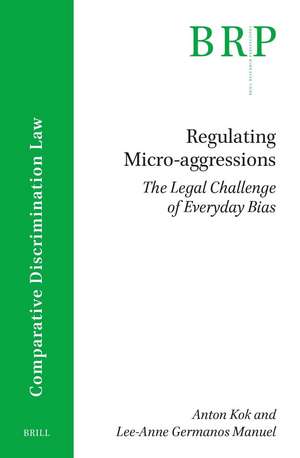
Regulating Micro-aggressions: The Legal Challenge of Everyday Bias: Brill Research Perspectives in International Law / Brill Research Perspectives in Comparative Discrimination Law
Autor Anton Kok, Lee-Anne Germanos Manuelen Limba Engleză Paperback – 9 sep 2026
Preț: 450.44 lei
Nou
Puncte Express: 676
Carte disponibilă
Livrare economică 30 octombrie-10 noiembrie
Livrare prin curier în România Termenul estimat este afișat lângă disponibilitate.
Transport gratuit pentru acest produs Plată online sau ramburs, în funcție de opțiunile comenzii.
Retur gratuit în 14 zile Comandă securizată și suport în română.
Specificații
ISBN-13: 9789004757516
ISBN-10: 9004757511
Dimensiuni: 155 x 235 mm
Greutate: 0.2 kg
Editura: Brill
Colecția Brill | Nijhoff
Seria Brill Research Perspectives in International Law / Brill Research Perspectives in Comparative Discrimination Law
ISBN-10: 9004757511
Dimensiuni: 155 x 235 mm
Greutate: 0.2 kg
Editura: Brill
Colecția Brill | Nijhoff
Seria Brill Research Perspectives in International Law / Brill Research Perspectives in Comparative Discrimination Law
Notă biografică
Anton Kok (BCom Law LLB LLM LLD, University of Pretoria) is Professor of Law at that university. In his writings he focuses almost exclusively on the (South African) Promotion of Equality and Prevention of Unfair Discrimination Act 4 of 2000. He is an admitted attorney and acted as judge in the Pretoria High Court for the first term in 2024.
Lee-Anne Germanos Manuel has a BCom Law and LLB Law degree from the University of Pretoria. She is an admitted attorney, having served her articles of clerkship at ENSafrica and worked as an associate commercial litigator. Lee-Anne subsequently pursued her masters degree in International Human Rights Law at the University Oxford, and became a legal researcher for the Helen Suzman Foundation. Lee-Anne went on to clerk for the Constitutional Court of South Africa, and simultaneously co-founded The Embrace Project, an NPC established to combat gender-based violence and femicide in South Africa. Lee-Anne has also occupied the position of Senior Campaigner for the South African office of Change.org, and is currently the Advisor to the South African Human Rights Commissioner leading the institution’s Anti-Racism, Equality and Education strategies.
Lee-Anne Germanos Manuel has a BCom Law and LLB Law degree from the University of Pretoria. She is an admitted attorney, having served her articles of clerkship at ENSafrica and worked as an associate commercial litigator. Lee-Anne subsequently pursued her masters degree in International Human Rights Law at the University Oxford, and became a legal researcher for the Helen Suzman Foundation. Lee-Anne went on to clerk for the Constitutional Court of South Africa, and simultaneously co-founded The Embrace Project, an NPC established to combat gender-based violence and femicide in South Africa. Lee-Anne has also occupied the position of Senior Campaigner for the South African office of Change.org, and is currently the Advisor to the South African Human Rights Commissioner leading the institution’s Anti-Racism, Equality and Education strategies.
Cuprins
Contents
1 Introduction
2 Conceptualising Micro-aggressions
3 Making the Case for the Legal Recognition of Micro-aggressions
4 The Recognition and Application of de minimis non curat lex in Different Jurisdictions
1 General Principles: Five Factors Invoked
2 Raising de minimis non curat lex in the Light of Constitutional Rights
3 Examples of High Court Judgments of South African Equality Courts
4 A Survey Sample of Lower Court Judgments in South African Equality Courts 2008–2012
5 A National Comparative Survey of the de minimis Defence
1 Germany
2 Canada
3 New Zealand
4 The Netherlands
5 Namibia
6 Summary of Comparative Analysis
6 The South African Approach to Discrimination, Hate Speech and Harassment
1 The Causes of Action Recognised in the South African Equality Act Read against the Aims of This Act
2 The Interpretation and Application of the Qualifiers (Internal Limitations) to the Causes of Action Recognised in the South African Equality Act
7 Ways Forward for Addressing Micro-aggressions
1 Discard de minimis non curat lex Where Micro-aggressions Occur against Vulnerable Groups
2 Promote the Values of Substantive Equality, Kindness and Respect in Equality Plans
8 Conclusion
Bibliography
Index
1 Introduction
2 Conceptualising Micro-aggressions
3 Making the Case for the Legal Recognition of Micro-aggressions
4 The Recognition and Application of de minimis non curat lex in Different Jurisdictions
1 General Principles: Five Factors Invoked
2 Raising de minimis non curat lex in the Light of Constitutional Rights
3 Examples of High Court Judgments of South African Equality Courts
4 A Survey Sample of Lower Court Judgments in South African Equality Courts 2008–2012
5 A National Comparative Survey of the de minimis Defence
1 Germany
2 Canada
3 New Zealand
4 The Netherlands
5 Namibia
6 Summary of Comparative Analysis
6 The South African Approach to Discrimination, Hate Speech and Harassment
1 The Causes of Action Recognised in the South African Equality Act Read against the Aims of This Act
2 The Interpretation and Application of the Qualifiers (Internal Limitations) to the Causes of Action Recognised in the South African Equality Act
7 Ways Forward for Addressing Micro-aggressions
1 Discard de minimis non curat lex Where Micro-aggressions Occur against Vulnerable Groups
2 Promote the Values of Substantive Equality, Kindness and Respect in Equality Plans
8 Conclusion
Bibliography
Index