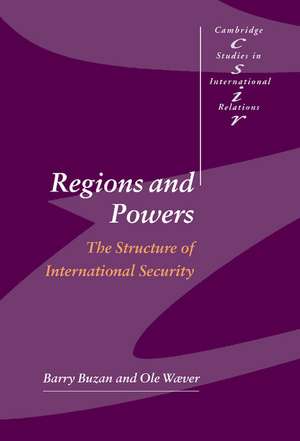
Regions and Powers
Autor Barry Buzan, OLE Waever, Ole Wveren Limba Engleză Hardback – 4 ian 2013
Publicul țintă al acestei lucrări fundamentale include studenții la științe politice, cercetătorii în relații internaționale și practicienii din domeniul securității, care vor găsi aici un instrumentar analitic sofisticat pentru înțelegerea noii ordini mondiale. Subliniem faptul că, după încheierea Războiului Rece, dinamica securității s-a mutat de la nivelul global spre cel regional, o schimbare pe care Barry Buzan și Ole Wæver o explică prin Teoria Complexelor de Securitate Regională (RSCT). Ne-a atras atenția modul în care autorii evită simplificările viziunilor unipolare, propunând în schimb o structură ce analizează diversitatea radicală a regiunilor, de la „statele slabe” din Africa subsahariană până la complexul de securitate din Asia de Est. Cartea extinde cadrul propus de Regional Orders de David A. Lake cu date noi și o metodologie care integrează nivelul regional ca punct focal al securității internaționale. În contextul operei lui Barry Buzan, lucrarea reprezintă o rafinare a conceptelor explorate în volume precum The Making of Global International Relations, trecând de la istoria disciplinei la o aplicare empirică riguroasă. Organizarea volumului este intuitivă: prima parte stabilește bazele teoretice și distincția între niveluri, urmată de secțiuni dedicate fiecărui continent. Această progresie permite cititorului să observe cum teoria se traduce în realități geopolitice concrete, oferind o interpretare distinctă a securității post-Război Rece care rămâne relevantă în curriculumul academic actual.
Preț: 1215.25 lei
Preț vechi: 1413.09 lei
-14%
Carte tipărită la comandă
Livrare economică 18 noiembrie-02 decembrie
Specificații
ISBN-10: 052181412X
Pagini: 598
Ilustrații: 12 maps
Dimensiuni: 157 x 235 x 36 mm
Greutate: 1.01 kg
Ediția:New.
Editura: Cambridge University Press
Locul publicării:Cambridge, United Kingdom
De ce să citești această carte
Suntem de părere că această carte este indispensabilă pentru oricine dorește să înțeleagă de ce conflictele actuale sunt rareori pur globale sau pur locale. Cititorul câștigă acces la metodologia Școlii de la Copenhaga, învățând să identifice „complexele de securitate” care dictează politica externă. Este o resursă esențială pentru a decoda nuanțele geopolitice dintre marile puteri și regiunile lor adiacente.
Despre autor
Barry Buzan este profesor emerit de relații internaționale la London School of Economics și o figură de referință a Școlii de la Copenhaga. Alături de Ole Wæver, a redefinit conceptul de securitate prin introducerea teoriei securitizării și a complexelor regionale. Opera sa vastă, care include titluri precum The Global Transformation, se concentrează pe evoluția instituțiilor primare în societatea internațională și pe modul în care istoria mondială modelează teoria contemporană a relațiilor internaționale.
Descriere scurtă
Cuprins
Recenzii
'The book is heroic in its ambition and Herculean in its execution. A landmark study that displays a rare combination of cutting-edge theoretical sophistication with an insatiable appetite for data.' Peter J. Katzenstein, Cornell University
'… offers a truly global empirical overview of security dynamics in all regions of the world.' Tidsskriftet Politik
'Among its most notable aspects are the clear prose and the sharp focus of the empirical studies … The empirical study is nothing short of titanic in its ambition and breadth, and the succinct overviews of regional security dynamics will undoubtedly become required reading in graduate security studies curricula.' Slavonic and East European Review
'This is undoubtedly an important volume that makes a significant contribution to security studies' Political Studies Review
'... A sophisticated analytical toolbox equipped with a plethora of useful concepts and categories, heuristic models and methods, checklists of comparative criteria, etc. ... this is a valuable study and it should be read by both security/IR scholars and policy practicioners. As a macro-study with a global sweep, the book opens the door up to research programming to students of security, above all in terms of the more detailed micro-studies of and within various RSCs.' Journal of International Relations and Development