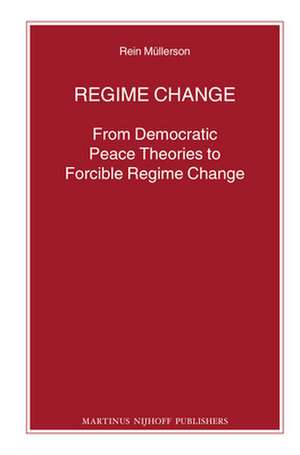
Regime Change
Autor Rein Müllersonen Limba Engleză Paperback – 30 ian 2013
Preț: 1122.32 lei
Preț vechi: 1305.03 lei
-14%
Puncte Express: 1683
Carte tipărită la comandă
Livrare economică 07-21 decembrie
Livrare prin curier în România Termenul estimat este afișat lângă disponibilitate.
Transport gratuit pentru acest produs Plată online sau ramburs, în funcție de opțiunile comenzii.
Retur gratuit în 14 zile Comandă securizată și suport în română.
Specificații
ISBN-13: 9789004232303
ISBN-10: 9004232303
Pagini: 248
Dimensiuni: 155 x 234 x 15 mm
Greutate: 0.41 kg
Editura: Brill
ISBN-10: 9004232303
Pagini: 248
Dimensiuni: 155 x 234 x 15 mm
Greutate: 0.41 kg
Editura: Brill
V-ar putea interesa
-
 Hegemony or SurvivalNoam Chomsky-18%Preț: 65.16 lei79.20 lei
 -
 Failed StatesNoam Chomsky-26%Preț: 62.72 lei84.58 lei
 -
 Imperial AmbitionsNoam ChomskyPreț: 114.24 lei
 -
 Fairness in International Law and InstitutionsThomas M. Franck-27%Preț: 554.71 lei759.30 lei
 -
 Central and Eastern Europe: The Challenge of TransitionRegina Cowen Karp-20%Preț: 308.41 lei383.57 lei
 -
 Conceiving Cosmopolitanism: Theory, Context, and PracticeSteven Vertovec-30%Preț: 576.09 lei821.91 lei
 -
 International Society and its CriticsAlex J. Bellamy-27%Preț: 407.91 lei558.55 lei
 -
 -27%Preț: 406.07 lei557.49 lei
 -
 Preț: 134.08 lei
 -
 The European Union as a Global ActorCharlotte Bretherton-15%Preț: 476.66 lei560.77 lei
 -
 International Relations: The BasicsPeter SutchPreț: 203.26 lei
 -
 -15%Preț: 436.50 lei513.52 lei
 -
 The Geopolitics ReaderSimon Dalby-15%Preț: 623.60 lei733.64 lei
 -
 Preț: 487.53 lei
 -
 Preț: 482.08 lei
 -
 China's Public DiplomacyIngrid D'Hooghe-23%Preț: 1301.99 lei1690.90 lei
Cuprins
Introduction
Chapter 1 – From an African village to a global village
1. Ex Uno Plures in the evolution of humankind
2. Is E Pluribus Unum replacing Ex Uno Plures?
3. Homogenisation of the world and heterogenisation of individual societies
4. ‘Oh, East is East, and West is West, and never the twain shall meet, Till Earth and Sky stand presently at God's great Judgment Seat’?
Chapter 2 – Whither goest thou, the world?
1. Universal history and historical determinism
2. Current regime changes: socioeconomic and political problems
3. Problems of liberal democracy and democratic capitalism
4. Limits of social democratic choice in a globalised world
5. Any viable alternatives?
Chapter 3 – On the futility and danger of external attempts to ‘democratise’ China
1. China’s rise and the changing balance of power
2. Modernising China – a democratic China?
3. A small diversion to illustrate the point: the Kyrgyz tragedy of 2010
4. Back to China: reforms, not revolution
5. The world’s reaction to China’s rise
6. From Westernisation to Sinification?
Chapter 4 – Regime changes in Russia: Gorbachev, Yeltsin and Putin
1. Understanding Russia or believing in Russia
2. Collapse of the USSR and the emergence of Yeltsin’s Russia
3. On Putin’s authoritarianism
4. Russia and its close neighbours
5. Russia – a part of Europe?
Chapter 5 – Democratic peace theories and regime change
1. Theory and politics of democratic peace
2. Problems with democratic peace theories
3. Immanuel Kant and the XXI century world
4. On the war-proneness of some democratising states
Chapter 6 – Humanitarian intervention, civil wars and regime change
1. Use of force and humanitarian concerns in ‘modern’ and ‘post-modern’ international societies
2. The Kosovo case revisited
3. Recognition of Kosovo, Abkhazia and South Ossetia
4. The Libya case
5. The Syria tragedy
6. Humanitarian intervention and regime change: some generalisations
7. From humanitarian intervention to R2P or ‘old wine in new bottles’?
8. Intervention in civil wars or internal disturbances and regime change
9. Determinants of success: efforts of interveners or characteristics of the target society?
Conclusions, index.
Chapter 1 – From an African village to a global village
1. Ex Uno Plures in the evolution of humankind
2. Is E Pluribus Unum replacing Ex Uno Plures?
3. Homogenisation of the world and heterogenisation of individual societies
4. ‘Oh, East is East, and West is West, and never the twain shall meet, Till Earth and Sky stand presently at God's great Judgment Seat’?
Chapter 2 – Whither goest thou, the world?
1. Universal history and historical determinism
2. Current regime changes: socioeconomic and political problems
3. Problems of liberal democracy and democratic capitalism
4. Limits of social democratic choice in a globalised world
5. Any viable alternatives?
Chapter 3 – On the futility and danger of external attempts to ‘democratise’ China
1. China’s rise and the changing balance of power
2. Modernising China – a democratic China?
3. A small diversion to illustrate the point: the Kyrgyz tragedy of 2010
4. Back to China: reforms, not revolution
5. The world’s reaction to China’s rise
6. From Westernisation to Sinification?
Chapter 4 – Regime changes in Russia: Gorbachev, Yeltsin and Putin
1. Understanding Russia or believing in Russia
2. Collapse of the USSR and the emergence of Yeltsin’s Russia
3. On Putin’s authoritarianism
4. Russia and its close neighbours
5. Russia – a part of Europe?
Chapter 5 – Democratic peace theories and regime change
1. Theory and politics of democratic peace
2. Problems with democratic peace theories
3. Immanuel Kant and the XXI century world
4. On the war-proneness of some democratising states
Chapter 6 – Humanitarian intervention, civil wars and regime change
1. Use of force and humanitarian concerns in ‘modern’ and ‘post-modern’ international societies
2. The Kosovo case revisited
3. Recognition of Kosovo, Abkhazia and South Ossetia
4. The Libya case
5. The Syria tragedy
6. Humanitarian intervention and regime change: some generalisations
7. From humanitarian intervention to R2P or ‘old wine in new bottles’?
8. Intervention in civil wars or internal disturbances and regime change
9. Determinants of success: efforts of interveners or characteristics of the target society?
Conclusions, index.
Notă biografică
Rein Müllerson is the President of Tallinn University Law School. 1994-2009 - Professor of International Law at King’s College, London. 2004 - 2005 the UN Regional Adviser for Central Asia. In 1992-94 -Visiting Centennial Professor of the London School of Economics and Political Science. Since 1995 - a Member of the Institut de Droit International.