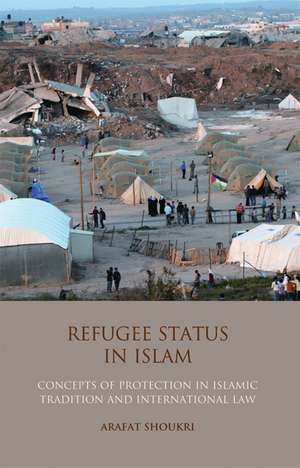
Refugee Status in Islam: Concepts of Protection in Islamic Tradition and International Law
Autor Arafat Madi Shoukrien Limba Engleză Hardback – 9 noi 2010
Preț: 801.94 lei
Preț vechi: 1299.63 lei
-38%
Puncte Express: 1203
Carte tipărită la comandă
Livrare economică 04-18 decembrie
Livrare prin curier în România Termenul estimat este afișat lângă disponibilitate.
Transport gratuit pentru acest produs Plată online sau ramburs, în funcție de opțiunile comenzii.
Retur gratuit în 14 zile Comandă securizată și suport în română.
Specificații
ISBN-13: 9781848853904
ISBN-10: 1848853904
Pagini: 224
Ilustrații: Illustrations
Dimensiuni: 140 x 136 x 18 mm
Greutate: 0.82 kg
Editura: Bloomsbury Publishing
Colecția I.B.Tauris
Locul publicării:London, United Kingdom
ISBN-10: 1848853904
Pagini: 224
Ilustrații: Illustrations
Dimensiuni: 140 x 136 x 18 mm
Greutate: 0.82 kg
Editura: Bloomsbury Publishing
Colecția I.B.Tauris
Locul publicării:London, United Kingdom
V-ar putea interesa
-
 The Oxford Handbook of Cuneiform CultureKaren Radner-32%Preț: 1224.04 lei1802.64 lei
 -
 -14%Preț: 264.99 lei306.66 lei
 -
 Turkey: What Everyone Needs to Know®Andrew Finkel-18%Preț: 64.92 lei79.22 lei
 -
 Preț: 294.79 lei
 -
 Leila Khaled: Icon of Palestinian LiberationSarah IrvingPreț: 137.11 lei
 -
 -15%Preț: 437.55 lei514.76 lei
 -
 -27%Preț: 67.04 lei91.67 lei
 -
 -32%Preț: 855.54 lei1264.38 lei
 -
 Without Glory in Arabia: The British Retreat from AdenPeter Hinchcliffe-20%Preț: 200.22 lei251.15 lei
 -
 Ottomania: The Romantics and the Myth of the Islamic OrientRoderick Cavaliero-20%Preț: 138.35 lei173.59 lei
 -
 Preț: 177.50 lei
 -
 -20%Preț: 344.66 lei429.02 lei
 -
 -19%Preț: 199.92 lei245.87 lei
 -
 Preț: 311.02 lei
 -
 -18%Preț: 359.64 lei437.13 lei
 -
 -20%Preț: 186.40 lei233.44 lei
Cuprins
Introduction
Chapter 1: The jiwar in the jahiliyya
- The definition of 'jiwar'
- The reasons for asking jiwar
- Rights and duties of the mustajir
- Persons from whom jiwar may be requested
- The termination of jiwar
- The continuity of the jiwar to the modern age
- Conclusion
Chapter 2: Jiwar in the Islamic Tradition in the Meccan period
- Heaven's protection to the Prophet
- The journey of the Prophet to al-Ta'if
- The migration to Abyssinia
- The migration to Medina
Chapter 3: Aman (safe conduct) in the Islamic Tradition
- Dar al-harb and dar al-Islam
- The definition of the term 'mustajir'
- The definition of the term 'muhajir'
- The definition of the term 'musta'min'
- Dhimmis in the Islamic tradition
- The Interpretation of the verse (9:6) and its relation to aman
- Conclusion
Chapter 4: The 1951 Geneva Convention relating to the Status of refugees in the light of the Islamic tradition
- Definition of the term 'refugee' (Article 1)
- Exclusion clauses
- Prohibition of expulsion or return 'refoulement' (Article 33)
- The safety of the musta'min
- General obligations (Article 2)
- Non-discrimination (Article 3)
- Religion (Article 4)
- Personal status (Article 12)
- Movable and immovable properties (Article 13)
- Right of association (Article 15)
- Access to courts (Article 16)
- Gainful employment (Article 17, 18 and 19)
- Welfare (Article 20, 21, 22, 23 and 24)
- Freedom of movement (Article 26, 27, 28 and 29)
- Refugees unlawfully in the country of refuge (Article 31)
- Expulsion (Article 32)
- Naturalization (Article 34)
Chapter 5: Conclusion
Chapter 1: The jiwar in the jahiliyya
- The definition of 'jiwar'
- The reasons for asking jiwar
- Rights and duties of the mustajir
- Persons from whom jiwar may be requested
- The termination of jiwar
- The continuity of the jiwar to the modern age
- Conclusion
Chapter 2: Jiwar in the Islamic Tradition in the Meccan period
- Heaven's protection to the Prophet
- The journey of the Prophet to al-Ta'if
- The migration to Abyssinia
- The migration to Medina
Chapter 3: Aman (safe conduct) in the Islamic Tradition
- Dar al-harb and dar al-Islam
- The definition of the term 'mustajir'
- The definition of the term 'muhajir'
- The definition of the term 'musta'min'
- Dhimmis in the Islamic tradition
- The Interpretation of the verse (9:6) and its relation to aman
- Conclusion
Chapter 4: The 1951 Geneva Convention relating to the Status of refugees in the light of the Islamic tradition
- Definition of the term 'refugee' (Article 1)
- Exclusion clauses
- Prohibition of expulsion or return 'refoulement' (Article 33)
- The safety of the musta'min
- General obligations (Article 2)
- Non-discrimination (Article 3)
- Religion (Article 4)
- Personal status (Article 12)
- Movable and immovable properties (Article 13)
- Right of association (Article 15)
- Access to courts (Article 16)
- Gainful employment (Article 17, 18 and 19)
- Welfare (Article 20, 21, 22, 23 and 24)
- Freedom of movement (Article 26, 27, 28 and 29)
- Refugees unlawfully in the country of refuge (Article 31)
- Expulsion (Article 32)
- Naturalization (Article 34)
Chapter 5: Conclusion